

Subdued development and growing demand are exacerbating the requirement for additional high-quality affordable seniors housing
Knight Frank’s review of the key trends and numbers in the affordable segment of the UK seniors housing market
10 August 2026

Sustained high waiting lists for social housing and an ageing population
Demand for affordable housing remains elevated with local authority waiting lists at a 10-year high in 2026 due to a chronic undersupply of appropriate housing across England.
There are 1.3m households on the waiting list for a social home but true need is believed to be much greater. Many councils have restricted allocations due to welfare reforms and have had to prioritise the increasing number of applicants with substantial support needs.
In particular, demand for seniors affordable housing is expected to rise significantly as the population ages and care needs increase and become more complex.
By 2050, the 65+ population will reach around 18 million, according to the Office of National Statistics. At this point, a quarter of the population will be aged over 65, up from 20% in 2026 and a 32% increase in total number terms.
Delivery slowing, falling behind population growth
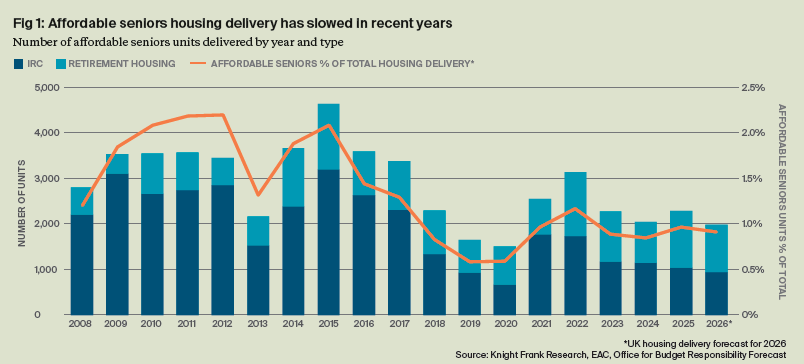
While the provision of affordable seniors housing has been increasing, rising from c.496k in 2000 to c.563k in 2026, new development has slowed since 2017 and has fallen behind accelerated population growth. Some 1,994 new affordable seniors homes are expected to be built in 2026 across 35 schemes. This represents a 13% decrease in delivery compared with 2025.
The slowdown in seniors housing delivery mirrors wider development activity across other sectors as developers grapple with viability challenges driven by rising build costs, high borrowing costs, competition for land, elevated labour and materials costs and a constrained planning environment.
Need for more new stock
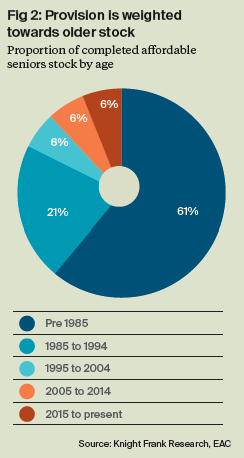
As well as there being a severe undersupply of affordable seniors homes, the existing stock requires modernisation with the majority (61%) of affordable seniors homes (c.300k) having been built before 1985.
Developing newer, high-quality homes for seniors is aligned with government priorities and falls within their mandated response to structural housing undersupply and the increasing care needs of the ageing population.
Affordable seniors housing is one of the models of housing that the Older People’s Housing Taskforce recommended for expansion in their 2024 report for the UK Government’s Ministry of Housing and Communities and Local Government and Department of Health and Social Care.
Government commitment to affordable housing delivery lags demand
In recent years, wider social and affordable housing delivery has slowed with registered providers prioritising the management of their existing portfolios over new development due to funding and viability constraints and stricter fire safety regulations.
In their June 2025 Spending Review, the Government announced £39bn in funding for the new Social and Affordable Homes Programme 2026-2036 (SAHP), targeting the delivery of 300,000 social and affordable homes across England.
The sector welcomed this funding but the scheme has been oversubscribed and providers have since been asked to re-profile their bids, further delaying the delivery of new social and affordable homes.
Evolving Labour plans may well require additional funding
In July 2027, Andy Burham announced that he wants the above funding to be pivoted toward “council” homes, built by local councils. Council housebuilding has reduced significantly since the 1980s due to policy changes and, today, represents only a fraction of delivery in the UK.
Local authorities will need time and resource to return to delivering homes.
Currently, a minimum of 60% of SAHP funding should be dedicated to social rent and, while Burnham has not specified what tenure he would like to see delivered, if this proportion increases, we may see additional pressure on funding and fewer social and affordable homes delivered overall.
Research

Seniors Housing

Knight Frank Capital Advisory

Sign up to Knight Frank Research.
