
Britain rearms, and an industry reshapes
05 August 2026

Defence was once treated primarily as the price of national security. It is increasingly becoming an instrument of industrial policy. Britain's expanding military budget and industrial strategy are supporting manufacturing, research and exports, while directing investment towards technologies that blur the boundary between defence and the wider innovation economy. The result is a sector that is larger, more diverse and more geographically dispersed than its traditional image suggests.
The industry generated £36.5bn of turnover and £15.8bn of value added in 2025, increases of two-thirds and 70% respectively over a decade. It directly employed 189,500 people, 35% more than in 2015, while productivity reached £83,400 per worker. Exports averaged £10.8bn over the past five years, accounting for roughly one-third of revenue. Industry-funded research and development has more than doubled to £4.3bn, making defence as much an innovation story as a production one.
Skills England and the Ministry of Defence estimate that employment in 14 priority occupations will increase by 53,000 between 2025 and 2035. A further 29,000 workers may need to be replaced as people leave their occupations. Higher defence spending will intensify the contest. ADS estimates that defence spending equivalent to 3% of GDP could create 50,000 direct jobs by 2035, rising to 85,000 at 3.5% of GDP. It is estimated that 19.9% of UK defence roles are in R&D and 45.6% are STEM roles.
The industry itself is changing. Large contractors such as BAE Systems, Babcock, Leonardo, Rolls-Royce and QinetiQ continue to provide scale, long order books and the capacity to deliver complex programmes. Around them, an extensive network of companies spans the supply chain. This supply chain is set to expand as the government prioritises sovereign capability, domestic production and greater control over critical components and, where possible, raw materials. Reindustrialisation, reshoring and larger strategic stockpiles should provide further impetus. Alongside this established industrial base is a faster-growing cohort of defence tech businesses developing artificial intelligence, autonomous systems, drones, cyber capabilities, space technologies, advanced materials, sensors and secure software. The primes provide industrial weight; defence tech brings speed and agility.
Government spending should accelerate both. The £298bn Defence Investment Plan includes £15bn of additional funding and takes annual defence expenditure from around £54bn towards almost £80bn by the end of the decade. Core spending is scheduled to reach 2.7% of GDP from 2027-28, with a stated path to 3% in the next parliament. Britain has also signed up to NATO's 2035 ambition of spending 3.5% of GDP on core defence and a further 1.5% on wider security and resilience. More than £5bn is directed towards drones and autonomous systems, with a further £2bn for an AI-enabled targeting network.
John Healey's appointment as Chancellor strengthens the political signal. As a former Defence Secretary and an advocate for treating defence as an engine of growth, innovation and industrial capacity, he should be welcomed by the sector. He has supported a move to 3% of GDP by 2030, but that ambition now confronts fiscal rules, higher borrowing costs and competing demands on public spending. The immediate test is whether the Treasury can close the estimated £4.7bn funding gap and give companies sufficient certainty to invest in real estate, skills and supply chains.
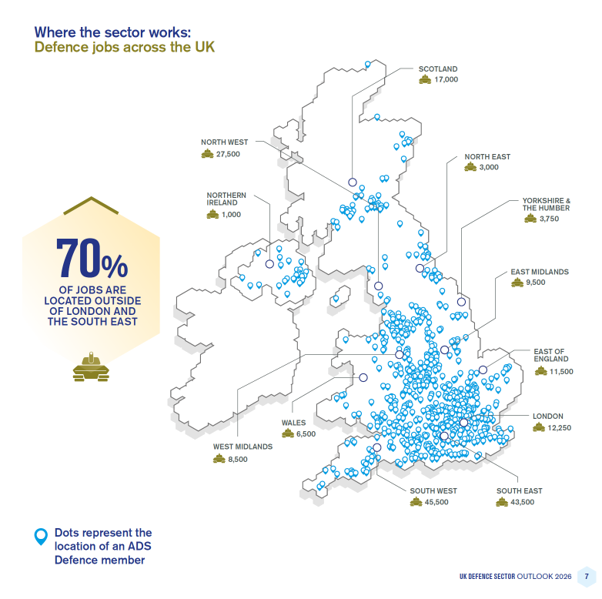
The UK’s defence geography is broad but far from uniform. Some 70% of jobs are located outside London and the South East. The South West leads with 45,500, followed by the South East with 43,500 and the North West with 27,500.
Source: ADS
This distribution reflects a network of specialised clusters rather than a single national hub. It reflects the sector's diversity and shows that one location is not necessarily right for everyone. The Farnborough-Aldershot corridor combines aerospace, military infrastructure and specialist engineering, while the Bristol-Yeovil corridor brings together aerospace, helicopters, and advanced and autonomous systems. Lancashire and Greater Manchester support combat air, missiles, advanced materials and cyber and component manufacturing, while the Edinburgh-Glasgow corridor combines radar, electronics, shipbuilding and space. Barrow-in-Furness and Derby anchor submarine construction and nuclear propulsion, supported by suppliers in Bristol, Glasgow and Liverpool. Hubs such as Oxford, Cambridge and the Thames Valley are focused on R&D-adjacent growth. London, meanwhile, is a hub for corporate headquarters (HQs), defence innovation accelerators and dual-use technology. Coastal locations such as Plymouth and Portsmouth focus on marine capabilities, including marine autonomous systems.
New centres of gravity are also emerging, backed by the Government's Defence Growth Deals. Swindon is developing as a drone and autonomous systems hub. Plymouth is building strength in marine autonomy, South Yorkshire in advanced materials and component engineering, Wales in unmanned systems, Scotland in naval and space technologies, and Northern Ireland in cyber and secure communications.
Recent initiatives focused on skills development could cement these clusters and create new ones. The Government, for example, is establishing Defence Technical Colleges in Plymouth, Lincoln and Yeovil. Elsewhere, 35 universities are forming a Defence University Alliance designed to strengthen R&D and build critical skills.
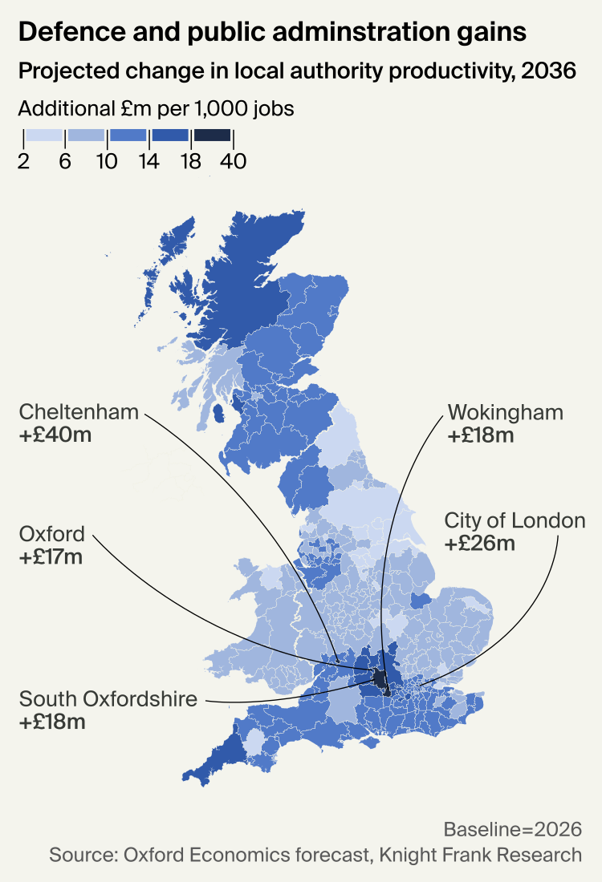
Analysis of Oxford Economics' GVA and employment forecasts highlights where sector growth is expected to generate the greatest productivity gains. These benefits are set to be highly concentrated geographically. Cheltenham stands out by a considerable margin, with productivity projected to increase by £40 million per 1,000 jobs by 2036. The strongest gains are focused along the Oxfordshire and Thames Valley corridor, where Wokingham (£18.2 million), South Oxfordshire (£18.1 million) and Oxford (£17.5 million) all significantly outperform the UK average of £9.5 million per 1,000 jobs. While the City of London ranks among the strongest-performing locations nationally, with gains of almost £26 million per 1,000 jobs, productivity growth across London as a whole is expected to be more moderate, at £11.7 million per 1,000 jobs.
Britain possesses many of the ingredients needed to become a more formidable location for defence. The policies now in motion, combined with powerful underlying growth drivers, should support the sector's continued expansion. The test is whether funding, procurement, skills and infrastructure can be aligned quickly enough.
Sign up to Knight Frank Research
