

Retail Renaissance: What happened to intu?
In paper four of the series, we explore a case study in why it's important to separate the assets from the corporate failure.
03 August 2026

3 key takeaways
Regional shopping centres stand the test of time
50 years on from the UK’s first RSC, they've cemented their place as one of the bedrocks of UK retail, albeit only through constant evolution, heavy investment and partial reinvention.
The downfall of intu wasn't about its assets
intu’s demise was a corporate failure, rather than a reflection of the assets it owned. Some of the schemes have already come to the market, with more waiting in the wings.
Interest in the ex-intu schemes is robust and broad.
The schemes are attracting a new breed of willing, proactive and committed owners playing a long, hands-on game, rather than trying to make a fast buck.
The success story of regional shopping centres
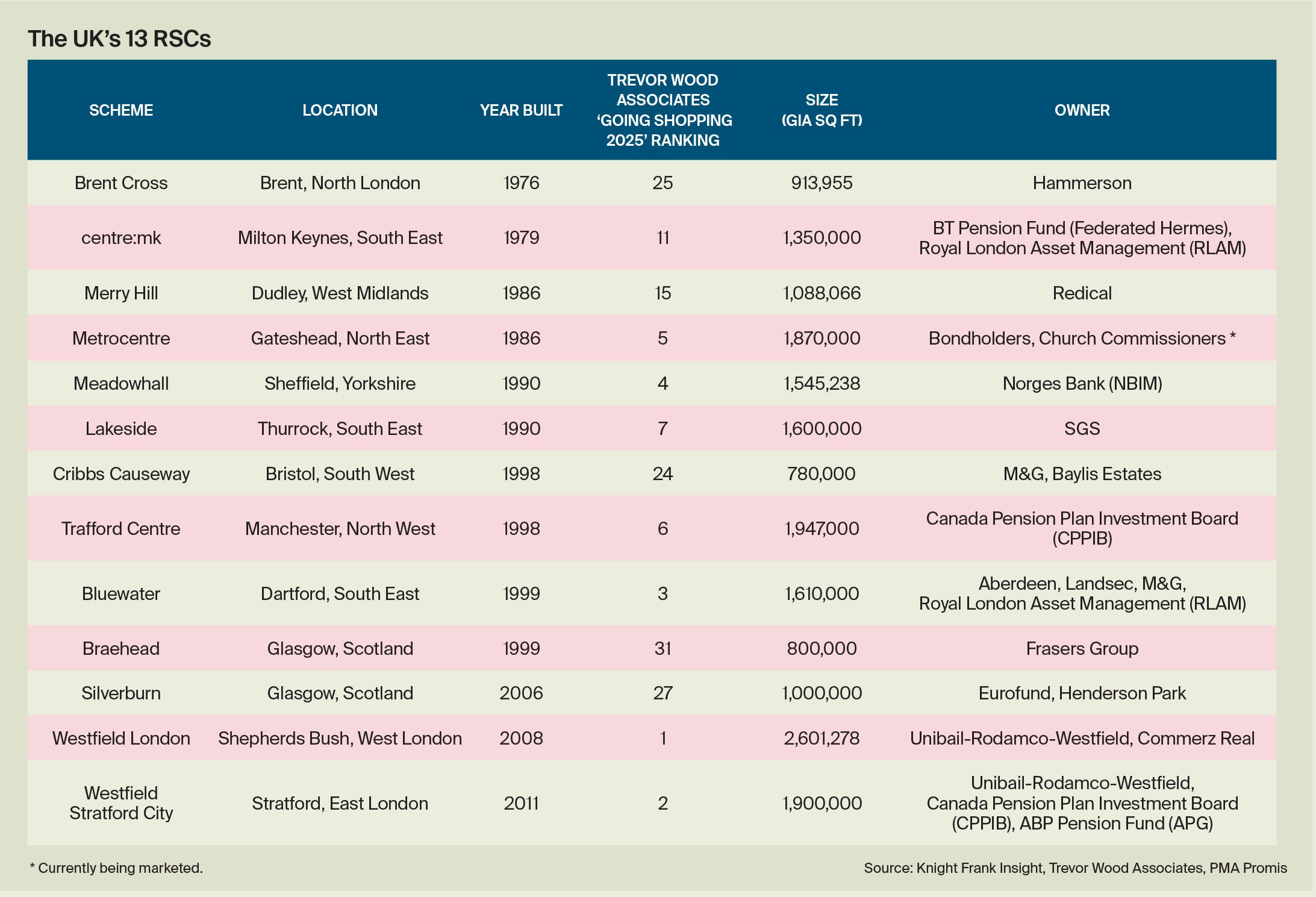
There was a seismic development in the UK retail market in 1976 – the opening of Brent Cross, the country’s very first regional shopping centre (RSC).
This was a retailing revolution that redefined how we shop, but something we probably now take for granted. What have we learned over the last half century and, more importantly, what do recent trends and developments say about the current state and future direction of the UK shopping centre market?
Fifty years on from the opening of Brent Cross, there are now over a dozen RSCs trading across the UK. The formula of one-stop destination shopping that RSCs offer has become entrenched in the fabric of UK retailing and the centres are all prospering, albeit some more than others. None of them has simply stood still – all the schemes have been subject to regular refurbishment and most extended on multiple occasions.
The rise and fall of intu
Over the last 50 years, intu was a name synonymous with UK shopping centres, albeit more through ownership than physical development.
intu has been fully entwined in this RSC evolution, but with a colourful history and a £4.5 billion debt pile, the business eventually succumbed to administration in June 2020.
The whys and wherefores of intu’s demise are indelibly linked to the minutiae and intricacies of its various corporate ownership structures over the years, as opposed to a damning reflection of the actual real estate it owned. However, the retail schemes were inevitably tarred with the same brush of failure, the tangibles in an otherwise muddied corporate balance sheet.
Ironically, the shopping centres themselves are almost a forgotten sideshow to intu’s corporate failure. Since intu’s demise, the assets themselves have continued trading, buried under several layers of contorted ownership structure – a mess of banks, creditors, lenders and bondholders, none of whose raison d’etres is to own and manage shopping centres.
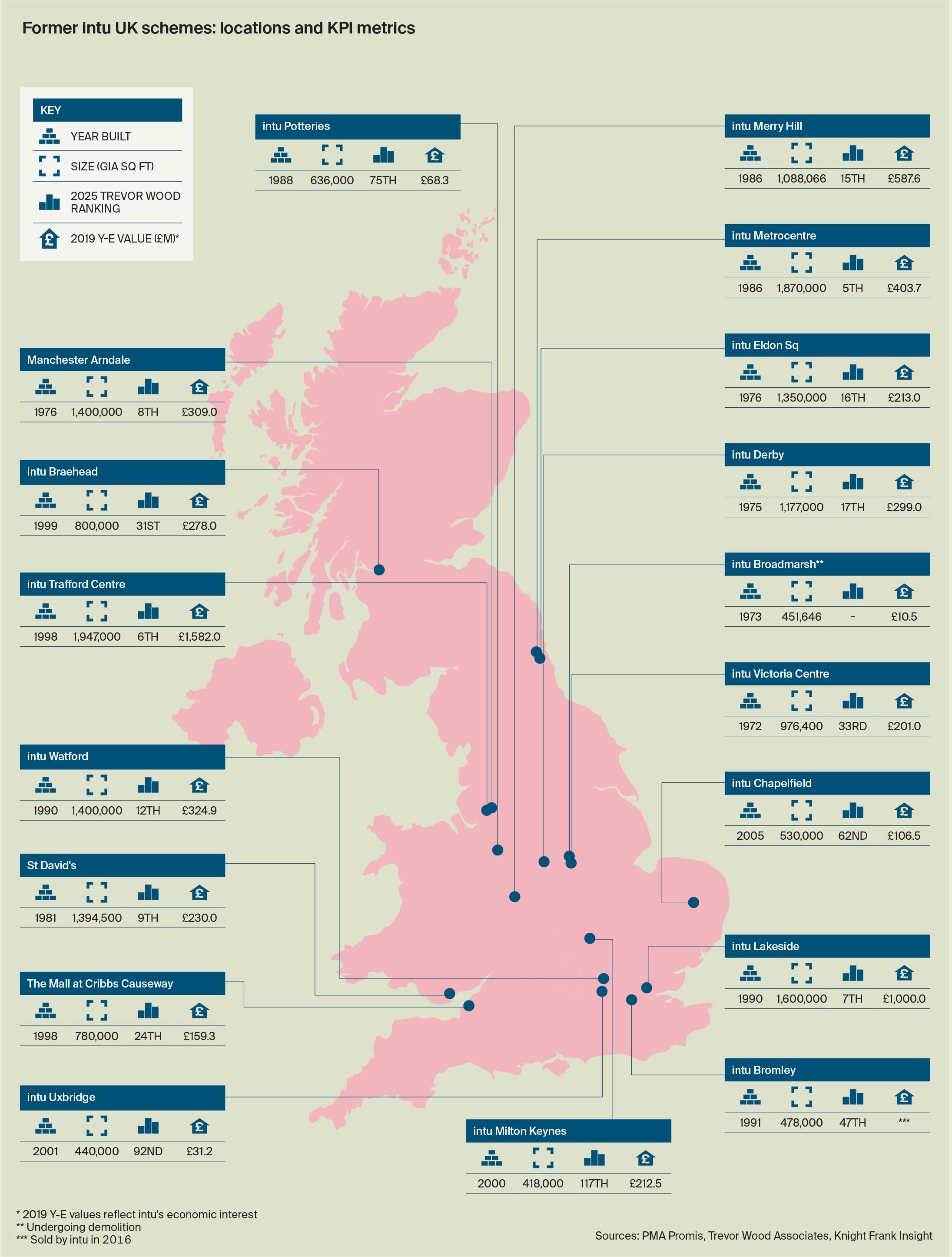
Old schemes are coming back to life
Having carried on during COVID and the post-pandemic years, the former intu schemes are now starting to move, in some shape or form. Only Broadmarsh in Nottingham has ceased to exist as a shopping centre.
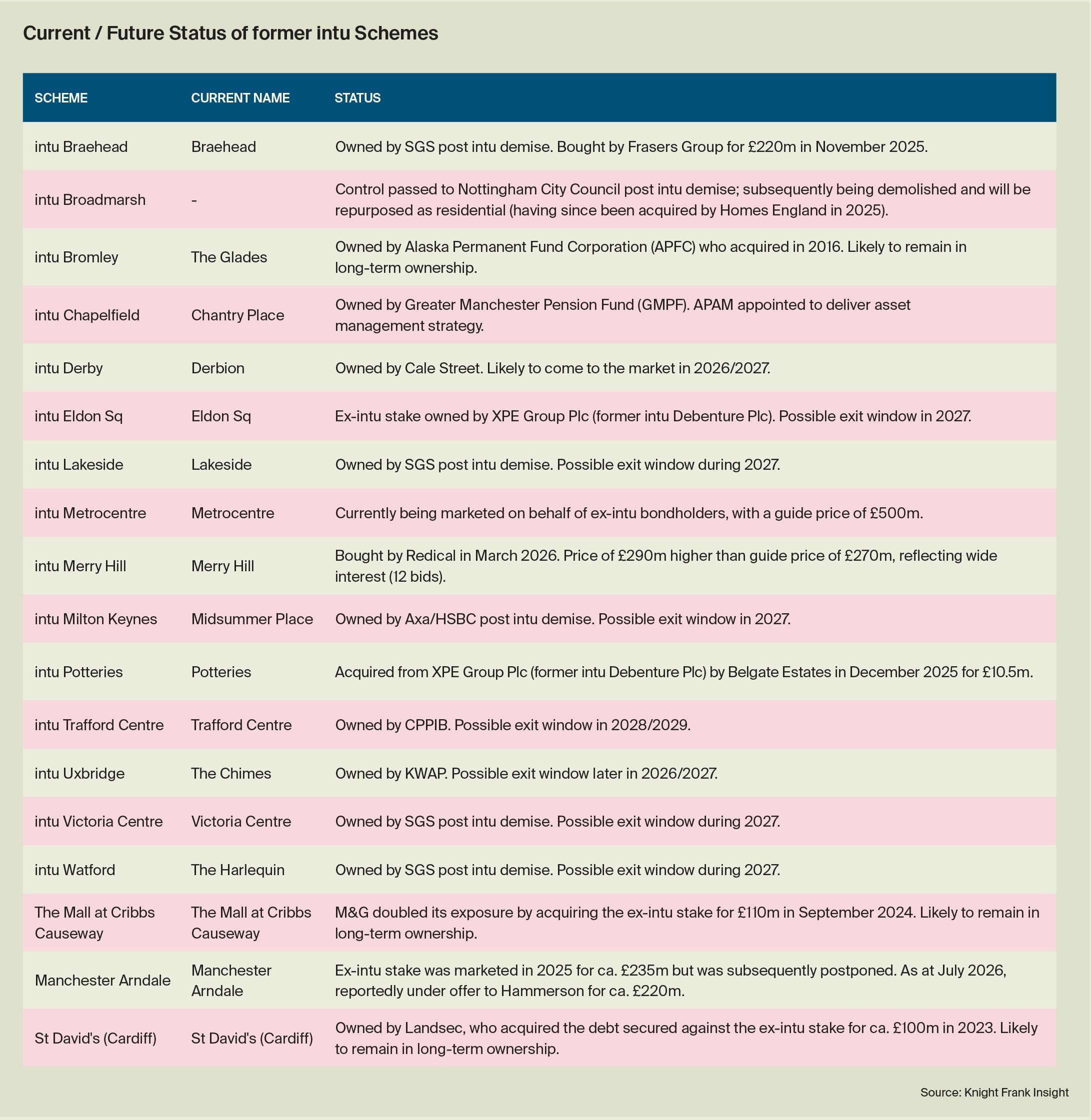
Ownership of the schemes, which intu didn't own outright, has often passed to the other party. Many centres transferred back to their financing structures, seemingly unwilling owners at first but with most rightly determining that investment markets or the assets themselves weren't in good enough health to affect a sale in the period immediately following intu’s demise. Some of these groups sought to make major investments to rectify some of intu’s legacy issues (often aligned with the appointment of new asset managers and directorships).
Braehead was sold to Frasers for £220m in November 2025, while Merry Hill was sold to Redical for £290m early in 2026. Metrocentre (at time of writing being marketed by Knight Frank) will provide a further test of investor appetite for prime shopping centres, with an even higher price tag (guide price >£500m).
Lessons learned and the way forward
intu failed but its schemes live on. A number of key ones have come and are coming to the market.
There are five key lessons and directions of market travel:
- Embodiment of structural failings
- Biggest isn’t necessarily best
- A more diversified ownership group emerging
- Full ownership – no more passive stakes
- Shopping centres have a future
In the aftermath of COVID, the prevailing narrative was of shopping centres being a dying breed and that most would be repurposed to other uses. The practicalities of this were always going to be challenging and the thought process ultimately limited. The best shopping centres (a camp into which virtually all the former intu schemes fall) do have a future as retail schemes, albeit in need of necessary updating, managed evolution and rolling capex. Basic disciplines, but ones that may have been neglected in the past. The new owners are unlikely to fall into the same traps.
A lot has changed in 50 years – RSCs aren't the novelty they were in 1976, they're embedded in the fabric of the UK retail market, in need of constant upgrade and re-invention. But fit-for-purpose and here for the duration. And increasingly in loving homes.
Sign up to Knight Frank Research
