

Retail Renaissance: The high street - never say never again
The fifth paper in the series explores how the high street has gained new interest from investors, with a fresh approach to retail at play.
06 August 2026

3 key takeaways
Renewed investor interest in the high street
This includes at least six institutional investors who sold down post COVID and vowed never to return.
A new investment playbook
This replaces the old one, which was too property-centric, disconnected from retail occupational markets, geographically-restricted and obsessed with demographic affluence.
The playbook is a bottom-up exercise, not a top-down tick-box.
Key considerations combine both centre-level KPIs (catchment/competition, supply/demand dynamics, space productivity) and asset-specifics (ownership/management structures, tenant trade/longevity, rental affordability).
The high street has a new retail investment playbook.
Many disenchanted investors, particularly UK institutions and funds, vowed they would never entertain the idea of investing in in-town retail again.
They had had their fingers badly burnt, their assets tumbling in value as part of retail’s painful, but ultimately necessary, rebase. Many of those assets were sold off at a hefty discount to perceived (read, historic) values. Once bitten, twice shy.
Time is a great healer. Retail’s wider renaissance has not gone unnoticed. Retail warehousing may've led the charge, but high street retail is also being re-evaluated. Investment strategies that were not so much put on ice as buried in the deep freeze are starting to thaw. Even some institutional investors are making noises about returning to high street retail.
Once bitten, twice cautious. Investors are wary of repeating previous mistakes and investing badly. Expect a tentative trickle of investment back into the high street, rather than a fast-flowing flood. And a new playbook than that deployed before.
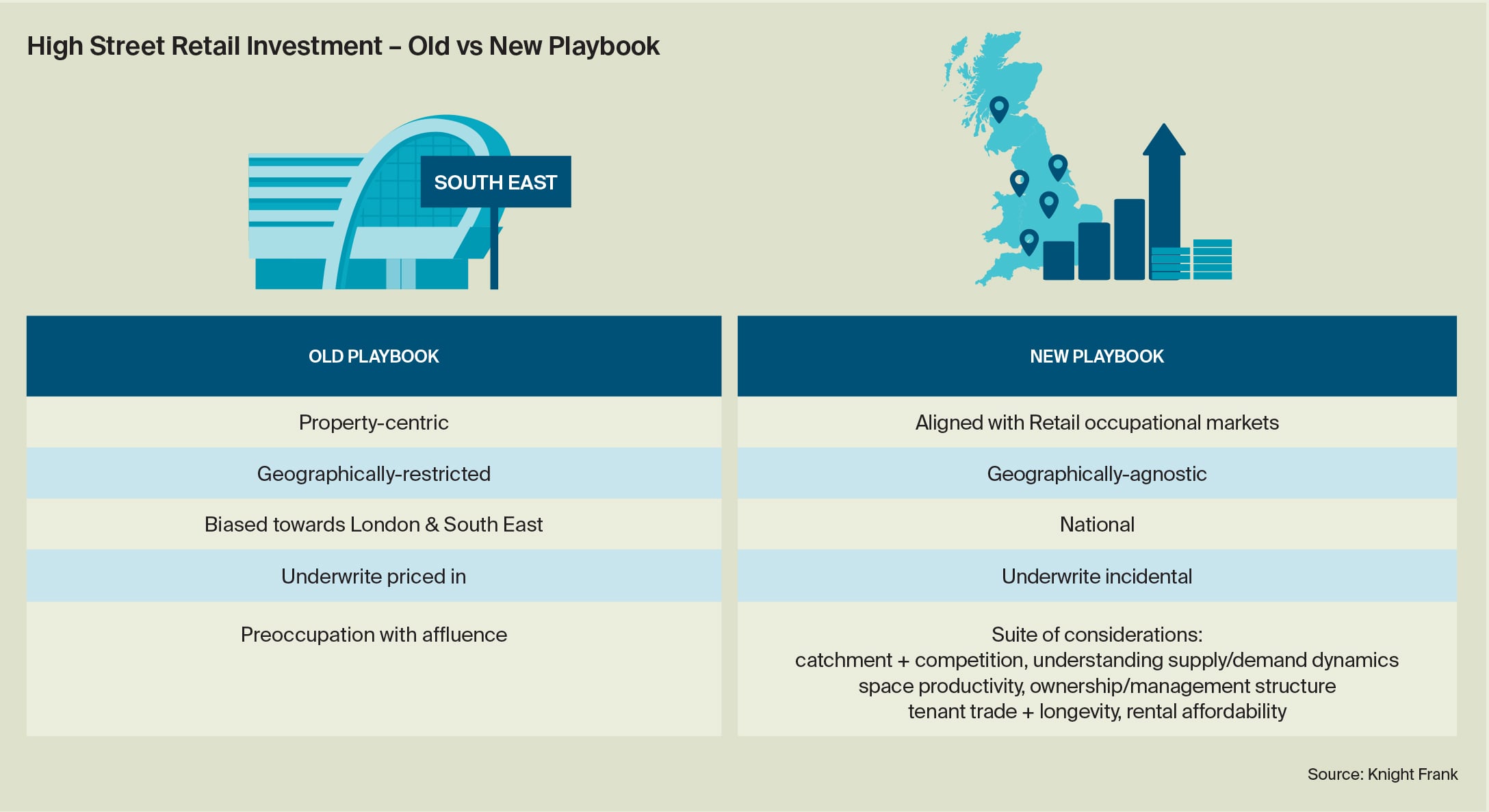
The old playbook: where it went wrong before
Investors were playing a property-centric game that didn't reflect the intricacies and complexities of the retail occupational market.
Strategies adhered to the basic tenets of real estate, most notably market cyclicality, but didn't account for the idiosyncrasies, volatilities and frailties peculiar to the retail market. Investment strategies were also propped up by ‘false friends’ – factors that we’re perceived to provide resilience and drive outperformance, yet did neither. Chief amongst these were geography and the flawed notion that London and the South East reigned supreme.
Demographics – another two-faced ‘false friend’. Above all, a blind obsession with affluence as affirmation of an asset’s worth. Just because the residential population is demonstrably ‘affluent’, it doesn't make that audience any ‘better’ and that asset any more valuable.
Well-presented assets, let to brands perceived to be good, in nice market towns in the South East, supported by an affluent catchment. A summary of many investors’ playbooks historically – less a playbook, more a top-down box-ticking exercise with precious little substance.
Alignment with the retail occupational market
The old investment playbook only paid lip service to the forces that actually define a successful investment strategy – closer alignment with the retail occupational market.
Happy tenants are sticky tenants. Sticky tenants pay rent and provide reliable income streams. Reliable income streams underwrite and determine a property’s value.
What drives retailers’ location planning and real estate strategies?
Making money, either directly through a P&L or indirectly as part of a cog in a multi-channel model, is the primary endeavour of any store-based occupier. And this may not necessarily be in the London or the South East, nor in prime locations.
The new retail investment playbook
The new investment playbook for retail needs to mirror its occupational counterpart. Rather than a top-down tick box list, a detailed, multi-faceted and forensic bottom-up analysis.
Not exhaustive by any means, the new playbook needs to address the following six facets as a bare minimum:
- Catchment and competition
- Understanding the supply and demand dynamics
- Productivity
- Ownership and management structure
- Tenant trade and longevity
- Rental affordability
Ready to dance to a new tune?
Is this new-found interest in in-town retail reflected in the numbers? In shopping centres, yes. In high street stock, not as yet.
Is the tide turning? With high street prime yields at 6.25% (some +225 bps higher than their peak in 2016) and with many high quality opportunities buyable at much higher cap rates, some savvy investors have acknowledged a renewed opportunity to aggregate high income-producing, lower intensity managed estates from disenfranchised owners.
Private investors and property companies remain the core buyer group, although French SCPI have been particularly active in the regional markets with Alderan and Iroko Zen amongst others completing half a dozen transactions so far this year.
What of the formerly disenchanted institutional investors, those that vowed “never again”?
Knight Frank intelligence can identify more than half a dozen UK institutions who are openly targeting high street investments – the most in recent memory.
The list includes a good number of investors who sold the sector so extensively in distressed periods either side of COVID. Disappointingly, but perhaps unsurprisingly, these investors are largely targeting well-secured parades let to investment grade covenants on prime pitches in Outer London or the South East. Old habits die hard.
But there is a world outside the South East window. And a whole different playbook as to how best to mine it.
Sign up to Knight Frank Research.
