
The New Frontier - Your weekly science and innovation update - 10th June 2026
Your weekly pulse check on science and innovation. Those on the supply side of real estate can track the trends set to drive demand, while occupiers gain fresh perspective on competitor activity and sector dynamics.
10 June 2026

Cambridge: Infrastructure first
The newly confirmed Greater Cambridge Development Corporation will cover Cambridge city and South Cambridgeshire, and its remit is unusually broad. It will be able to assemble land, draw in investment and fund enabling infrastructure. The Government expects it to become the local planning authority for residential schemes above 250 units and all other development above 5,000 sq m. Its board will be largely appointed from the centre and it will report directly to the Secretary of State. Ministers have already committed £800m to accelerate housing, jobs and infrastructure across the wider corridor.
The theory is simple: infrastructure in tandem with building. Water, transport and power are to be planned alongside growth rather than belatedly stitched in behind it. The same week brought another sign of intent. Homes England and the Hill Group completed a £350m purchase of the 700 acre Cambridge East site from Marshall Group, with plans for 10,000 homes, 9,000 jobs and a regional construction skills hub. For science and innovation developers, this is the clearest indication yet that Cambridge’s housing and infrastructure bottlenecks have become a Whitehall priority.
The case for intervention is strong. Cambridge is a nationally important science cluster and it is plainly constrained by infrastructure. A long term, well funded delivery vehicle could achieve what local politics sometimes struggle to sustain. Business opinion appears broadly supportive. Cambridge Ahead’s Dan Thorp called it potentially one of the biggest moments in the 65 year Cambridge Phenomenon, pointing to business confidence in such initiatives. But the objections are serious too. The model removes planning powers from elected councils. Planning is not the only constraint. And development corporations do not always deliver as promised. Ebbsfleet remains a cautionary example.
Another flag planted
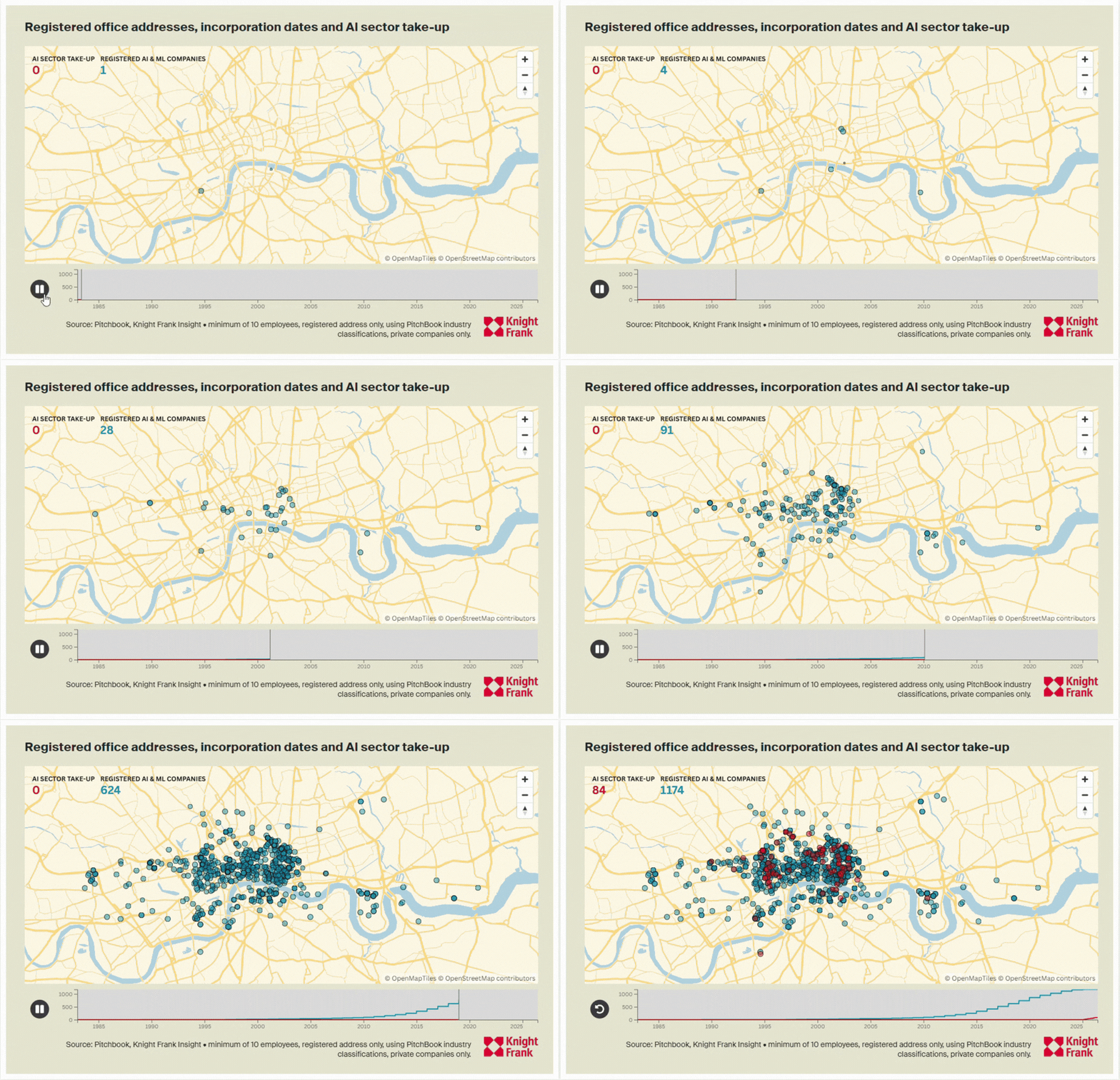
Runway, the New York AI company valued at $5.3bn and backed by Nvidia, AMD and General Atlantic, this week named London as its European headquarters. It plans to invest $100m into the UK AI ecosystem over the next 18 months, rising to more than $200m by 2028. The rationale was familiar: proximity to customers and, in the words of co-chief executive Anastasis Germanidis, an exceptional talent pool. London’s appeal to frontier firms is no longer theoretical. It is showing up in capital allocation, hiring plans and real estate decisions. At Knight Frank we continue to track these patterns closely, including via snazzy tools such as the one below! Please get in touch if you would like to discuss them further.
Coming of age
Oxford Quantum Circuits closed an oversubscribed £260m Series C this week, the largest private quantum computing round Europe has yet seen. Bullhound Capital led the raise, with the British Business Bank providing a £100m anchor commitment. OQC builds superconducting quantum computers designed to operate within commercial data centres. Its chief executive, Gerald Mullally, called it a coming of age moment for British quantum. That is not an empty boast. Britain now hosts two of the three best capitalised private quantum companies in the world. My colleague Lily Nyugen wrote a great piece on this sector in our Tech Report.
This wasn’t the only significant fund raise this week. IMU Biosciences, founded by researchers from the Francis Crick Institute and King’s College London, raised $53m in Series A funding led by IQ Capital and Molten Ventures, alongside a £5m commitment from the British Business Bank. The company has built one of the world’s largest immune datasets and intends to scale its platform in the UK.
Outside London, Wordsmith AI, the Edinburgh based legal AI company, raised a $70m Series B from Highland Europe and Index Ventures. It plans to reach 300 employees globally by the end of the year, up from roughly 110 today. Legal AI is moving at pace, albeit the market is top heavy. Harvey, one of the leaders, has expanded from eight employees in 2023 to nearly 1,000. Legora has grown from four to more than 400 over the same period. AI giants are making moves. OpenAI has entered the market formally, while Freshfields has announced a partnership with Anthropic and Kirkland & Ellis announced one with Palantir.
Healthtech tells a similar story. Semble, headquartered in London, closed a £30m Series C led by Revaia, with Partech joining and existing backers Mercia Ventures and Octopus Ventures also increasing their support. The platform now serves more than 10m patients across 1,700 healthcare businesses, including Nuffield Health and Modality. Semble’s headcount has grown by more than 50 per cent since December 2024.
Bench to bedside
The NIHR has opened a £600m funding call for a new generation of Biomedical Research Centres, covering the five years from 2028 to 2033. Individual centres will be able to receive up to £50m. These centres, partnerships between leading NHS trusts and universities, provide the translational infrastructure through which early stage research becomes commercial therapy. The latest round comes with a strengthened remit to support the NHS 10 Year Plan and the Life Sciences Sector Plan, with greater weight placed on industry collaboration and tackling health inequalities.
For developers and landlords with exposure to NHS adjacent estates, this is more than a funding announcement. It is a location signal. Sites anchored by Biomedical Research Centres tend to attract follow on capital and generate persistent demand for clinical trial space, GMP manufacturing and laboratories. The current network has supported roughly 60,000 studies and produced 55,000 papers in nine years. That is precisely the kind of institutional depth that can turn a cluster into a durable source of demand.
Other reads this week
A useful London pattern is now plainly visible. World class AI research labs are producing world class people, who then leave to build companies. This week, two former DeepMind researchers raised £1.49m for Airspeed to scale their proprietary technology, recruit globally and expand into the United States. Inherent, founded by alumni of DeepMind, Microsoft and the White House, raised $50m.
PitchBook reports a shift in investor positioning. Crossover investors, generalist mutual funds and hedge funds, having become heavily exposed to AI through index drift, are beginning to rotate back into life sciences. The first quarter of 2026 delivered more biopharma exits than any quarter since late 2021, while median venture pre money valuations are rising. Kevin Eisele of William Blair put it neatly: technology and AI companies have become such a large part of major indices that some investors are now rebalancing. That may prove helpful for biotech. But it also says something broader about where capital goes next, and why real estate should pay attention.
Sign up to Knight Frank Research.
