
The New Frontier - Your weekly science and innovation update - 26th May 2026
Your weekly pulse check on science and innovation. Those on the supply side of real estate can track the trends set to drive demand, while occupiers gain fresh perspective on competitor activity and sector dynamics.
26 May 2026

London hosts, San Francisco owns.
A Knight Frank review of operating and headquarters locations for the world's leading frontier AI companies shows a clear geographical split. San Francisco remains the dominant base for headquarters; London stands out as the leading global hub for operating presence, with eight of the top fifteen firms maintaining activity in the capital. This reinforces London's status as a global centre for AI talent and deployment, but it also highlights a familiar imbalance. The UK continues to host international growth without consistently producing scaled domestic champions.
Government policy is now explicitly targeting that gap. The £500 million Sovereign AI Fund has been established to back homegrown firms, with Suzanne Ashman, one of the most respected venture investors in the country appointed this week to lead the investment effort.
New data published on 20th May confirmed UK AI investment hit a record £8.3 billion in 2025, with nearly half of the deals first-time fundraises and roughly three-quarters of Britain's AI fintech companies based in the capital.
Defence turns to SMEs.
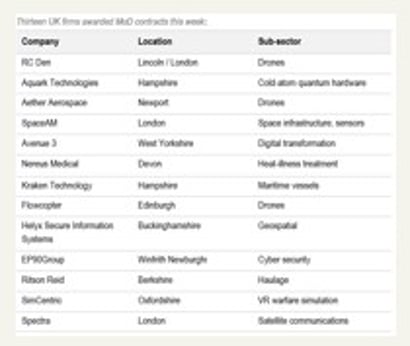
The government is pursuing a parallel strategy in defence. Thirteen UK firms have been awarded contracts of up to £4 million to support the Ministry of Defence in accelerating procurement and deploying new technologies for the Armed Forces. The scheme is structured to channel a greater share of work towards SMEs with the MoD committed to increasing SME spend by 50% by May 2028, equivalent to an additional £2.5 billion and taking total SME spend to £7.5 billion.
The state turns LP.
Further government backing is also coming through early-stage capital. The British Business Bank made a £25 million cornerstone commitment to Antler's UK Fund II, targeting founders at the point of company creation; initial cheques of up to £500,000 will be deployed into new UK startups, with follow-on capital available through Antler's later-stage vehicle, Elevate. More broadly, the Bank has completed twenty-three investments so far this year. The largest including £25 million into Wayve and $20 million into Ineffable Intelligence.
The cumulative effect of the Sovereign AI Fund, the National Wealth Fund's defence pivot and the British Business Bank's expanded chequebook is that the British state is, by stealth, becoming one of the larger limited partners in UK deep-tech.
Devolution and innovation at UKREiiF
The real estate sector convened in Leeds this week, where a striking convergence emerged around innovation-led growth. Regions arrived with near-identical propositions: branded corridors and arcs, built around academia, industry and government collaboration, and anchored in a clear sectoral focus.
Devolution was a central theme, reflected in strong ministerial presence, a wave of policy announcements, and the near parallel Great North Investment Summit. The direction of travel is clear. A fiscal devolution roadmap is due at the Autumn Budget, exploring the transfer of a share of national tax revenues to those regions best placed to deliver.
At a city level, ambition is scaling quickly. Birmingham has launched a 1,040-acre Mayoral Development Corporation targeting £11 billion of regeneration, while Leeds is advancing plans for its own Mayoral Development Zone.
Innovation project examples -
Liverpool — £11 billion of investment opportunities, a new £2 billion LCR investment fund, a new investment strategy, a 10-year Growth Plan and an emerging Mayoral Development Corporation. This includes expansion of life sciences and innovation across the city region.
North East - North East Investment Prospectus building on credentials in advanced manufacturing, life sciences, creative sectors and clean energy.
South Yorkshire - Sheffield "Innovation Spine" including Station Campus
West Midlands – More than £20 billion of investment-ready opportunities. A new development corporation to lead on the regeneration of East Birmingham, including Birmingham’s Knowledge Quarter.
Staffordshire/Stoke – Keele Innovation District masterplan.
West – Chancellor backed proposals for a new mayoral development zone in the South West. It would cover the West Innovation Arc.
Other reads this week.
- Trinity College Cambridge has submitted a generational masterplan for Cambridge Science Park, proposing to expand built space from 2.8 million sq ft to roughly 8 million sq ft on the 152-acre north Cambridge site.
- Quantinuum — the trapped-ion quantum computing company formed in 2021 from the merger of Cambridge Quantum and Honeywell Quantum Solutions has formally filed its S-1 for a Nasdaq IPO.
- UKRI visited Northumbria University on 15th May to view research reshaping the UK's space sector.
- CircuitHub raised $28 million, with an explicit “onshoring electronics manufacturing” The US-firm has operations in Cambridge, UK.
- King's College London and Cranfield University have proposed a merger. The move is designed to combine Both universities aim to create a global powerhouse equipped to tackle pressing challenges in net-zero energy, water security, and AI.
- European Bioinformatics Institute has been credited with accelerating AI drug discovery; the UK-based open data resource is associated with a £12 billion productivity gain.
- Embecta has closed its acquisition of UK medical device maker Owen Mumford for up to $201 million.
- UK ranks 2nd globally in startup ecosystems for the sixth consecutive year, remaining Europe's leader. Britain has seventy cities in the global top 1,000, four in the top 100 (London, Manchester, Cambridge and Oxford). Manchester showed the strongest ecosystem growth of any UK city, ranked above Cambridge and Oxford on momentum.
- SpaceX filed for an IPO this week at a $1.75 trillion valuation. Polymarket traders give it a 56% chance of closing its first trading day above $2.2 trillion. The S-1 cites a $28.5 trillion total addressable market and plans that focus on AI, orbital data centres, and an interplanetary footnote.
- Meta announced plans to lay off 10% of its workforce with another 7,000 employees reassigned to new AI initiatives. The company that employed over 87,000 people at its peak is heading toward a workforce potentially under 60,000. According to layoffhedge in 2026, 45 tech companies have cut a combined 169,078 jobs, averaging 10.8% of workforce per company.
Sign up to Knight Frank Research.
