

Supply Squeeze Curbs Activity in London Rental Market
January 2026 PCL lettings index: 223.7 January 2026 POL lettings index: 229.0
09 February 2026

January failed to live up to its early promise in the London lettings market.
Demand was strong in the first fortnight of the year, but this was partly driven by tenants activating plans delayed by the Budget, which meant the early momentum faded.
It was a similar story in the sales market, as we explore here.
As a result, the number of new prospective tenants registering last month was 4% below the five-year average. Meanwhile, the number of tenancies started fell by 12%.
Falling levels of supply are also to blame for the declines.
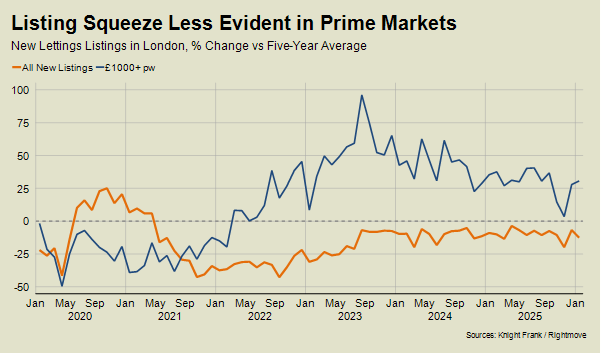
The number of new lettings listings in prime central and outer London in January was 13% below the five-year average, Rightmove data shows. Overall, the number of listings in January was down by a third compared to its pre-pandemic level in January 2019.
The reason for the decline is that it has become less attractive to be a landlord in recent years. In addition to a succession of regulatory and tax changes, this May sees the introduction of the Renters Rights Act.
The new legislation means landlords face uncertainty around rent increases, repossession rules and what happens if they try to sell.
It means some have pre-empted the new rules by attempting to do precisely that. While there was a fall in the number of properties for rent in January, the number of sales listings in London was 14% higher than the five-year average.
The uncertainty has also tempered demand among would-be landlords in the sales market. For example, some are holding off to see whether the court system becomes overwhelmed under new repossession rules, according to Berkeley Group executive chairman Rob Perrins on Knight Frank podcast Housing Unpacked last month.
Despite the supply squeeze, average rental growth in prime central London actually narrowed in January, with demand typically lower at the start of the year. Rental values increased by 1.3% in the year to January, which was down from 1.7% in December but up from 0.6% in the first month of 2026.
It is also true that supply has held up better in higher-value markets, as the chart shows. Owners are typically more flexible, and some have rented out their property while prices are under pressure in the sales market.
The number of lettings properties above £1,000 per week in London was 31% above the five-year average in January, Rightmove data shows.
Meanwhile, average rents in prime outer London increased 2.7% in January, which was the largest increase since July 2024.
With uncertainty growing ahead of the Renters Rights Act, tight supply and upwards pressure on rents look set to define the market this year – again.
Sign up to Knight Frank Research.
