
Second staircases and 18,000 missing homes
Making sense of the latest trends in property and economics from around the globe
11 February 2026

Housing development in London is running near its lowest level in a decade – developers started work on just 5,547 homes last year, down 84% from the peak in 2015.
Readers will be familiar with the issues: subdued buyer demand amid elevated mortgage rates, a restrictive planning and regulatory environment, and limited grant funding for registered providers are among the factors dragging on output. Mark Allan, chief executive of Landsec, told an industry panel this week that of its 9,000-home pipeline "not one of them is viable".
The list of issues weighing on viability is long, and includes the post-Grenfell fire requirement for a second staircase in buildings higher than 18 metres. While the requirement for a second staircase was expected, developers were surprised that the threshold was set that low. This piece published by the Times yesterday reveals why: analysis of the government's own impact assessments by the consultancy Place Base shows that a second staircase for buildings between 18 and 30 metres tall would save 0.004 lives during a "major incident", which it estimates as having a one-in-50,000 probability of happening.
“Over a 70-year period the impact assessment assumes that 2.84 major fires could occur across the country in buildings between 18 and 30 metres in height. This is equivalent to 0.00016 deaths per year, or one death every 6,153 years,” according to Place Base’s report.
Place Base estimates that 18,000 homes a year are not being built because of the second staircase requirement. Whether that's an appropriate trade-off for alleviating risk is a question for the government. I recommend the Times piece for more.
Coordinate pricing
The economics of housebuilding have become highly political. Polling from the US, UK and Europe consistently places affordability and the cost of living among the top three issues for voters.
Mortgage rates have eased, but affordability remains stretched. The stock of unsold homes in many economies is running high relative to sales rates, in large part because people can't afford to buy them. Politicians balk at weak housing delivery numbers and lean on the industry to deliver more, but building homes that will be priced out of reach – whether due to mortgage rates or the price of development – is bad business.
US President Donald Trump voiced his frustration with developers in October, and late last week Bloomberg reported that the Department of Justice is exploring opening an antitrust investigation into the homebuilders. Officials have grown concerned that the trade group Leading Builders of America "could be used to restrict housing supply or coordinate pricing", the report said.
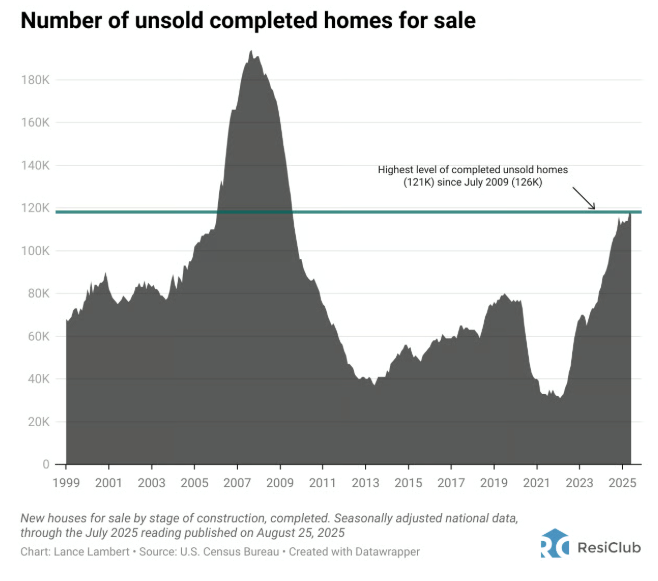
Official figures for July – which look to be the latest available – put the number of unsold and completed new homes at 121,000, which is the highest since 2009. Single-family home starts are running at two-and-a-half-year lows. Chart courtesy of ResiClub.
Early momentum
Average prices in prime central London fell 5% during the year to January, extending the 4.7% decline the previous month.
The November Budget could have been worse and activity has started to rise since. The number of offers accepted in London in December was 34% higher than in December 2024, and the increase in January was 12%, according to Tom Bill's latest update.
Still, elevated supply will keep a lid on any recovery in values for now. The number of sales instructions increased by 15% compared to the five-year average in January.
Meanwhile, January failed to live up to its early promise in the London lettings market. Demand was strong in the first fortnight of the year, but this was partly driven by tenants activating plans delayed by the Budget, which meant the early momentum faded. Rental values increased by 1.3% in the year to January, down from 1.7% in December.
In other news...
London on course to overtake Paris for Michelin stars within decade (Times), Billionaires Fleeing California Wealth Tax Snap Up Miami Mansions (Bloomberg), Hong Kong Family Offices Numbers Jump 25% Since 2023 in Wealth Hub Boost (Bloomberg), and finally, Markets expect UK interest rates to bottom out at 3.0% in Q1 2027, BoE survey shows (Reuters).
Sign up to Knight Frank Research.
