
The New Frontier - Your weekly science and innovation update – 16th November 2026
Your weekly pulse check on science and innovation. Those on the supply side of real estate can track the trends set to drive demand, while occupiers gain fresh perspective on competitor activity and sector dynamics.
16 November 2026

Chips with everything
Britain has a new $7bn technology company. There is one unusual detail: it has yet to ship its first chip.
Fractile, an AI-chip designer based in London and Bristol, raised $720m this week. Thrive Capital, Founders Fund, Lightspeed and Redpoint led the Series C, with Alphabet’s CapitalG and BlackRock joining as new investors. Britain’s Sovereign AI fund and the British Business Bank also took part.
The speed of the revaluation is striking. Fractile was worth about $1.1bn as recently as May. Its new valuation rests on an increasingly important bet about where AI economics are heading. Training models have consumed most of the attention so far. But once a model has been trained, it needs to be put to work. That process, known as inference, could account for roughly three-quarters of compute demand by 2030. Hence, the rush to develop specialised chips that move data between memory and processors faster and more efficiently. Fractile does this by putting storage and calculation together on one piece of silicon, using a memory type called SRAM.
Fractile plans to launch its first commercial product next year and is hiring in London, Bristol, Palo Alto and Taipei. It also has a $250m supply agreement with Anthropic.
It is not alone. Tendrils Compute, another British chip company, has raised $30m from investors including the Sovereign AI fund, Jack Altman and Visionaries as it attempts to reinvent the CPU.
Such advancements could have a two-fold impact on real estate. First, they could support further growth in the UK sector. Second, if advances in chip design make AI faster and more cost-effective, they could ease some of the key constraints facing AI companies, making it easier for them to establish and scale.
Biotech has been busy too
Cambridge-based T-Therapeutics has raised £100m in a Series B co-led by Advent Life Sciences and the British Business Bank to develop treatments for cancer and autoimmune diseases.
London-based Potential Sciences, a start-up using AI to design new medicines, has received backing from the Sovereign AI fund as part of an eight-figure fundraise. Founded only in 2025, it has eight employees and remains at its earliest stage.
London-based Oyster Therapeutics, formerly Kesmalea Therapeutics, raised $60m to advance its tau-protein targeting drug for Alzheimer’s disease. Founded in 2020, it has 25 employees and a research collaboration with Massachusetts General Hospital.
Alethio Therapeutics, a University of Oxford spin-out, completed an oversubscribed €80.46m ($90m/£67m) Series A. It is developing therapies for myeloproliferative neoplasms, chronic blood cancers for which existing treatments manage symptoms rather than remove the cells that drive the disease. Formed in 2021, it has 19 employees.
It has, in other words, been quite a week for writing cheques, and that is evidence of confidence in UK science and innovation. Capital does not translate automatically into property demand. But knowing who has raised it, what the money is for and where a company intends to scale is one of the best early-warning systems for future requirements.
A quiet quarter, a record year, with some nuance
Step back from this week’s fundraising and the wider investment numbers point in much the same direction.
Our latest quarterly science and innovation update reports that UK life sciences VC investment reached £3.63bn during the first nine months of 2026, the second-highest Q1–Q3 total on record, behind only the exceptional market of 2021. There is an important caveat. The recovery is not as broad as the headline suggests. A relatively small number of companies are doing much of the heavy lifting, with Isomorphic Labs in particular having an outsized effect on the numbers.
There are nevertheless signs that conditions underneath are improving. The Endpoints Biopharma Sentiment Index increased from 96 in Q2 to 105 in Q3, moving above the neutral 100 level for the first time since the post-pandemic downturn. Current conditions jumped from 87 to 103. Dealmaking was the most commonly cited reason for optimism, and 76% of respondents expect AI to improve drug-discovery productivity during the next year.
Employment provides an interesting wrinkle. Some 52% of biotech respondents expect to add staff, whereas 44% of big-pharma respondents expect cuts.
For property, that distinction may be as important as the overall direction of travel. Younger biotech businesses create incremental, expansion-led demand, while big-pharma demand may be led more by restructuring and transformation.
The science and innovation occupier gets harder to define
The science and innovation occupier base is broadening. AI, defence tech, quantum, robotics, semiconductors and advanced materials are creating a new generation of requirements. These range from conventional offices and wet laboratories to dry labs, secure R&D facilities, automation-ready laboratories, high-power industrial buildings and specialist manufacturing space.
The largest Golden Triangle transactions illustrate the change. Significant 2026 deals have included quantum computing company Oxford Ionics, defence tech scale-up Cambridge Aerospace, robotics company Humanoid and sustainable fuels business OXCCU.
Demand has translated into a strong year for science and innovation take-up despite a quieter third quarter. Some 499,711 sq ft of space was leased across Oxford, Cambridge and London during the first nine months of 2026, 12.1% ahead of the same period last year and the strongest nine-month period on record.
AI companies have taken just under 1m sq ft of London office space this year, roughly double the 2025 total. At least ten AI labs have emerged from stealth this year: Ineffable Intelligence, Recursive, Emulate, Inherent, Machenta, Metis Reasoning, Cursive, Potential Sciences, Callosum and Zenithon. Several have raised extraordinary sums unusually early in their lives.
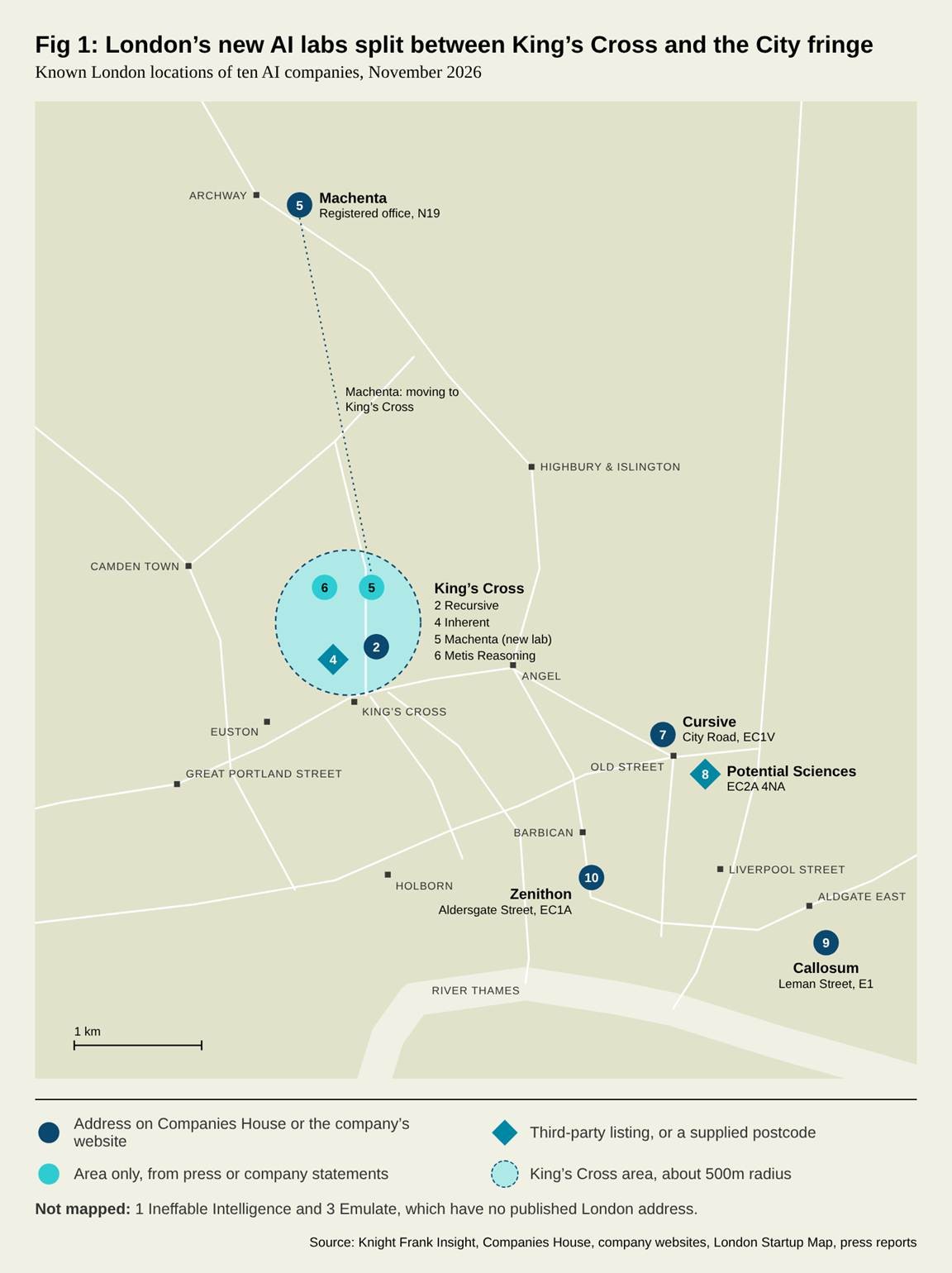
Not every one of these companies will become a major occupier. Some could remain relatively small computational teams. Others may disappear entirely. But that is not really the interesting property question. The interesting question is what happens if just a handful succeed.
Frontier companies can now pass from university research or stealth mode to hundreds of millions of pounds of backing in remarkably short periods. Traditional leasing data only notices that demand once an active requirement reaches the market. Funding, hiring and procurement data can reveal it considerably earlier.
These sectors are increasingly overlapping. AI is discovering drugs. Robotics is automating laboratories. Advanced materials feed into healthcare, energy and defence. Quantum technologies have applications spanning pharmaceuticals, finance and national security.
For developers, that suggests thinking less in terms of rigid sectors and more about technical requirements. Power, floor loading, data connectivity, security, goods access, dry lab capability and the ability to accommodate automation may prove just as important as the number of wet lab benches. Flexibility is beginning to acquire a rather more precise meaning.
Quantum gets a customer
Quantum is attracting serious capital too. Britain’s quantum companies have raised around £1.73bn in equity, with £587m secured across 23 deals in the first half of 2026 alone, more than in 2024 and 2025 combined. The money is concentrated: five companies account for roughly two-thirds of all capital raised, including Oxford Quantum Circuits, whose £260m Series C in June was Europe’s largest private quantum funding round.
Notable, the government is starting to become a customer as well as a funder. Ministers recently detailed £138m of cross-government procurement for quantum sensing, including £30m from the Ministry of Defence, while UKRI has committed £12m to a new commercialisation skills centre and £35m to networking testbeds.
That marks an important step in quantum’s journey from university research towards a commercial industry. Grants help develop technology; procurement gives companies revenues and greater visibility over future demand. That can support hiring, investment in equipment and, eventually, more substantial property commitments.
Fault-tolerant quantum computing may still be a 2030s prospect, but commercialisation does not have to wait that long. Error-correction software, post-quantum security and hybrid quantum-classical computing offer nearer-term routes to revenue, areas where British companies already hold significant intellectual property. For real estate, the sector is therefore worth watching.
Defence tech discovers venture capital
If quantum illustrates the transition from research to commercialisation, defence tech shows what happens when innovation turns into hardware.
UK defence tech businesses in our tracked cohort raised £776m in the first nine months of 2026. That is more than three times the previous annual record of £219m and represents 43% of everything the cohort has raised since 2011.
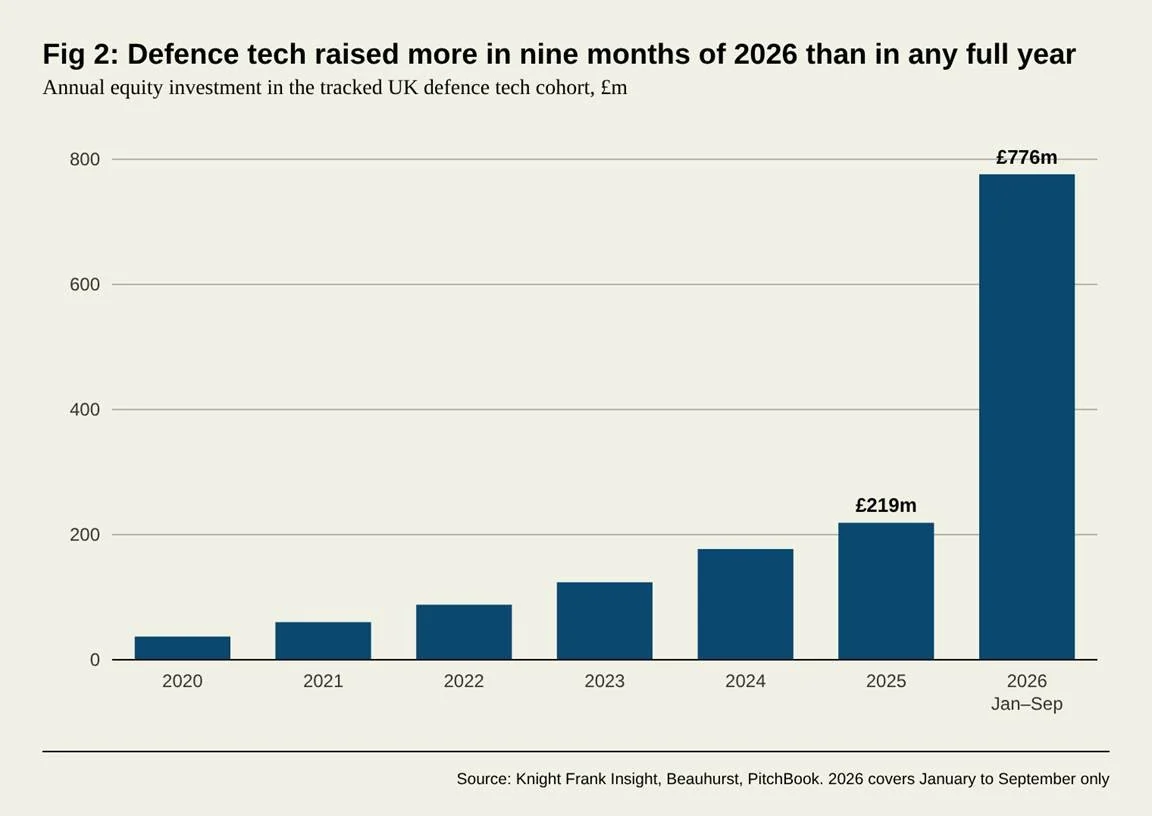
This week London-based UFORCE announced a $700m Series A at a $6bn valuation, co-led by Valor Equity Partners and the UK National Wealth Fund. It is the fund’s largest defence investment to date. UFORCE is a British-Ukrainian company with major hubs in Kyiv and Washington, DC. It builds unmanned air, land and sea platforms and the battlefield management software that links them, tested in combat in Ukraine since 2022. It emerged from stealth only in March 2026, with a $50m seed round at a valuation of more than $1bn.
There is a shift in terms of who is providing the money. Defence was once a difficult sell to mainstream venture capital. That is changing quickly. Large generalist technology investors are now backing defence companies, while established contractors are investing directly in start-ups. BAE Systems has backed Oxford Dynamics and MBDA has taken a minority stake in Hydra Drones. The distinction between start-up and defence prime is consequently becoming a little fuzzier.
Cambridge Aerospace is the standout example. Founded only in 2024, the maker of drone and missile interceptors has already reached a $3.4bn valuation following an extraordinary run of funding rounds. Its latest capital is intended partly to increase manufacturing capacity for existing and new contracts.
Kraken Technology tells a similar story from Fareham. The autonomous-vessel manufacturer reached a $1bn valuation this year and makes its own composite structures.
These companies may be funded like technology start-ups, but they increasingly occupy space like advanced manufacturers. They need production floors, secure R&D environments, testing facilities, loading and logistics access and plenty of power. Their requirements look less like conventional offices or wet laboratories and more like the increasingly sought-after territory between science space and light industrial.
In other news…
- Moderna is relocating its UK commercial headquarters from 123 Victoria Street to TRIBECA in King’s Cross. The company has taken 4,206 sq ft in The Reflector, with the space expected to be ready by the end of April 2027.
- UKRI is backing five new research and partnership hubs in Exeter, London, Southampton and Sunderland with more than £52m of government funding. The hubs will develop technologies that help people manage their own health.
- IXICO announced a contract to support a global phase 3 Huntington’s disease trial for an unnamed international biotech. The company expects the contract to generate £2.7m in revenue over six years.
- Hiverge raised $20m. The AI company was founded by researchers from DeepMind and Cambridge University.
- Helsing has unveiled a military intelligence and targeting platform billed as an alternative to Palantir software.
- Rillet is the latest US AI firm to announce a UK expansion, opening a London office less than three months after raising $100m.
- UK real GDP increased 0.7% in Q3. Information and communication, and professional, scientific and technical activities, were among the largest positive contributors to growth. Information and communication increased by 2.1%, driven mainly by computer programming, consultancy and related activities (up 4.4%). This industry has been the largest driver of GDP growth across 2026, with evidence that many of the businesses reporting the largest increases in turnover are involved in artificial intelligence and cloud computing.
- Science minister Chris McDonald used an FT pharma summit on Wednesday to argue that NHS records should become “a very powerful driver for investment” in AI-led drug discovery. He called the combination of the health service’s long-running data and Britain’s AI sector a “strategic competitive advantage”. McDonald, a minister in both the business and health departments, said no other country could reproduce the depth of the UK’s health records gathered over decades. He also conceded the plan depends on keeping public trust, which recent controversies over Palantir and UK Biobank have tested.
