
The Bank hikes as oil drops below $100
Making sense of the latest trends in property and economics from around the globe
06 November 2026

The Bank of England's decision to raise the base rate to 4% yesterday, the first rise in three years, prompted a shift in the outlook.
Eight of the nine members of the Monetary Policy Committee voted to hike, which is a little more hawkish than economists had anticipated. Traders now see a 50% chance of a rise in December and expect almost three more before the end of next year.
“Unless progress towards resolving the conflict is made, or there is other news which softens the risk to inflationary pressures, a further increase in bank rate may be warranted,” Governor Andrew Bailey said, just as oil prices tumbled to less than US$100 a barrel, the lowest since early October. Brent crude is down about 18% this week.
Make of that what you will. The Bank made the case that a burst of inflation is already in the pipeline, while admitting that there is little evidence so far of prices accelerating outside sectors directly hit by higher energy costs. The outlook for UK mortgage rates is now uncertain – we might not know for months what the results of the US midterm elections will mean for some of the global economy's most important issues, particularly the Iran war. Nevertheless, it's been a good week for fixed rate mortgages. Barclays, Halifax, Nationwide and Virgin have all announced cuts across their ranges since Monday.
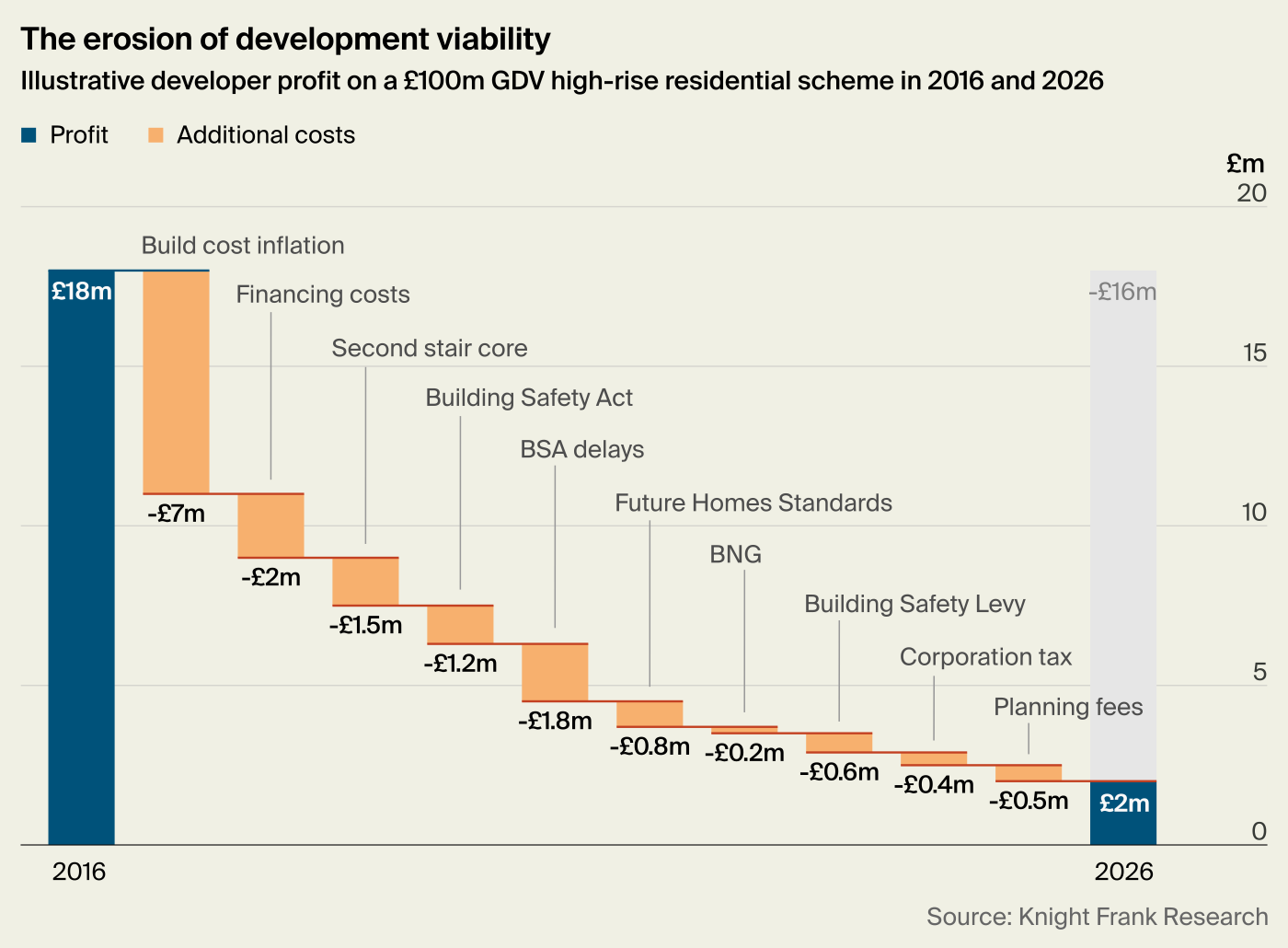
Viability erosion
UK construction activity contracted sharply in October, led by declines in housebuilding, according to S&P Global's construction PMI. Output has been shrinking for nearly two years, and the rate of contraction was the fastest since June.
Ollie Knight's latest newsletter includes the remarkable chart below showing how the economics of housing delivery have shifted materially over the past decade. Our illustrative appraisal shows how higher construction and development finance costs, alongside additional taxes, levies and regulatory requirements, have progressively eroded development viability. The cumulative impact leaves considerably less capacity to absorb further costs, acquire land and bring new homes forward.
Knight Frank's latest Residential Development Land Index shows land value declines beginning to slow, but few respondents to our survey of small and volume housebuilders anticipate an imminent recovery. More than half expect new home reservations to finish 2026 below last year's levels. Another 38% expect little change, while only 6% anticipate an increase. Almost two-thirds expect housing starts to remain flat during the final quarter, while close to a third expect further falls.
Vacancy contracts
Strong leasing activity in the London office market during Q3 helped push the vacancy rate to 7.3%, its first fall below the long-term average since the pandemic, according to a new Knight Frank London Office Market Report. The completion of deals currently under offer would result in a further 120bps fall in the vacancy rate.
Take-up in Q3 reached 3.2m sq ft, up 4.3% from the previous quarter and 15.1% above the long-term quarterly average. Quality remained central to occupier decisions, with new and refurbished space accounting for 80.7% of leasing activity, compared with 69.6% in Q2.
Large transactions made a greater contribution to Q3 activity. Jane Street Capital’s 470,000 sq ft off-plan pre-let at One Spitalfields, E1 was the quarter’s largest commitment, followed by Mishcon de Reya’s 160,569 sq ft letting at MidCity Place, WC1 and Deutsche Bank’s 152,791 sq ft acquisition at YY London, E14. These transactions demonstrate continued willingness to make substantial commitments, although quarterly volumes remain sensitive to the timing of individual deals.
Forward-looking indicators remain encouraging, despite continued interest-rate uncertainty. At the end of the quarter, 4.5m sq ft was under offer across London, with almost 90% comprising new or refurbished space. Active requirements exceeding 10,000 sq ft totalled 13.2m sq ft, down 8.2% over the quarter but still 34.2% above trend. Around 40% of active demand was already in negotiations or under offer, suggesting near-term momentum will be sustained. However, we expect 34.3% of requirements to stay put, which adds a degree of caution to the positive active demand headline figures.
Development shortfalls
Q3 saw a heightened level of development completions, reaching 2.9m sq ft and some 124.2% ahead of the long-term average. Just over half of the space completed in Q3 was pre-let, meaning the impact on vacancy was minimal. Large schemes such as Google’s Platform 37, King’s Boulevard, N1 in King’s Cross (650,000 sq ft) significantly impacted the level of completions.
At the end of Q3, there was 13.7m sq ft under construction across the London market, 11.5m sq ft of which is being delivered speculatively. This means that 16.1% of the under-construction pipeline is already pre-let, a figure which is expected to grow in the coming months given the number of pre-lets under offer or in advanced negotiations. Based on the long-term average take-up of new/refurbished space, we predict a 9m sq ft shortfall of development by the end of 2030 across London.
Investment turnover reached £2.6bn in Q3, improving from approximately £2.0bn in Q2 but remaining 12.8% below the long-term quarterly average. The recovery is encouraging, although activity continues to be influenced by a small number of substantial transactions and a more constraining financing backdrop. See the report for more.
In other news...
Hefty fines of up to £30,000 proposed for landlords found in breach of energy efficiency rules.
Elsewhere - AI companies mull rebranding data centres as “compute campuses” (FT),
Developers Eye Golf Courses for Data Center Projects (Bloomberg), and finally, Top private equity dealmaker to quit UK for Greece (FT).
Sign up to Knight Frank Research.
