
Some clarity post-Budget but does buyer support move the dial?
...Budget gives more details on Your First Home, and are we at a turning point for the land market?
05 November 2026

A little more breathing room
The dust has settled on the Budget and, for housebuilders at least, there were no nasty surprises from financial markets. The 10-year gilt yield has since fallen to around 5.2%, its lowest level in seven weeks, helped by a relatively reassuring Budget and easing oil prices. That is welcome, although yields remain almost 70 basis points higher than a year ago.
That matters more for the housing market than most of the measures announced by the Chancellor.
Take Your First Home. The structure of the scheme should improve affordability for those able to access it, and almost 70% of housebuilders responding to our latest survey said buyer support would give them greater confidence to bring sites forward. But given the scale of funding announced, we don't expect it to materially shift sales rates across the sector.
The more important number for developers over the coming months will be the gilt yield. Mortgage pricing has already moved sharply higher this year. The latest Bank of England data available for September put the average quoted two-year fix at 75% LTV at 5.13%, up from 3.93% in January, while the equivalent five-year rate has risen from 3.94% to 4.98%.
Two speed market
Elsewhere, there are tentative signs that the land market is stabilising. The pace of declines in the Knight Frank Residential Development Land Index slowed during the third quarter. Greenfield land values were down 3% annually, brownfield values fell 5%, while values in prime central London were also 3% lower.
It is too early to call the bottom. But the direction of travel matters.
Greenfield sites continue to prove most resilient. Well-located, lower-density schemes are generally simpler to deliver and benefit from more consistent demand. Urban development remains tougher, with high build costs, planning requirements and weaker sales rates continuing to weigh on viability.
There has also been some improvement in the market for affordable housing. The first allocations from the government's Social and Affordable Homes Programme have improved appetite among housing associations for Section 106 and grant-funded homes, according to developers. You can read the full report here.
Will Your First Home move the dial?
The scheme is generous for those who qualify. Buyers will need a deposit of just 2.5%, supplemented by a 20% government equity loan, interest-free for the first five years. That leaves a mortgage requirement of 77.5%, materially improving affordability compared with a conventional 95% mortgage.
The big question is how far Your First Home reaches. The government has committed £4.7 billion over five years, including £700 million in 2027/28 and £1 billion in each subsequent year. Transformational for lacklustre national new-build sales rates? Probably not.
Indeed, the Office for Budget Responsibility said it expects the package “to only have a marginal impact on house prices and supply given its limited overall size.” Applicants must buy a home worth less than £650,000 in London and £500,000 in outer London, with other areas to be set based on local prices.
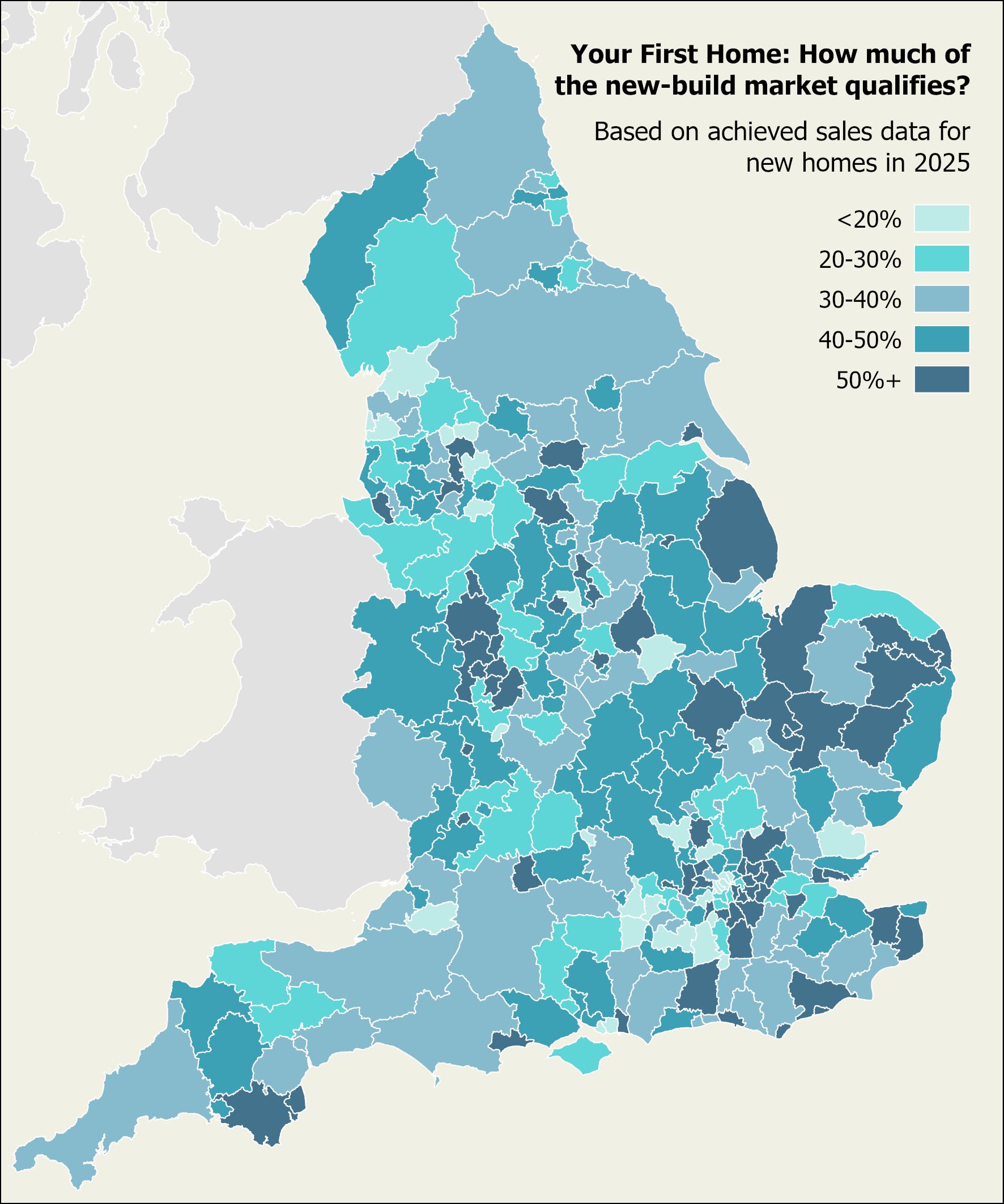
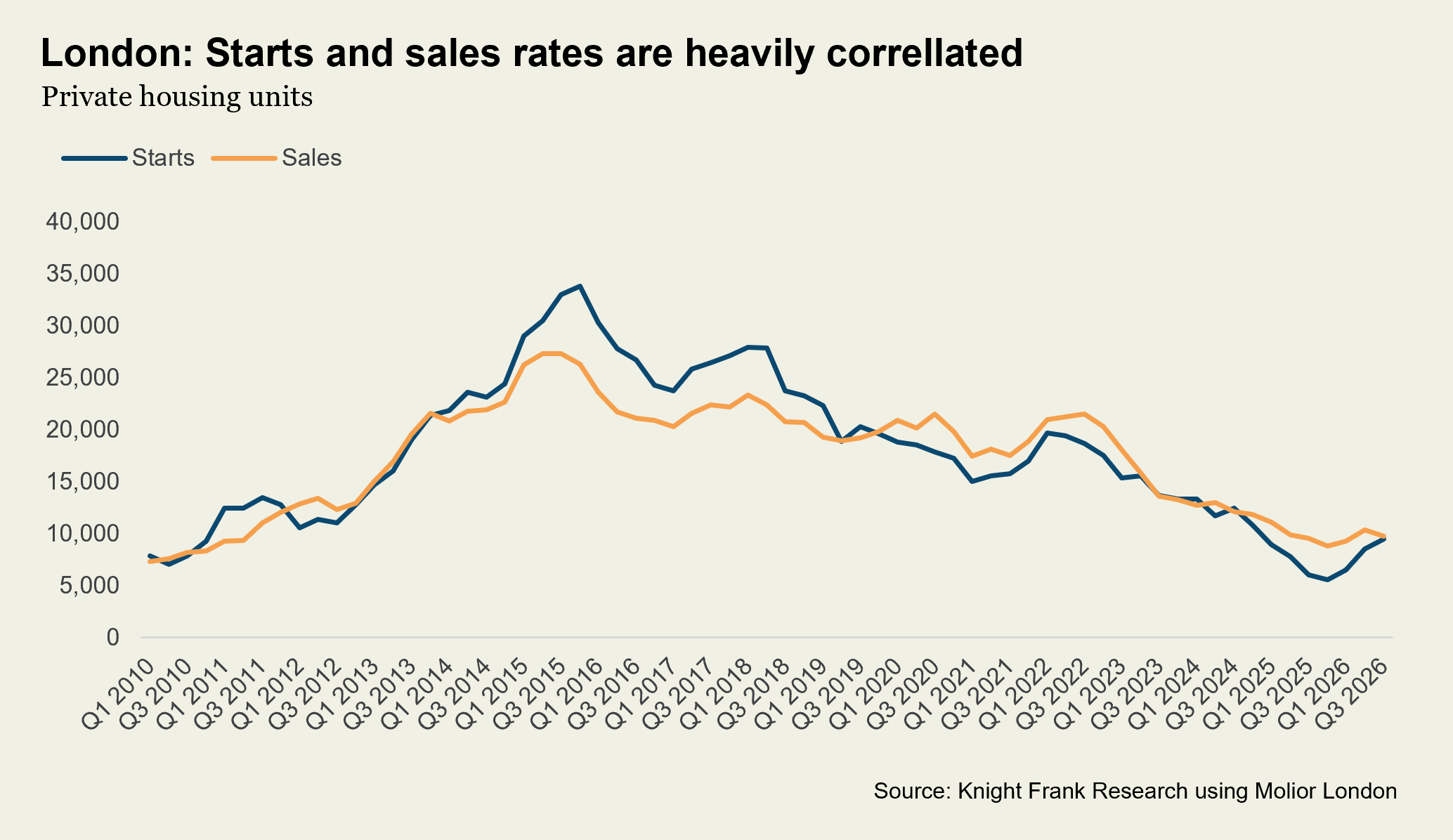
That is particularly relevant in London. Developers sold just 1,440 private homes during Q3, according to Molior compared with 8,600 at the market peak in early 2015. With sales rates dictating the pace of development, London's housing ambitions look difficult to achieve without a much stronger recovery in demand.
Meeting the London Plan target of 55,845 homes annually would require sales, starts and completions of private homes to run at roughly 35,000 a year, Molior estimates suggest.
Those numbers cannot be separated. Developers generally cannot build homes materially faster than they can sell them. Some 7,160 private homes started on site in the capital during the first three quarters of the year, broadly in line with approximately 7,070 new-home sales.
Still hard to build
For now, the land market appears to be edging closer to stabilisation. But buyer support, lower borrowing costs and further progress on planning and viability will all be needed for that to translate into more homes being built.
The latest S&P Global UK Construction PMI rose from 44.3 in August to 46.1 in September, suggesting the downturn in construction activity is easing. But housing remains firmly in contraction territory, with an index reading of just 40.7, the weakest of the three construction sectors. New orders also fell at their fastest pace for three months.
Costs aren't helping either. S&P Global reported sharp increases in fuel surcharges, freight and raw-material prices during September, despite overall input-cost inflation easing to a seven-month low. The Middle East conflict is disrupting shipping and supply chains as well as putting pressure on energy costs. For developers, the combination of expensive finance, rising costs and weak sales makes it difficult to make schemes stack up.
What happens next?
Few housebuilders expect an immediate recovery. More than half, 56%, expect new home reservations to finish 2026 below last year's levels. Another 38% expect little change, while only 6% anticipate an increase. Almost two-thirds expect housing starts to remain flat during the final quarter, while close to a third expect further falls. There are, however, reasons to think the market is getting closer to a turning point.
Land value declines are slowing. The market for affordable housing has improved. And, through Your First Home, the government has acknowledged something that has become increasingly clear over the past year: fixing supply without addressing demand won't be enough to restart housebuilding.
Reports in the FT that the Bank of England might be considering loosening the rules around mortgage lending again will also help.
Chart of the month
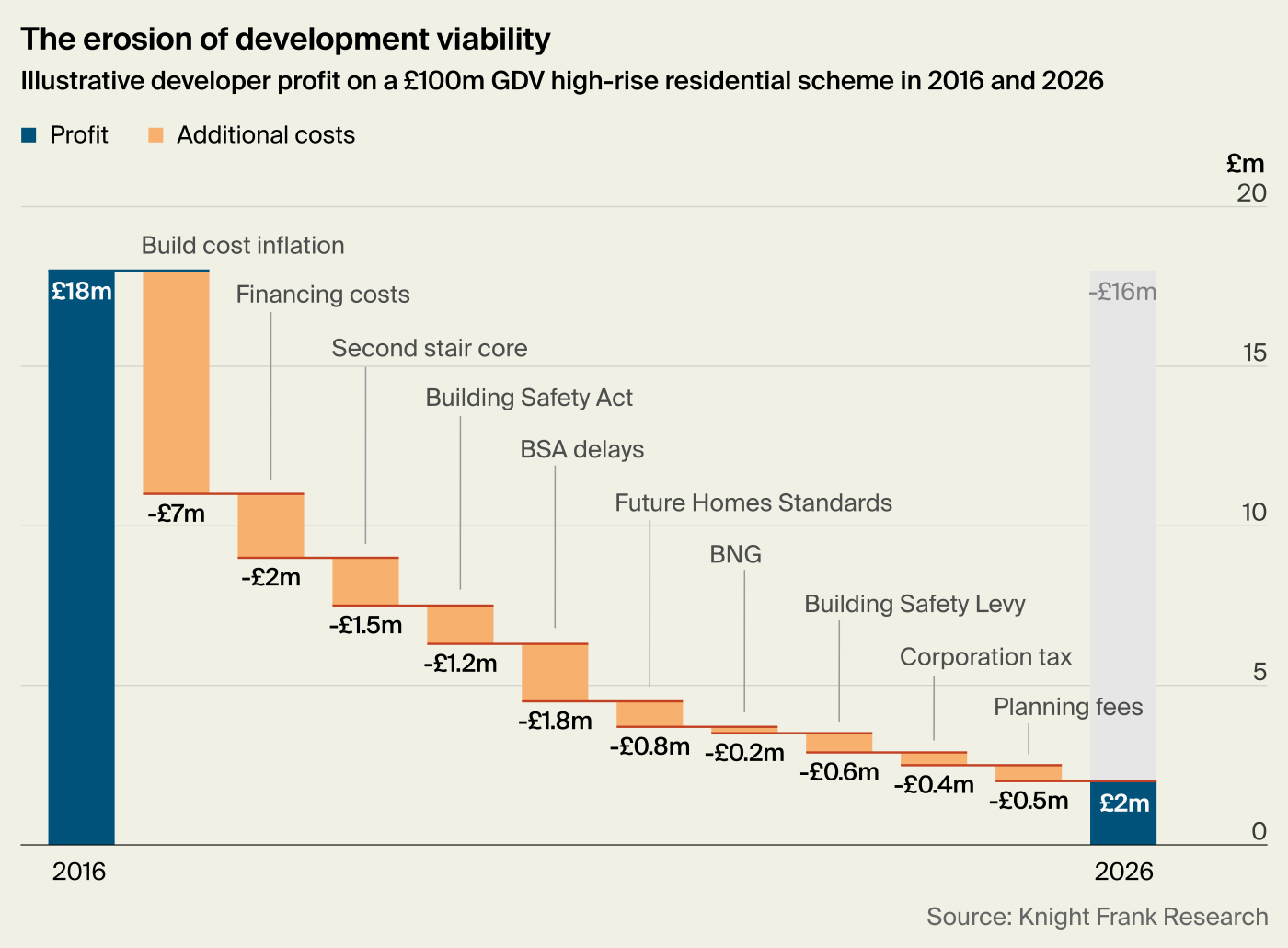
The economics of housing delivery have shifted materially over the past decade. Our illustrative appraisal shows how higher construction and development finance costs, alongside additional taxes, levies and regulatory requirements, have progressively eroded development viability. The cumulative impact leaves considerably less capacity to absorb further costs, acquire land and bring new homes forward.
Sign up to Knight Frank Research.
