

Student Accommodation Outlook: Investing through the noise
The drivers of PBSA investment are changing. In a more constrained capital markets environment, investors are placing greater emphasis on income growth, operational execution and institutional resilience.
20 October 2026
A noisy market…
The UK purpose-built student accommodation (PBSA) market looks markedly different in 2026. Headline investment volumes, pricing and the deal pipeline are sending mixed signals, which leaves investors with more noise to navigate than in recent cycles. The sector has become increasingly fragmented, with no single trend defining it.
Activity in 2026 illustrates this clearly. Second quarter investment totalled £164 million across 13 transactions, one of the lowest quarterly volumes on record and below the five-year Q2 average of 17 deals. Yet a strong first quarter took half-year volumes to £2.3 billion, keeping year-to-date activity ahead of 2025.
Provisional estimates put third quarter investment at around £485 million, which would take year-to-date volumes to approximately £2.8 billion, materially below long-term trends. The slowdown reflects friction over pricing rather than weaker demand. Buyers and sellers continue to disagree on value, which is prolonging negotiations and delaying execution.
Prime direct-let yields stand at circa 5.00% NIY in London and 5.75%-6.00% NIY in the regions. Buyers want evidence of value, so marketing periods are longer, due diligence is deeper, and deal structures are increasingly carrying more conditions. Appetite remains strongest for first-generation standing stock, particularly where there is scope for value-add returns. Even here, fire safety requirements, remediation works and a later leasing cycle continue to delay transactions.
Who's buying what?
PBSA is operationally intensive, but a mature market and a broad range of management platforms now allow institutions to enter the sector while keeping operational risk in check. Ownership of private direct-let stock remains highly concentrated, with nine investors controlling around 40% of the market. The rest is fragmented, which makes competition for scale intense.
Single-asset operational stock remains the cornerstone of investor activity, with 20 confirmed operational deals in H1 2026. Buyers want assets that perform from day one, which means plug-and-play schemes with established operations that need little intervention after acquisition are in demand.
Asset composition matters just as much – demand is concentrated on schemes with 100% Russell Group exposure, manageable sizes of 400–500 beds and mid-market product that appeals to both domestic and international students. Pricing discipline underpins this – buyers are looking for defensive entry points, often below replacement cost, and pairing them with active asset management to capture rental reversion and improve risk-adjusted returns.
Portfolio activity, by contrast, has slowed sharply from last year. Only one portfolio sale completed in the first six months of 2026, with another reportedly closing in September. A joint venture of Partners Group and Aboria Capital, have bought a five-asset portfolio from HSBC Asset Management for a gross price of £180 million. Investors still want scale across core-plus and value-add platforms – for now, though, realism about local market conditions is outweighing broader confidence about the sector fundamentals.
Land transactions and forward funding structures have recorded a slow opening six months to the year, recording eight and four deals, respectively. A tougher development landscape, including Gateway 2 approval delays, planning constraints and viability pressures, continues to weigh on development activity and capital allocation. While there are signs that the Building Safety Regulator process is becoming more predictable than immediately after implementation, regulatory timelines remain materially longer than many investors and developers had anticipated.
Construction inflation may have moderated from its peak, but build costs remain elevated relative to pre-pandemic levels. Together with higher financing costs and more extensive regulatory requirements, this continues to challenge the viability of new development in some locations. The result is a more selective development market, particularly outside the strongest university cities where rents can support higher delivery costs.
And with what capital?
Global appetite for PBSA remains deep. Investors now have a wider range of opportunities across Europe, particularly in markets where student housing remains earlier in its institutionalisation cycle and yield spreads are wider. Consequently, cross-border flows into the UK have eased from recent peaks, to 57% of capital spent on UK PBSA in 2025, below the 10 year-average of 68%.
Domestic capital has become the backbone of the market over the past 18 months, with UK investors the most active buyer group so far in 2026. Led by large-scale moves from established players including Unite Group’s agreed acquisition of Empiric Student Property, at approximately £720 million, and its joint venture with Manchester Metropolitan University, where total development costs are estimated at around £390 million.
International capital remains active, albeit selective. Knight Frank is tracking more than £1.5 billion of UK PBSA assets under offer, and much of the due diligence on these opportunities is being done by North American investors. Canadian capital is at the front of the pack. La Caisse is under offer on a portfolio operated by Vita, which would be its first acquisition in UK PBSA.
Thin margins, thin deal flow
Government bond yields are now structurally higher. As a result, the spread between UK gilts and property yields has compressed to around zero basis points (bps) and turned negative in some cases. History suggests this matters for liquidity. Leaving aside the COVID-19 shock, spread width and deal volumes in UK commercial real estate have moved closely together. In each previous episode when spreads fell below 150 bps (2007, 2022 and 2023), transaction numbers declined over the following six months.
That threshold has been breached again in 2026, and the outlook offers little relief. Fiscal concerns and softer growth are shaping monetary policy expectations, and forecasts point to the Bank of England raising rates by at least 25 bps by year-end. Higher rates could place further upwards pressure on gilt yields and erode what little spread remains. Where spreads are already negative, the inversion would deepen, adding pressure on pricing and making deals harder to execute.
Pbsa is a real asset, not a bond proxy
However, a thin headline spread overstates how much relative value has been lost. A 10-year gilt pays a fixed nominal coupon and returns par at maturity, and inflation erodes the real value of both the income and the capital. Property returns work differently: initial yield plus expected income growth, net of depreciation.
In PBSA, direct-let rents reset every academic year. Income can therefore reprice with inflation far faster than in long-leased commercial property, which gives the asset a route to capital growth that a gilt cannot offer.
Adjusted for gilt-implied inflation, the spread remains positive at around 130–165 bps through 2026, having recovered from negative territory in 2021/22. That premium only holds true where income genuinely keeps pace with inflation, which favours markets with deep demand supply imbalances.
Total returns: from capital to income
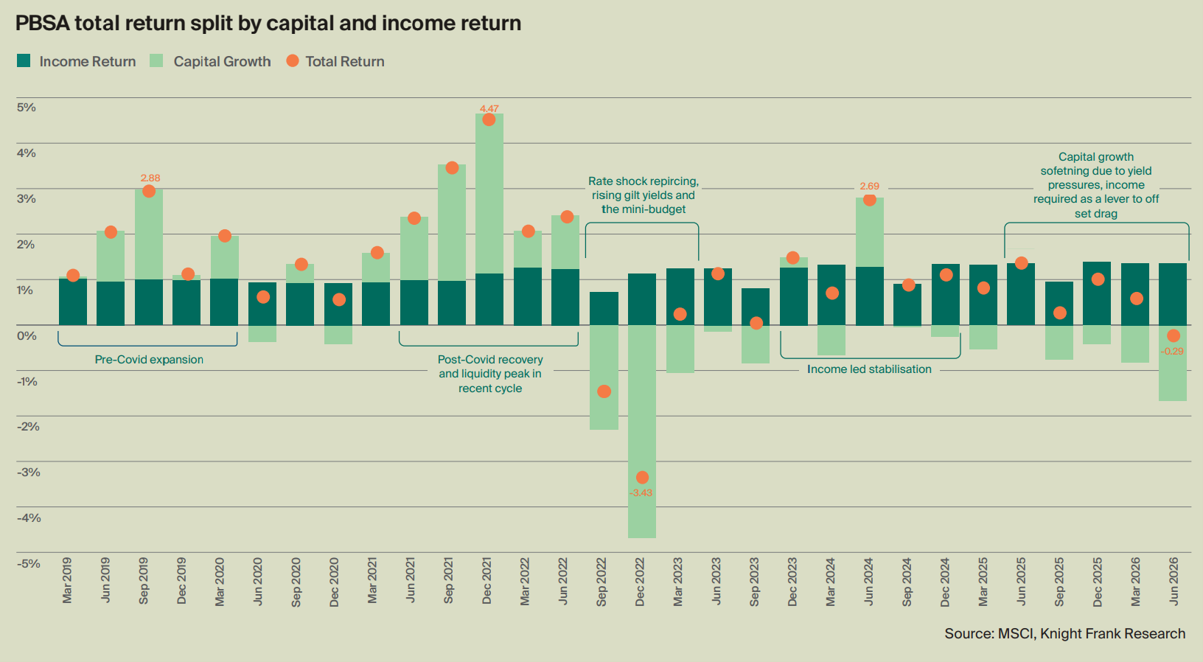
This makes the make-up of returns central to underwriting. Over the past seven years, UK PBSA has gone through a full cycle. Capital growth drove outperformance as yields compressed, a sharp repricing then reversed it, and income now accounts for most of total return. With income carrying performance, the key question is how much rent reaches the bottom line. Headline rental growth can overstate performance where operating costs are rising faster.
Underwriting should therefore focus on how resilient net operating income is, driven by cost control, net effective rent, occupancy and asset positioning. Performance will diverge as a result, and well-located, efficiently run schemes are set to pull ahead of older assets with high operating costs.
Sign up to Knight Frank Research.
