
The New Frontier - Your weekly science and innovation update – 3rd November 2026
Your weekly pulse check on science and innovation. Those on the supply side of real estate can track the trends set to drive demand, while occupiers gain fresh perspective on competitor activity and sector dynamics.
03 November 2026

Capital gains
Britain is good at producing ideas. Turning them into large businesses that remain in the UK has proved harder. The Budget’s most consequential offer to science and innovation is therefore not another research initiative, but more capital to help companies grow.
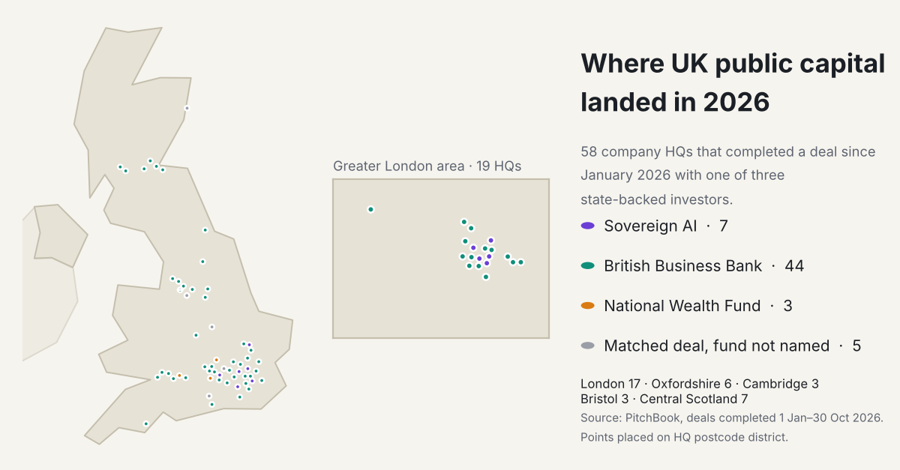
The National Wealth Fund receives an additional £15.4 billion and the British Business Bank £5 billion. The Treasury says the combined £20.4 billion will support around 140,000 jobs across advanced manufacturing, AI, defence, technology and clean energy. For start-ups approaching commercialisation and scale-ups financing expansion, the significance is practical: money for the next production line, team and, potentially, lease. For landlords and investors, the companies that receive government backing are prime occupiers.
Capital alone, however, does not create customers. An additional £120 million for the Sovereign AI Fund is split equally between direct investment, with greater emphasis on physical and industrial AI, and public-sector procurement. Robotics, healthcare and security applications offer routes from promising technology to paying contracts.
At a sector level, the Budget provided more detail, with AI, defence and life sciences among the clearest areas of focus.
For defence, the geography and funding became clearer. Closing the £4.7 billion funding gap in the Defence Investment Plan provides greater near-term certainty, even if the funding needed to meet higher spending targets remains unresolved. Over the next four years, up to £5 billion of National Wealth Fund and British Business Bank investment and lending will target defence, dual-use and national-security businesses.
For property, the prize will follow the contracts, and winning companies will need secure manufacturing, engineering, testing and R&D capacity. Increasingly, the places where this will happen are identifiable. A £400 million Army drone programme will be manufactured in South West England, with testing and training in Wales. New energetics factories are nearing completion in the South West and under construction in the Midlands. Scotland gets a Defence Growth Deal centred on Rosyth and Helensburgh, alongside two Defence Technical Excellence Colleges; Wales receives a £5 million bridging payment for its own college; and Northern Ireland a £50 million deal designed to draw SMEs into the defence supply chain. Team Plymouth gets £3 million to help young people not in work or training into the local defence industry, while Team Barrow is singled out for a “generational” investment in submarines.
The innovation infrastructure is also being loosened up. Plans for a defence-focused innovation unit, alongside measures to make drone testing easier, could shorten the route from development to deployment for defence tech firms and make the UK a more attractive place to invest.
Life sciences received a less comprehensive response to its demands, but the Budget still contained important commitments. More than £1 billion of public-private investment was announced across major projects in Manchester, Oxfordshire and Loughborough, alongside support for a wider pipeline of innovation-led schemes, including the Don Valley Corridor, the John Innes Centre and Sainsbury Laboratory in Norwich, M-SParc in Anglesey and Bristol Temple Quarter.
Cambridge also received a significant boost. The Greater Cambridge Development Corporation will be the first to pilot a new development-corporation financing model from April 2027, backed by £110 million of capital grants and £105 million of repayable finance. The funding is intended to support land acquisition and infrastructure-led development.
UKRI will pursue further university partnerships modelled on the Cambridge–Manchester approach, pointing to a wider effort to connect research strengths across established and emerging clusters.
Yet the investment comes against a much tougher backdrop for parts of the UK’s research base. The Government is attempting a difficult balancing act: investing in the infrastructure and clusters that can drive future growth while finding savings elsewhere to remain within its fiscal constraints. The risk is that cuts undermine some of the scientific capabilities on which that growth ultimately depends.
That tension is particularly evident at the Science and Technology Facilities Council, where proposals for cuts of up to 30% to parts of its Particle Physics, Astronomy and Nuclear portfolio have prompted concern across the scientific community. Prospect and leading figures in science have warned that the reductions could put hundreds of jobs at risk and weaken nationally important research capabilities and facilities.
AI received a more substantial package of support. Commitments across the Budget and the preceding security package exceed £1.3 billion, although much of the funding is directed towards institutions and capabilities rather than broad-based programmes, with a strong focus on security and resilience. This includes £100 million for a new AI Biosecurity Lab; a further £120 million for the AI Security Institute; an £18 million Advanced Chip Design Academy in Edinburgh; and a new NCSC AI cyber security centre of excellence in Manchester.
Cyber resilience is another focus. A £60 million National Cyber Shield will develop agentic AI capabilities to automate parts of the UK’s cyber defences, including a £25 million AI and Cyber Security Challenge Fund, while a new £70 million National Exposure and Real-Time Vulnerability (NERV) Centre will use AI to identify vulnerabilities across critical infrastructure and the wider economy. A further £65 million will strengthen metagenomic surveillance and support the development of medical countermeasures.
For developers, one of the most significant measures sits within the National Wealth Fund’s plans. A previously announced £700 million Strategic Sites Accelerator, delivered with the Office for Investment, will help unlock commercial and industrial sites aligned with mayoral and Industrial Strategy priorities. Alongside National Wealth Fund co-investment through mayors’ new Good Growth Funds, this should give local leaders greater capacity to turn sector ambitions into investable sites and supporting infrastructure.
The Budget also offered some support for start-ups and scale-ups but, against rising operating costs, the measures may prove insufficient to materially improve the growth environment. The industry verdict was telling: helpful, but not bold enough.
Finally, it is worth touching on devolution. The Budget strengthens the link between devolution and place-based science and innovation, giving regional leaders greater influence over where growth is concentrated and how it is funded. For real estate, the significance is the stronger connection between growth, local revenues and investment. Giving mayors a greater financial stake in economic expansion should strengthen incentives to attract employers, unlock development and invest in infrastructure. In principle, this creates a virtuous circle: growth expands the tax base, additional revenues fund investment, and that investment supports further growth and development. The test will be how much incremental revenue regions actually retain once funding baselines and redistribution arrangements are determined.
I’m continuing to experiment with Claude visualisations. Two are particularly useful for this story: the first maps where the additional public capital is landing, while the second plots every investment announcement in the Red Book. https://lnkd.in/p/ee8ywRYG
Brains for hire
League tables come in many flavours, but only one is built purely on the views of the people doing the hiring. The Global Employability University Ranking and Survey 2027, compiled by HR consultancy Emerging and published by Times Higher Education this week, asked 15,665 recruiters across 40 countries which institutions’ graduates they most want to hire. These are the universities best preparing their graduates for work.
Oxford rises from fifth to third globally, overtaking Cambridge (steady at fourth) to become the UK’s top university for employability. The pair sit behind only MIT and Stanford, and ahead of Harvard. Imperial slips from ninth to 13th and LSE holds 19th, giving the UK four of the world’s top 20, the same as last year.
The real movement is in the regions. Manchester climbs into the global top 50, Warwick jumps 29 places to 101st, Edinburgh 28 places to 114th. Durham, Bristol, Birmingham and Bath all move up, and Kingston and Newcastle enter the table for the first time. Seventeen UK institutions now make the top 300. Five are in London; the rest are spread across the country.
|
University |
UK rank |
2027 |
2026 |
Change |
|
Oxford |
1 |
3 |
5 |
+2 |
|
Cambridge |
2 |
4 |
4 |
0 |
|
Imperial College London |
3 |
13 |
9 |
-4 |
|
LSE |
4 |
19 |
19 |
0 |
|
Manchester |
5 |
50 |
56 |
+6 |
|
King’s College London |
6 |
65 |
65 |
0 |
|
UCL |
7 |
74 |
98 |
+24 |
|
Warwick |
8 |
101 |
130 |
+29 |
|
Edinburgh |
9 |
114 |
142 |
+28 |
|
St Andrews |
10 |
134 |
139 |
+5 |
|
Birmingham |
11 |
155 |
159 |
+4 |
|
Durham |
12 |
191 |
200 |
+9 |
|
Bristol |
13 |
194 |
204 |
+10 |
|
Cardiff |
14 |
197 |
193 |
-4 |
|
Bath |
15 |
219 |
227 |
+8 |
|
Kingston |
16 |
233 |
– |
New |
|
Newcastle |
17 |
290 |
– |
New |
Source: Emerging GEURS 2027; 2026 positions from THE. Loughborough (233rd in 2026) does not appear in the 2027 table.
Record biotech funding
UK biotech venture investment reached £270 million in the third quarter, up 44% on a year earlier, according to the BioIndustry Association. That takes the year-to-date total to £2.8 billion – already more than any full year since 2021. Total Q3 equity was £421 million, including £151 million of follow-on funding, most of it Silence Therapeutics’ £130 million Nasdaq raise ahead of its $1.3 billion takeover by Merck KGaA. The largest round was Basecamp Research’s £104 million Series C in London.
The caveats are familiar. Seed funding fell to just £12 million across four deals and there has been no UK biotech IPO for 17 quarters. Capital is concentrating in a handful of late-stage and AI-bio companies, mostly in the Golden Triangle.
The North rises
Northern England’s mayors have been selling the region abroad. A delegation of northern mayors went to India and came back with commitments expected to create more than 600 jobs and attract over £100 million of investment. Health Innovation Yorkshire & Humber signed a partnership with IKP Knowledge Park in Hyderabad’s Genome Valley, one of India’s leading life sciences clusters. Hexaware, a technology firm, will open an R&D centre in Leeds as part of a £25 million UK expansion that should create 240 jobs in AI, cyber security and data science. The University of Huddersfield signed a technical textiles agreement, and the University of York welcomed its first students in Mumbai. None of this will transform the region on its own, but it shows the North can attract investment on the strength of its sectors.
The bigger news came in the Budget documents. The Northern Growth Strategy argues that better transport, denser cities and stronger clusters could join up the North’s fragmented strengths into a single economy. Raising productivity in the five largest northern mayoral areas to the national average could add £40 billion a year to GVA. Better transport could bring almost one million more people within 30 minutes of city-centre jobs. A £1.7 billion City Investment Fund will target brownfield land, infrastructure costs and viability gaps. By 2029, the Integrated Settlement is expected to support 163,000 sq m of commercial floorspace and 4,000 jobs, and to improve productivity at 2,800 businesses.
The strategy also names the sectors it will back:
- Greater Manchester: life sciences, advanced materials and manufacturing, AI and cyber
- Liverpool City Region: life sciences, AI, engineering biology and quantum
- East Coast corridor: offshore wind, hydrogen, carbon capture and ports
- West Yorkshire: financial and professional services, pitched as the “Northern Square Mile”
- South Yorkshire: advanced manufacturing and defence, centred on the AMRC and the Don Valley
For real estate, the plan matters more as a place-making programme than as new money. Its effect should be to concentrate development around station districts, city-centre extensions, innovation corridors, ports and established clusters. Occupiers are offered deeper talent pools, closer links with universities, better-connected sites and more responsive local government. Investors and developers should look for places where transport spending, mayoral funding and sector demand overlap.
The caveat is the usual one. Much still depends on business cases, planning and co-investment. The ambition is now on paper, and the next task is turning it into reality.
In other news...
A few notable openings and milestones this week. Lovable opened its London office with a 70-strong team, establishing the capital as its second engineering, product and design hub after Stockholm. The Royal Marsden NHS Foundation Trust opened its new Centre for Cancer Genomics in the London Cancer District, while One North Quay, London’s first purpose-built vertical science, technology and innovation campus, topped out at 23 storeys in Canary Wharf.
Anthropic acquired Mithril Medicine in July, although the deal was not disclosed until October. The company had just one full-time employee, its founder, supported by eight paid consultants and advisers with expertise in biology, antibody engineering and research planning. It also worked with 11 external laboratories and Claude. The founder and advisers designed and oversaw the programme, while contract laboratories produced the antibodies, measured their binding, conducted cell-based assays and undertook the mouse studies. Claude helped coordinate contracts, logistics and experiments across the laboratory network. According to Anthropic, the programme progressed from an initial idea to proof of principle in mice in under 18 months.
Our US partners, Cresa, have released their Q3 Bay Area life sciences report. One of the stand-out themes is the broadening of demand beyond traditional biotech, with advanced manufacturing, physical AI and other technical occupiers increasingly competing for buildings with specialist infrastructure already in place.
Significant funding rounds to note this week include:
-
A former senior UK police officer has raised funding from VC firms including Sequoia at a valuation of almost $400 million to launch a company providing AI services for law enforcement.
-
Machenta, a frontier AI company developing a new type of foundation model for robots, has raised £30 million in seed funding. The capital will be used to scale its instant-learning model and expand the team at its new office and laboratory in King’s Cross, London. The round is reportedly the largest seed investment secured by a UK robotics company and comes less than a year after Machenta was founded.
-
London-based wealthtech firm Nevis has raised $70 million in a Series B round, bringing total funding to $110 million in the two years since its Amid rapid growth, the company will use the capital to expand agent capabilities, deepen integrations across the custodian and wealthtech ecosystem, and grow its product and go-to-market teams.
-
Easol, a London-based provider of an experience commerce platform, has raised $30 million in Series A extension funding.
-
Oxford-based First Light Fusion has won a Dstl contract for hypervelocity-impact research using its gas gun and pulsed-power testbeds, continuing its pivot towards defence and other applications beyond the energy sector. The contract underscores the growing value of dual-use technologies.
And finally, listen to our very own Head of Science and Innovation, Nicholas Blevins, talk about the evolving relationship between commercial real estate and the life sciences sector. https://inquisitiveminds.bristows.com/post/102o6v8/life-sciences-lab-notes-from-bristows-knight-frank-qa-life-sciences-sector
