

Plan for rural resilience, not just homes
Planning reform may get Britain building, but the rural economy needs support too.
06 October 2026
The government, as discussed below, has just announced further streamlining of the planning system as part of its bid to deliver 1.5 million homes by the end of this parliament. Given that approvals for new houses have dropped to 13-year lows and Labour’s spending plans depend on a sizable fiscal boost from the construction sector, its desire to get the country building again is understandable. But provided with enough support, the countryside could also contribute billions more to the nation’s economy than it does currently.
As it stands, however, rural businesses plan to cut rather than boost investment, largely due to the government’s controversial reform of the Inheritance Tax regime. With just a few weeks to go until their first budget, the new Prime Minister Andy Burnham and his Chancellor John Healey still have an opportunity to start rebuilding some bridges with the countryside. Leave it any longer, and those bridges may become impossible to repair.
Sign up to receive this newsletter and other Knight Frank research directly to your inbox
In this week's update
- Diesel supply standoff
- Grain prices dip
- CLA IHT damage warning
- NE planning role cut
- SFI feedback survey
- Scottish bluetongue zone
- Welsh peatland grants
- Farm reservoir advance
- Tree funding launched
- Chicken labelling call
- Property of the week
Commodity markets
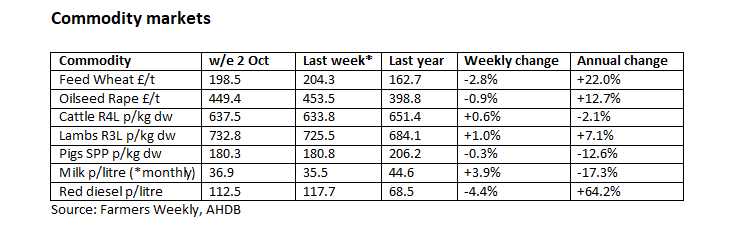
Source: Farmers Weekly, AHDB
Diesel supply standoff
Oil prices dipped slightly last week after members of the G7 group of leading global economies agreed to release 100 million barrels of their strategic diesel and crude reserves. The move came after US President Donald Trump threatened to ban the export of US diesel in a bid to cut pump prices for American consumers. Prices, however, started to rise again this week as Yemen’s Houthi rebels stepped up their attacks on Saudi Arabia.
Grain prices dip
Feed wheat prices weakened last week as the US Department of Agriculture’s quarterly grain stocks report revealed higher-than-expected US corn stocks. Rainy weather across key US growing areas also improved the prospects for the 2027 crop. Markets, however, remain on edge as exports from Russia and Ukraine remain constrained. UK arable farmers need to time any sales for their 2026 and 2027 crops incredibly carefully.
The headlines
CLA IHT damage warning
Nearly 90% of family-owned farms and estates are cutting back on investments to avoid becoming liable for Inheritance Tax (IHT), according to the results of a CLA survey of 700 rural businesses.
Survey respondents said they were cancelling the creation of holiday homes, delaying the purchase of new machinery, stopping growing crops, putting on hold the building of the reservoirs needed to cope with drought, and even allowing buildings and land to deteriorate.
Of those who say they’ve cancelled investment, more than a third have shelved projects worth over £150,000, while 64% have abandoned plans worth over £50,000.
Although the government says most family businesses will not be affected following the lifting of the IHT threshold to £2.5 million, nearly 85% of respondents said the allowance is not enough to cover the value of their business, citing the rising cost of machinery, livestock and crops.
Nearly half say they would have to sell up to a quarter of their land to cover any IHT bill, while 70% say they are worried their family business will not survive the next 10 years. Almost a third claim they are seriously considering leaving the farming industry in the next five years.
Scrapping the IHT changes is part of the NFU’s five-point list for Chancellor John Healey to consider in his imminent Autumn Budget if the government is genuine about instigating a ‘rural reset’.
NE planning role cut
The role of Natural England (NE) in the planning process is to be curtailed to speed up the delivery of new homes, the government has announced.
Instead of being consulted on every planning application, NE will focus on planning proposals that “present the greatest risks or opportunities for nature, allowing the regulator to prioritise complex and strategic cases and engage earlier in the planning process.”
Currently, the quango is legally required to assess more than 22,000 planning applications for new developments a year, regardless of their potential impact on the environment.
The government says the changes, outlined in a new operational statement, will allow NE to move away from providing repeated advice on individual cases and prioritise larger-scale work, helping to identify and resolve environmental issues early on.
Meanwhile, the Conservative Party has just revealed it will go much further by scrapping Natural England and the Environment Agency altogether if elected.
Switching the quangos’ functions to Defra is part of a planned bonfire of red tape that Shadow Chancellor Andrew Griffith reckons could cut £50,000 off the cost of building a new home.
Other proposals include ditching energy efficiency regulations, including the Future Homes and Building Standards, and implementing a single levy for developers in place of section 106 agreements and the Community Infrastructure Levy.
News in brief
SFI feedback survey
The Environment, Food, and Rural Affairs (EFRA) Select Committee, which is responsible for scrutinising Defra, wants to hear from English farmers and their advisers about their experience with the application process for this year’s Sustainable Farming Incentive (SFI). Thousands of applicants failed to secure funding after the scheme’s £233 million budget was allocated within just six hours when it opened on 22 September. The survey closes on Friday 16 October.
Scottish bluetongue zone
Livestock trading north of the border should become easier after the Bluetongue Restricted Zone that covered parts of south-west Scotland was extended to cover the whole of the country on Saturday 3 October. Movement licences to move susceptible livestock, such as cattle, sheep and other ruminants, into, within and out of the south-west Scotland zone will no longer be necessary.
Welsh peatland grants
Payments of between £10,000 and £250,000 to help fund peatland restoration in Wales are up for grabs following the opening of the 2027 round of the country’s Peatland Restoration Grant last week. Applications close on 30 November and £700,000 is available in total. Projects will need to address one or more of the National Peatland Action Programme priorities.
Farm reservoir advance
To help combat potential on-farm water shortages, Defra has announced that farmers can start filling their water storage reservoirs a month earlier than the usual 1 November start date. To protect the environment, however, the change does not apply to river catchments that are classed as principal salmon rivers to help fish stocks recover or those where Section 57 restrictions are in place.
Tree funding launched
Farm clusters will be able to apply to Defra’s new £53 million Community Trees Fund that aims to plant up to 500,000 new trees outside woodlands, including on streets, in parks and across rural landscapes. A further £26 million will be available for mayors and local authorities to help deliver Local Nature Recovery Strategies.
Chicken labelling call
A new report from the RSPCA is calling for mandatory labelling of meat from fast-growing chicken varieties. From concern to choice: Growing the demand for higher-welfare chicken says the majority of the one billion broiler chickens reared in the UK each year take just 35 days to reach their target slaughter weight of 2.2kg. The charity claims this causes significant welfare issues for the birds.
Property of the week
Herefordshire haven

A 266-acre property with “some of the finest views in England” has just been launched. The Poston Court Estate, near Vowchurch, in west Herefordshire, overlooks the Golden Valley, the Black Mountains and the Forest of Dean. In addition to the main Grade II listed house, a lodge and cottage provide further accommodation. Set within formal walled gardens, an orangery and summer house pavilion offer numerous leisure and entertaining opportunities. The entire estate is guided at £7 million, with the land lotted separately at £2 million. Please contact Will Matthews for more information.
Discover more of the farms and estates on the market with Knight Frank
