
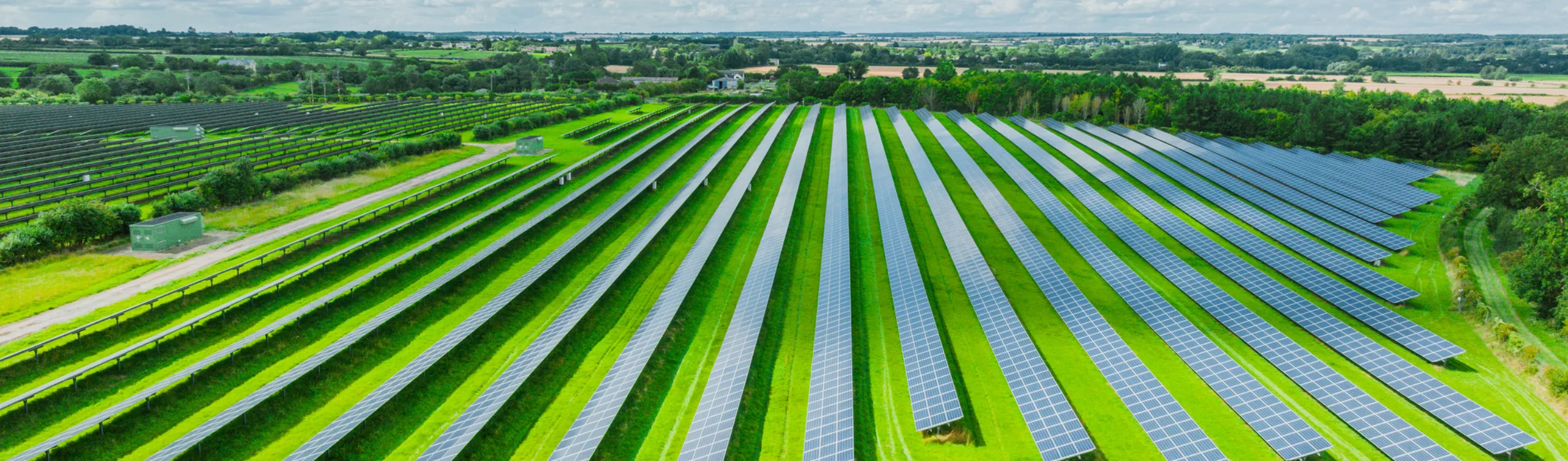
The UK Government’s Clean Energy Superpower Mission
After the buzz of London Climate Action Week (LCAW), I dissect the interplay of real estate and the government's stated ambitions through its Modern Industrial Strategy, Spending Review and Infrastructure Plan as well as look at resilience of real estate.
03 July 2025

A Clean Energy Superpower Mission
The government has drawn a line in the sand with its ambition to make the UK a Clean Energy Superpower. That’s the main takeaway from the synthesis of the UK’s Modern Industrial Strategy, its 10-Year Infrastructure Strategy, and the Clean Power 30 Action Plan. All feature ambitious deployment targets, accelerated grid and planning reforms, and a focus on supply chain resilience and skills. This is particularly relevant as the UK recently lost top spot to France as the leading European destination for foreign direct investment in utilities and energy supply, and as China leapt ahead by installing more solar capacity in May 2025 than any other country did in the entirety of 2024.
For real estate investors, developers, occupiers, and owners, the message is clear: align with these policy priorities and act early to unlock value in a rapidly evolving market. “Electrification will be the primary route to decarbonisation, with electricity demand expected to at least double by 2050.” A growing need for cleaner electricity and increased supply is creating numerous opportunities. A full takeaway document is available here for sustainability and here for all aspects of real estate with key pieces below.
For renewable developers, operators and investors, key messages include:
Grow the renewable energy sector. The government aims to remove barriers and enhance long-term planning. Clear quotas by zone and technology, along with reforms to the connections process and planning will help bring more projects to the ‘ready to connect’ stage. Investment Zones and Clean Energy Clusters, will provide tax incentives and are expected to increase demand. Long-term opportunities will also arise from the Strategic Spatial Energy Plan due in 2026, the Centralised Strategic Network Plan for transmission due in 2027, and Regional Energy Strategic Plans expected late 2027.
Build renewable supply chains. The £1 billion Clean Energy Supply Chain Fund, along with Ofgem’s Advanced Procurement Mechanism, aims to secure early supplier capacity and reduce reliance on imports. Developing UK-based suppliers could enhance the ability to procure essential equipment, mitigating supply chain risks of delays and cost overruns. This will likely foster demand-pull innovation, with increased demand and deployment supported by supply chain development and cost-reducing innovations which will, in-turn, spur more advancements and economies of scale.
And providing clarity over pricing. The government has confirmed legacy arrangements for projects in the next Contract for Difference (CfD) auction round, even with the introduction of zonal pricing. The Electricity Market Reforms (REMA) will be confirmed in due course, which may be more long-term pricing indications. In addition they state an aim to develop the Corporate Power Purchase Agreements (CPPAs) market (more on this here), which can offer longer-term price stability and revenue.
For physical real estate owners, investors and developers:
Electric and efficient assets. The government’s decarbonisation goals emphasise that electrifying real estate and transportation is essential. As electricity demand increases, improving energy efficiency and providing charging infrastructure becomes ever more important. This includes supporting the rollout of heat pumps in both domestic and non-domestic properties, as well as more digitalisation and the implementation of smart technologies to ensure efficient building operations. The Clean Flexibility Roadmap is set to be published later this year on the government's ambitions here. Developers and owners must incorporate these considerations into their plans when retrofit existing assets, which, as indicated by our ESG Property Investor Survey, is a strategy of three-quarters of property investors.
Supporting transportation. The reinforced focus on the Zero Emission Vehicle mandate and building capacity for supply chains and autonomous vehicles will accelerate the need for vehicle charging facilities at homes, workplaces, and leisure facilities, as well as on transport nodes. EV adoption in the UK is the fastest in Europe, and on the rise particularly among corporate fleets, presenting opportunities for asset owners to implement a charging strategy, especially on busy transport routes.
Spaces needed to support the growing clean energy industry. As supply chains for clean energy, heat pumps, and electric vehicles expand, opportunities will arise for owners of industrial and logistics assets. The demand for flexible, modern industrial and logistics space will increase, particularly in Investment Zones, Clean Energy Clusters, and the North East Combined Authority Electric Vehicles manufacturing cluster. We discuss in more depth ‘clean tech’ real estate requirements, which include many of these sectors, in the Quantifying Technology in Real Estate 2025.
And enabling energy availability for development. Timely grid connections for new homes and businesses are essential for economic growth. Plans to double annual grid demand connections from 2.1GW to 3.5GW by 2035 could significantly enable development. The new ‘Connections Accelerator Service’ and streamlined planning processes aim to reduce delays and prioritise high-value projects, potentially impacting data centers and other infrastructure projects. A new spatial tool, due in July, will highlight indicative water and electricity headroom by region, facilitating site identification for development. Previously, we identified 15,000 homes being held up by power shortages.
For real estate occupiers:
Competitive energy costs. Ensuring that energy costs remain competitive on a global stage is crucial for supporting the electrification process. The introduction of the British Industrial Competitiveness Scheme aims to reduce electricity costs by approximately £35-40 per megawatt-hour (MWh) until 2030 for 7,000 electricity-intensive businesses. The British Industry Supercharger package will increase the Network Charging Compensation scheme from 60% to 90% starting in 2026, assisting about 500 businesses. The potential REMA could alter electricity pricing mechanisms, while the development of the CPPA market may provide more options for procuring renewable energy directly from generators, contributing to new projects and limiting energy cost variability.
Occupiers may look to benefit from clustering effects within relevant industries, which could potentially influence location decisions. In addition, they may expect electric and efficient real estate as a minimum specification.
The direction of travel is clear for a path to net zero with the built environment and energy infrastructure playing a pivotal role. Next week, I will look more at the benefits of action, or costs of inaction for resilience, and how AI may be a benefit for climate.
What else I am reading
The CPPA market is already growing, as discussed here. Now Transport for London has announced a 15-year agreement to power the underground network with some 20% of EDF’s new 400 MW solar farm being supplied. Around half of corporate occupiers in Hong Kong would pay a premium, with the majority stating a willingness to pay up to 10% more for ESG-compliant buildings. Access to public transport and energy, water and waste reduction systems were flagged as their top priorities, and biodiversity net gain skewing incentives.
Sign up to Knight Frank Research.
