
Meeting the Commercial Property Retrofit Challenge
September very much has a ‘back to school’ feel and with that we're excited to introduce the first instalment of our new research series, Meeting the Commercial Property Retrofit Challenge. In this series, we explore the critical questions and market-level evidence necessary for developing a robust decarbonisation and future-proofing strategy. This month, we also examine European locations' environmental credentials and what prime residential property buyers are prioritising.
05 September 2024

Buzzword or a sticky trap?
Obsolescence is a growing concern in the real estate industry, affecting assets, investments, and portfolios. While the concept isn’t new, the pace of potential obsolescence is accelerating due to evolving regulatory, physical, financial, and functional sustainability risks. Today, we launch the first part of our three-part series - Meeting the Commercial Property Retrofit Challenge: Part 1: Defining a Strategy- to unpick some of those risks.
Regulatory risks are particularly pressing, with 70% of commercial property floor space currently rated EPC C or below, potentially becoming unlettable if proposed minimum standards are enacted in the UK. Understanding local market dynamics will help in timing asset plans and identifying focus areas. Getting ahead of regulation could provide a first-mover advantage, especially in markets with demand-supply imbalances. For example, in Leeds, 65% of office take-up is for EPC A or B-rated properties, yet only a third of the overall market office stock meets this standard.
Not all solutions to meet regulatory risks require heavy capital expenditure or vacant possession. We analysed 3,000 instances of EPC improvements and found that while four interventions are typically needed, many properties achieved EPC B-rating by installing LED lighting with smart controls as one of these interventions, while only 36% replaced gas boilers with air-source heat pumps.
But is achieving an EPC B rating enough? The 'Paris Proof' energy use intensity target is 55 kWh/m², significantly lower than the average EPC B office consumption of 184 kWh/m² and the overall office average of 280 kWh/m². To meet the UK's net-zero pledge by 2050, a greater focus on actual energy use and metrics beyond EPCs is crucial. Our report explores these metrics, along with the potential impacts on value, liquidity, renewable energy, and embodied carbon.
This isn’t just a UK phenomenon. A Bloomberg article last week highlighted the move from investors to green buildings around the world, with an ex-Managing Director at Goldman Sachs betting his career on it. The trend is enduring and only likely to grow. The article mentions that despite some anti-ESG rhetoric, “investors in the US are actually showing more willingness to allocate capital to greening buildings than their counterparts in Europe.”
Planning for the future occupier requirements is critical
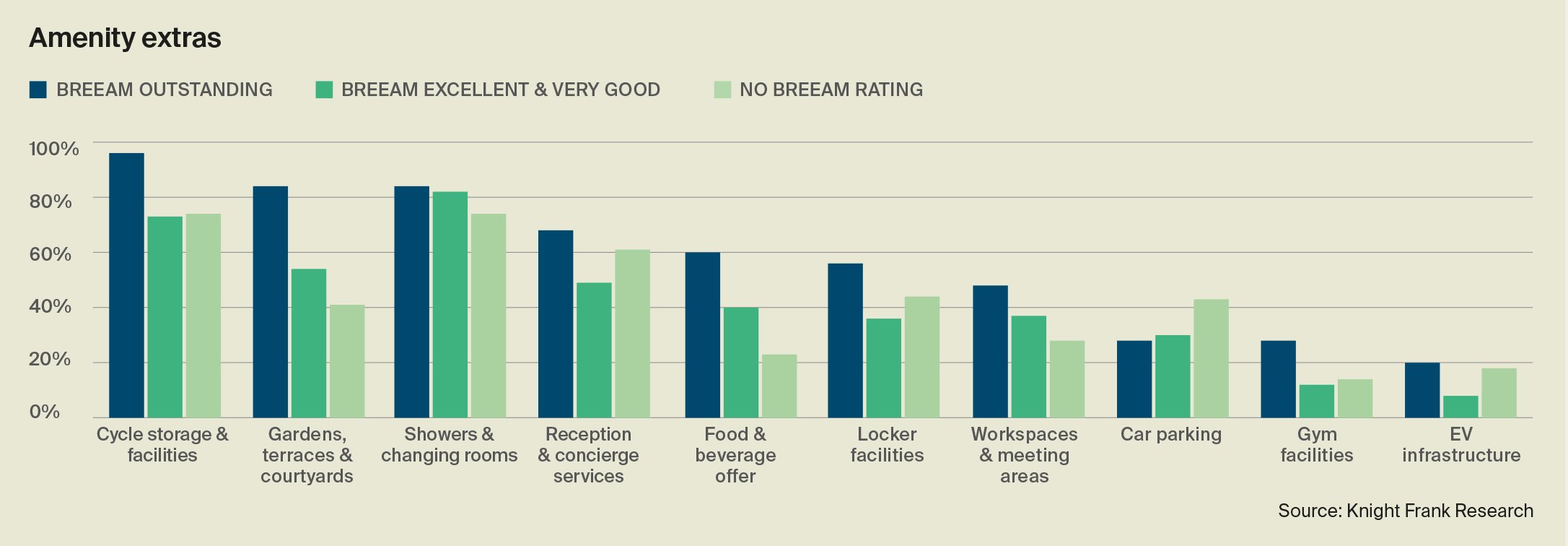
Future demand must drive any asset strategy, and not all occupiers have the same sustainability expectations. Our analysis reveals that office occupiers with strong ESG commitments typically require four key amenities: food and beverage options, mental well-being facilities, gym facilities and cycle storage facilities.
However, is the market delivering what occupiers want? Our deep dive into 400 retrofit offices shows that 37% have a food & beverage offering, rising to 60% of those achieving a BREEAM Outstanding certification. The top three amenities delivered are end-of-trip facilities (such as showers & changing rooms), found in 80% and reception and concierge services, found in just over half. In the highest-rated retrofits, outdoor amenities like gardens, terraces, and courtyards are more prevalent – found in 84% of those achieving BREEAM Outstanding. London retrofits tend to offer more amenities but with a different focus—discover more in our full report.
European environmental credentials for prime buyers
Our European Lifestyle Report, launched yesterday by Kate Everett-Allen, assesses 10 cities and 10 resort locations across Europe on five key metrics: Economy, Human Capital, Quality of Life, Environment, and Infrastructure & Mobility. For environmental credentials, covering air quality, climate risks, and cleanliness, Stockholm leads, followed by Dublin.
But it’s not just the wider locations' environmental criteria that will attract prime residential buyers. “While luxury buyers have been slow to adopt energy-efficient homes and sustainable materials, interest in green technologies is increasing”, notes Mark Harvey, Head of International Residential Sales. “Innovations like air quality systems, living walls, solar-powered pool heaters, and smart home automation are becoming increasingly popular”, he mentions in the report.
18% - Nicola Ryan’s Stat of the Month
Historical buildings present a particular issue for retrofitting due to their age, architectural significance, and legal protections. With nearly 18% of commercial buildings in major UK cities dating back to before 1940, these buildings often fall short in energy efficiency. The delicate balance between preserving cultural heritage and meeting future sustainability standards is critical as we work towards the UK's net-zero goal – we explore this in more depth in our latest blog.
What else I am reading
A new report by the Sustainable Development Foundation on how retrofit could, and should, be rolled out across 28 million UK homes, National Planning Policy Framework consultation includes measures for solar and wind deployment, The Times explore Labour’s renewable energy plans and financial strategies targeting biodiversity are about 10 to 15 years behind those cutting greenhouse-gas emissions according to an early player in the market.
Sign up to Knight Frank Research.
