
Real estate at a crossroads: the pressures and possibilities shaping the future workplace
How do we make real estate decisions today that stand up to a world changing faster than buildings can? The (Y)OUR SPACE 2025 panellists discuss.
04 December 2025
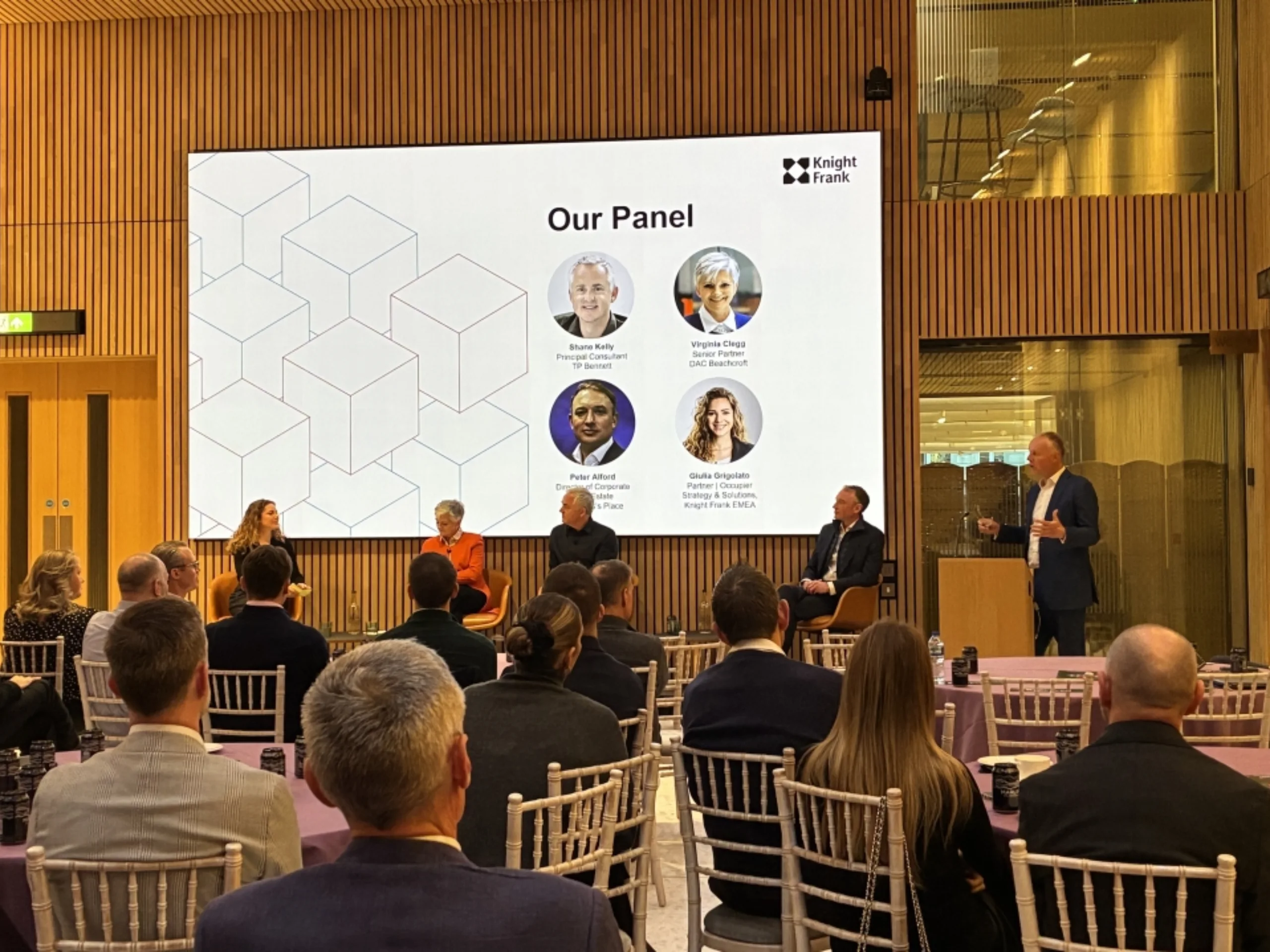
At our recent (Y)OUR SPACE 2025 event, a panel of experts from across law, financial services, workplace strategy and architecture explored the question: How do we make real estate decisions today that stand up to a world changing faster than buildings can?
Across a lively 30-minute conversation, they unpacked the tensions between business volatility and real-estate inflexibility, the shifting purpose of the workplace, and why data, culture, and design thinking all need to evolve in tandem.
Volatility vs. inflexibility
Opening the discussion, Virginia Clegg (Senior Partner, DAC Beechcroft) reflected on what resonated most from the keynote: volatility. Organisations are transforming at speed - driven by economic pressure, technology, AI and workforce shifts - but real estate continues to move at a slower pace.
This challenge was echoed by Shane Kelly (Principal Consultant, TP Bennett), who sees first-hand how strategy cycles have been compressed. Real estate decisions that once took years are now made in weeks - yet carry implications that last a decade or more. For him, the key message is continuity: workplace strategy can’t only surface when a lease event appears. It must be a continual business conversation.
Is real estate a cost or an enabler?
Turning to business transformation, Peter Alford (Director of Corporate Real Estate, St James’s Place) stressed that real estate’s value depends on sector, model, and mindset. Different sectors have different needs; in some industries - hotels, logistics - property is the business. For professional services, there’s more flexibility than other sectors.
For Peter, the real question is whether leaders see offices as a strategic asset: a space for brand expression, performance, learning, and culture. Virginia agreed, adding that organisations should ask: What does our real estate say about us? If it isn’t supporting strategy, talent and reputation, speaking to both clients and colleagues, then something is misaligned.
Shane highlighted a post-pandemic truth: the flight to quality is real, aspiration has never been higher. Occupiers want quality, identity and performance - not gimmicks. And critically, the workspace itself (not just the amenities) is now expected to deliver that.
Scenario planning matters more than ever
The panel agreed that making decisions today with 2030 in mind is harder than ever. Organisations are caught between reacting to imminent lease events and planning for a longer-term ESG, workforce and technology trajectory.
Peter described SJP’s dual workstreams: reactive (12–18 months) and proactive (towards 2030). Shane added that most future-looking decisions now stretch far beyond move-in day - the design must support 10–15 years of evolution.
Giulia Grigolato (Partner, Occupier Strategy & Solutions, Knight Frank) highlighted the structural issue: real estate operates on multi-year cycles, while technology, workforce shifts, and geopolitical changes reshape businesses quarterly – real estate is always catching up. Even with tools, scenarios and analytics, she said: “all we can do today is de-risk decisions and make them as resilient as possible for the future.”
The workplace is evolving, but hasn’t caught up
When asked whether their own workplaces had adapted, Peter was candid: not yet. With 21 offices around the UK - some new, some still to be updated - aligning hybrid work with inflexible layouts remains a work in progress.
For him, flexible work needs flexible space. Fixed attendance models suit more traditional layouts; hybrid requires settings for collaboration, quiet work, privacy and flow.
Virginia highlighted a nuance often missed in “collaboration-first” narratives: people come to the office for many reasons - focus, learning, routine, structure, environment. Responding to this is complicated and means understanding what colleagues need and why. At DAC Beechcroft, demand for quiet rooms is rising, as is the need for better spaces for virtual collaboration.
Giulia highlighted an interesting learning from a legal client: open-plan layouts can unintentionally undermine mentorship. When senior partners lose private offices, junior lawyers often feel less confident approaching them - impacting learning and development - and serving as a reminder of the power of real estate to shape culture.
Data is essential, but it must go beyond monitoring
On data, all panellists agreed: it’s essential and influential, but not the whole story.
Peter uses footfall, utilisation and condition data to drive decisions about closures, investment and design. Virginia noted that data often helps reassure stakeholders ahead of change - particularly around desk ratios - but isn’t the sole decision tool and must be paired with professional judgement and aligned with the business strategy.
Giulia argued that most organisations still use data for auditing, not design insight. They measure attendance, but not why certain spaces succeed or fail. She encouraged a shift towards evidence-based design, not trend-based design.
Shane emphasised the importance of combining quantitative data with qualitative insight: “You have to talk to people. The only way to know why one corner of the office works and another doesn’t is through engagement.”
Planning for the peak or designing for the average?
Peter sees no commercial justification for planning around peak days, preferring to take the approach of designing for a consistent weekly average and use management, not excess floorspace, to spread attendance patterns.
Shane noted that pre-pandemic, even “full” offices only ever reached around 80% occupancy; the myth of the 100% peak never reflected reality. The key is mindset: moving away from seeing the desk as the primary unit of work.
For him, pilots are essential. Done well, they reduce fear, build confidence and reveal what truly works before committing to large-scale change.
A future defined by agility and intent
The panel agreed that real estate can no longer sit on the periphery of business strategy. Success will come from organisations that:
- Understand their people deeply
- Embrace flexibility and scenario planning
- Use data meaningfully, not mechanically
- Commit to ongoing dialogue - not one-off projects
- See real estate as a long-term strategic asset
As the session closed, one conclusion was clear: there is no single “golden formula.”
But there is a shared direction - towards spaces that perform, adapt and support people better than ever before.
To read the latest (Y)OUR SPACE 2025 report, click here
