

Investors spent some £679 million acquiring or funding BTR assets in the first quarter of 2026
UK BTR market update Q1 2026
05 May 2026

Muted start to the year for investment
Just shy of £700 million was invested in the UK BTR market in the first three months of 2026 across 12 transactions, marking the slowest Q1 since 2018. The softer start to the year follows a bumper end to 2025. But with several large transactions currently under offer or progressing through legals, we expect to see a stronger Q2. That said, the wider economic backdrop remains sensitive. Geopolitical volatility rippling out from the war in the Middle East has resulted in a spike in UK gilt yields to reflect expectations that central banks may keep monetary policy tighter for longer. Oxford Economics now predicts that UK CPI inflation will top 4% in the second half of 2026 before cooling in 2027. There is a degree of caution from some investors as a result.
Operational stock leads
Activity in Q1 was driven primarily by investors acquiring operational stock, which accounted for 61% of total investment. Pension Insurance Corporation’s purchase of Ebb & Flow in Reading from Lincoln MGT for over £200 million was the standout deal, representing the largest acquisition of an operational asset outside of central London on record. Other notable transactions to complete over the course of the quarter included Sterling Place in Ealing and 219 Baker Street in central London, with Knight Frank acting for the buyer. Both deals contributed to the capital recording its highest quarterly investment spend in two years in Q1. Following a record-breaking year in 2025 with £2.6 billion invested, single family housing (SFH) investment was more muted in the first quarter. In total, seven deals completed with a combined value of just under £200 million and an average lot size of £28 million.
SFH bucks the development trend
The UK’s BTR stock now stands at 165,790 completed homes, up 27% nationally compared to Q1 2025. There are a further 50,690 homes under construction as well as 126,565 homes in the planning pipeline. Converting these permissions into new starts remains a challenge, particularly given the headwinds facing urban high- rise development which have weighed on delivery of all tenures. Consequently, the number of units under construction fell by 10% between Q1 2025 and Q1 2026. SFH development continues to buck the trend, with 9% more houses for rent under construction at the end of the first quarter than in Q1 2025.
Completions set to fall
We expect just over 24,000 new BTR homes will complete in 2026 based on estimated completion dates for schemes currently under construction, of this 15,000 are multifamily units and around 1,000 co-living. Overall, this would represent a slight drop on last year’s delivery figure. However, a large proportion of these schemes will have been funded in a less challenging development environment through 2023 and 2024. Longer-term the drop in new BTR starts means delivery is expected to reduce further to the end of the decade.
Supply up but down
The number of homes listed for rent across the UK was 4% higher in March than a year previous which – combined with a drop in migration and a return to more normal levels of tenant demand – has contributed to a moderation in rental growth. However, despite the short-term pick-up in listings, available supply has fallen by nearly 25% compared with pre-pandemic averages. This means scarcity remains, which will see rents continuing to rise over 2026. That is supported by the fact that demand has been relatively robust. According to the RICS monthly survey of surveyors, a net balance of +10% reported a pick-up in tenant demand in March. In terms of rental price expectations, a net balance of +29% expect rents to rise over the near term, up from +20% in the February survey. The changing macro-economic backdrop means that we expect rental demand will strengthen further as we head into the traditionally busier spring/summer lettings period as affordability pressures grow in the sales market. The best five-year fixed-rate deals currently exceed 4.8%, which is more than a percentage point higher than in March. The net result is likely to be a fall in first-time buyer activity.
Renters Rights, rewritten – what does it mean for BTR?
By Yetunde Dania
Partner, Trowers & Hamlins LLP YDania@trowers.com
The Renters’ Rights Act 2025 (the Act) represents the most significant overhaul of the private rented sector in a generation. While much of the political debate has focused on the impact on individual private landlords, the BTR sector faces its own set of distinct challenges and opportunities. For operators, the Act requires careful operational and strategic recalibration.
BTR operators who already operate to high management standards, invest in the provision of high-quality resident services, and maintain transparent rent-setting processes are well placed to absorb the reforms with limited disruption. But, with the secondary legislation now published and coming into force on 1st May 2026, the picture is finally clear and some of the issues for consideration are as follows:
1. The end of fixed-term tenancies
What?
Perhaps the most fundamental change brought about by the Act is the abolition of assured shorthold tenancies and fixed-term assured tenancies.
So what?
All residential tenancies will become periodic tenancies from the outset, meaning that tenants can no longer be locked into a fixed term and, crucially, cannot be removed by a simple Section 21 “no-fault” eviction notice.
Now what?
This is a significant structural shift in favour of the rights of tenants. BTR operators have historically relied on fixed-term tenancies, typically of six or twelve months in duration, as a tool for managing occupancy, planning lease expiries, and maintaining rental income streams. The move to periodic tenancies removes that certainty as a tenant will be able to give two months’ notice to leave at any point. Equally, landlords can no longer rely on simply the tenancy expiring as a mechanism for regaining possession.
2. The abolition of Section 21
What?
Landlords must provide valid reasons – via an updated Section 8 process – to regain possession, such as rent arrears or intent to sell.
So what?
The inability to recover possession without establishing a statutory ground will require a more robust and evidence-based approach to tenancy management. The likelihood of court proceedings in the majority of cases will result in increased costs to the landlord and a delay in the reletting of properties. This represents a significant constraint on landlord flexibility.
Now what?
BTR operators will need to invest in stronger tenancy management processes, ensuring that rent arrears and other tenancy breaches are properly documented, and any possession action is founded on solid grounds from the outset otherwise they are at risk of facing a fine of up to £7,000. The reputational stakes for institutional landlords are also higher: court proceedings for possession attract increased scrutiny in a way that the Section 21 possession route never did.
3. Mandatory grounds for possession
What?
The Act introduces a revised suite of mandatory and discretionary grounds for possession under Schedule 2 of the Housing Act 1988 (as amended).
So what?
For BTR landlords, several grounds are particularly relevant: Ground 1, where the landlord or a family member wishes to move in and Ground 1A which permits landlord to recover possession where they wish to sell the property, both useful grounds but they come with restrictions. Importantly, these grounds cannot be used within the first twelve months of a tenancy, which provides tenants with a period of security from the outset.
Now what?
For BTR schemes, the inability to use Ground 1 or Ground 1A is largely academic, as institutional landlords are unlikely to be moving into their own units, or selling individual flats within a block. The practical concern lies in the discretionary grounds, where the court retains the power to refuse possession even where the ground is technically established. Managing arrears through the courts will require patience, resource, and well-maintained records.
4. Rent increases and the tribunal
What?
The Act introduces new restrictions on rent increases, limiting landlords
to one increase per year and requiring a minimum two months’ notice (previously one months’ notice) to be given to tenants.
So what?
Where a tenant disputes a proposed rent increase, they may refer the matter to the First-tier Tribunal which will assess whether the proposed rent is at or below the market rate.
Now what?
For BTR operators, whose business models are built around rental income growth, this is a change which cannot be ignored. The tribunal mechanism introduces uncertainty and potential delay into rent review processes.
Operators will need to ensure that their proposed increases are well-evidenced and benchmarked against comparable market rents to withstand scrutiny, and they should factor potential tribunal timelines into their financial modelling.
The above is not an exhaustive list. For further details, or if you have any questions, contact Trowers & Hamlins for more information.
Research
We like questions, if you've got one about our research, or would like some property advice, we would love to hear from you.



BTR

Valuation, Capital Advisory and Planning



Recent Living Sectors Research

Prime residential
The Residence Report
The global perspective on luxury residential development
08 September 2025

Towards a New London Plan
16 July 2025
Build-to-rent and Multifamily
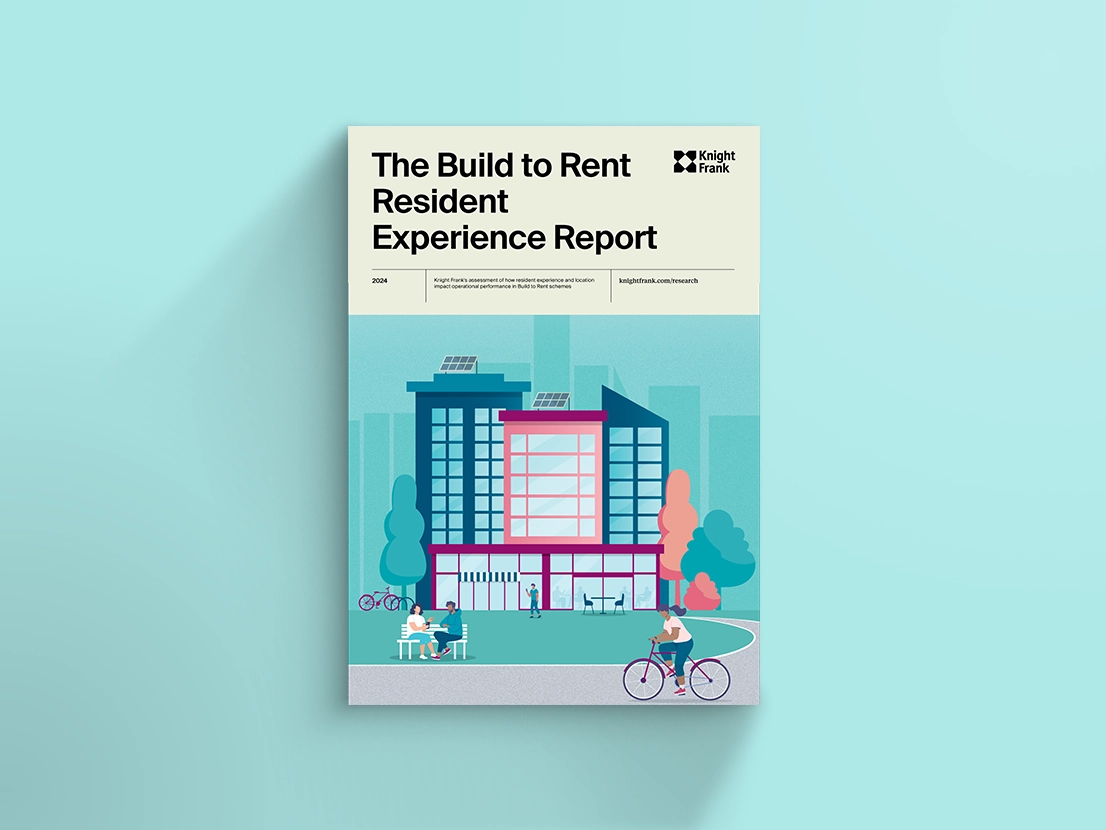
Build to Rent Resident Experience Index
Our Build to Rent Resident Experience Index measures the lived-experience for residents in BTR schemes, and identifies what “best-in-class” looks like.
11 September 2024

Land & Development
Co-Living Report
Our Co-Living report outlines the opportunity for funders and developers to capitalise on the solid near-term and projected long-term demographic trends underpinning the rapid growth of the sector, as well as providing a detailed analysis of the development pipeline.
03 July 2024

Land & Development
Affordable Housing Report
In this report, we assess the state of the UK affordable housing sector. A slowdown in housing delivery comes against the backdrop of a long-term need for more housing of all tenures, but particularly for affordable housing.
20 June 2024
Land & Development
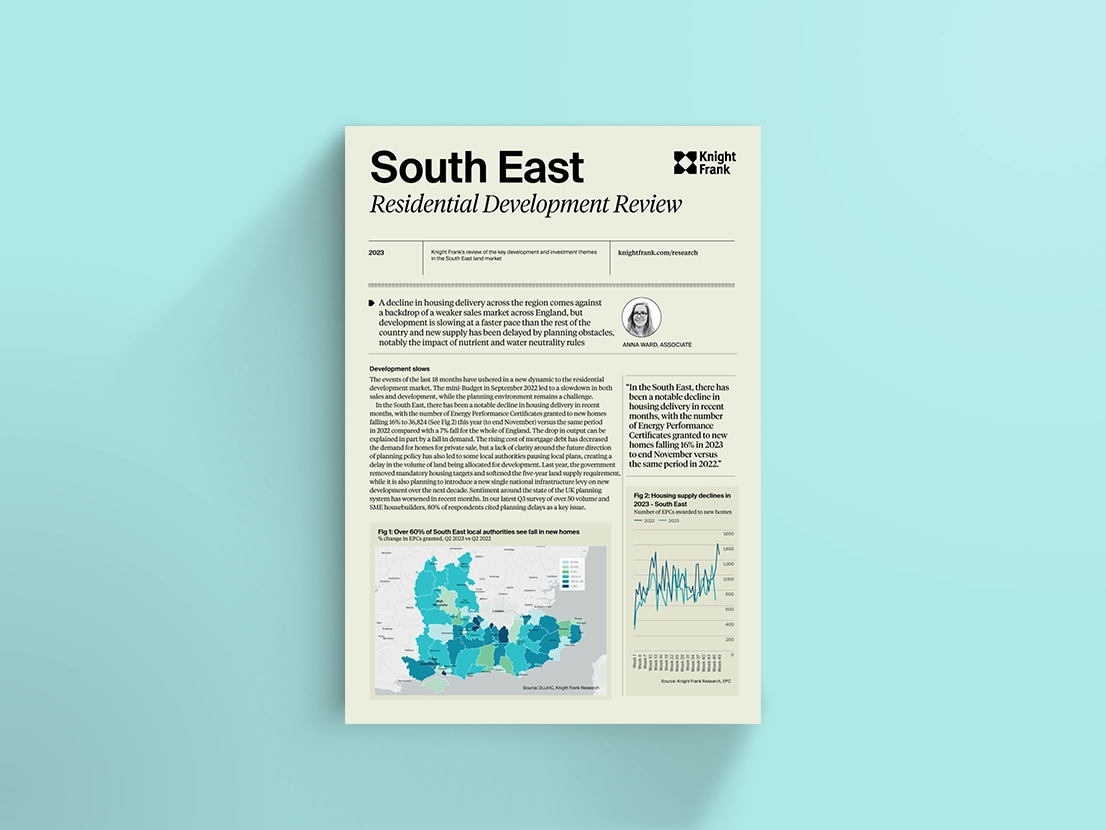
South East Residential Development Review
Knight Frank's review of the key development and investment themes in the South East land market
29 November 2023

Land & Development
Focus on: Hammersmith & Fulham
This report provides a detailed analysis of the residential market in Hammersmith & Fulham. The report examines market dynamics, demand and the development pipeline.
27 June 2023
Sign up to Knight Frank Research.
