
Lisbon's maturing market
Lisbon has evolved from a primarily investment driven market to one where lifestyle is now the dominant draw, attracting a broader mix of relocators and second home buyers.
13 April 2026
Foreign investors put €3.9 billion into Portuguese real estate in 2025 according to the Bank of Portugal, up 10% on the year and a new high, consolidating property’s rise as the largest share of inbound capital.
Greater Lisbon captured the bulk of foreign direct investment, supported by a population that has climbed to roughly 575,000 and a development pipeline that is gradually being pushed to the outskirts where land supply and affordability are stronger.
Price performance
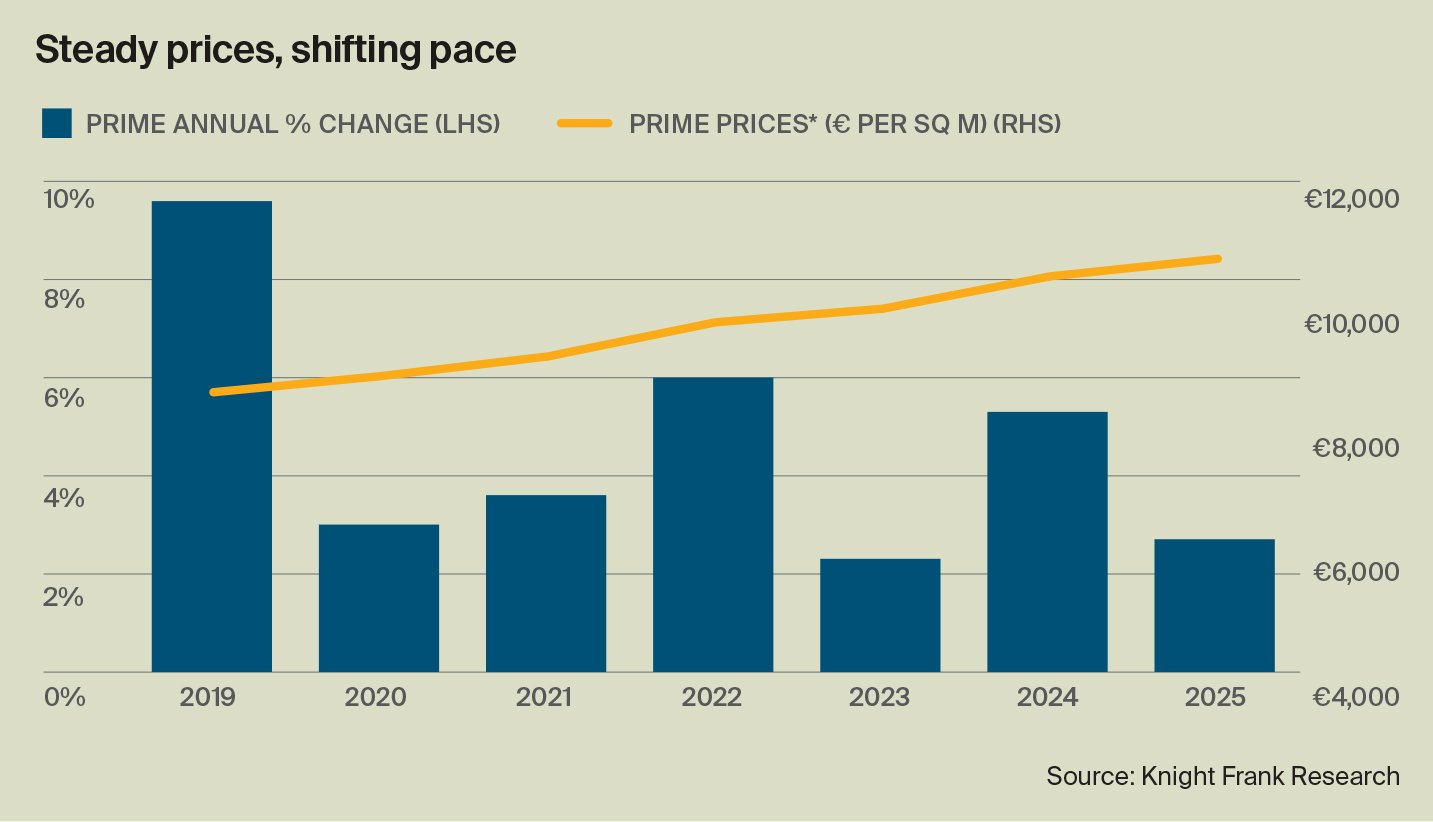
Prime prices rose 2.7% in 2025, slower than pre‑pandemic highs of 10% per annum, creating a potential entry window. Supply remains tight with only around 2,000 new homes delivered in 2025.
Easier mortgage conditions, helped by eight ECB rate cuts in the latest easing cycle, have injected some liquidity into the market with 9,613 transactions recorded in 2025, up 12% year‑on‑year. Plus, strong demand from expats, and strong rental demand from expats, and digital nomads continues to support investor appetite.
Policy landscape
Lisbon’s appeal strengthened after Portugal’s 2011 bailout, when confidence returned and international buyers helped revive the market through incentives such as the Golden Visa and the original Non‑Habitual Residents (NHR) tax regime.
Both schemes have since tightened – the Golden Visa property route ended in 2023 and NHR 2.0 narrowed eligibility in 2024 – but mobile households remain drawn to Portugal’s stability, growing tech ecosystem and lifestyle advantages.
Visa channels, including the D2 and D7, continue to pull new entrants. By October 2025, Portugal’s Agency for Integration, Migration and Asylum (AIMA) had issued more than 386,000 residence permits, highlighting sustained foreign interest despite ongoing administrative reforms.
Who’s buying?
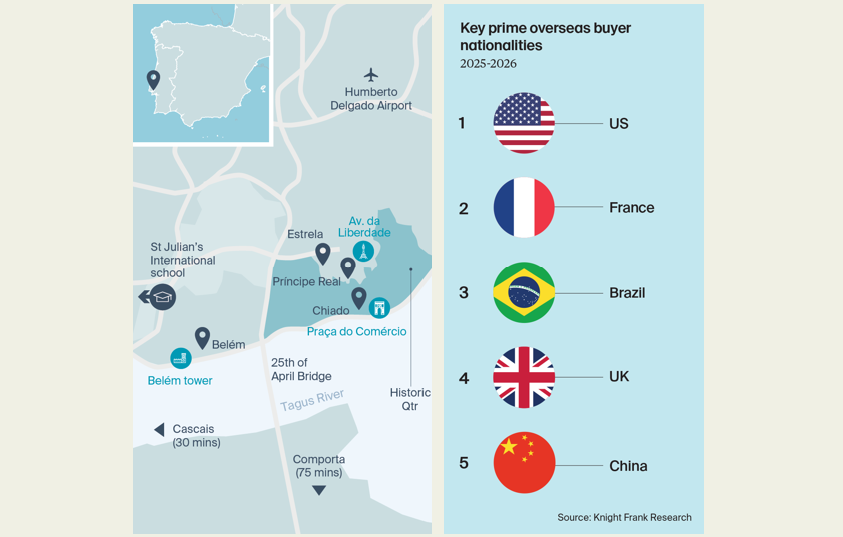
Demand is broadening, with US buyers gaining ground and strong demand from France, Brazil, the UK and China shaping the prime segment.
Price outlook
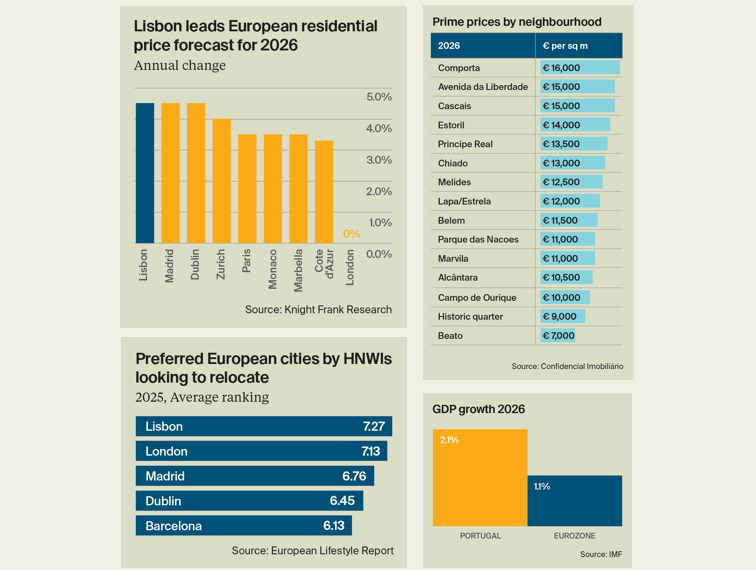
Prime prices are forecast to rise another 4.5% in 2026, placing Lisbon among Europe’s top performers as constrained supply, lifestyle appeal and cross border demand continue to anchor values.
Portugal’s economy is also projected to outpace the Eurozone next year, with the IMF forecasting 2.1% GDP growth versus 1.1% for the bloc, this will bolster domestic wealth and housing demand.
Infrastructure
A delayed €7 billion new airport is now slated for 2034. Events such as the Web Summit – drawing around 70,000 attendees – are exposing the limits of current capacity, including private jets heading to the event being diverted to Spain in 2025.
Outlook
Lisbon heads into 2026 with firm momentum. Ongoing visa routes, expected infrastructure upgrades and a supportive economic backdrop are widening its buyer pool.
Comporta
Once a quiet fishing village on the Alentejo coast and just 75 miles from Lisbon, Comporta has evolved into one of Europe’s most exclusive coastal destinations with major brands set to open in the next few years.
Prized for its pristine sandy beaches, rice fields, pine forests and low density development. Its appeal lies in u nderstated luxury, eco-credentials and protectednatural landscapes.
In the last five years alone, prime prices have doubled. Top beachfront homes now command €16,000-plus per sq m but with further growth forecast.
Cascais
Cascais is an affluent coastal enclave west of Lisbon, prized for its beaches, leafy avenues and relaxed, international atmosphere. Prime homes typically range from €2 million to €3 million, with steady low digit annual growth over the past five years. Monte Estoril, with its classic architecture, and Guia, known for its contemporary homes, are among the most sought after areas.
Families, retirees and digital age professionals gravitate here for its safety, strong schools and easy commute to Lisbon. The housing stock spans waterfront villas, gated communities and elegant marina side townhouses. Buyers are drawn by the lifestyle – surfing, golf and waterfront dining.
Market View
Expert Insight
Knight Frank’s Jack Harris (JH) and Quintela + Penalva’s Carlos Penalva (CP) discuss current market conditions, buyer profiles and the new trends shaping Lisbon’s prime segment
What’s really moving the market?
CP: The historic districts is seeing renewed interest. With ongoing construction constrained by tight planning rules, buyers are targeting character, authenticity and walkability – especially international clients relocating.
JH: The headline numbers look steady, but the real story is geography. Prime demand is pushing beyond the traditional core as infrastructure upgrades and lifestyle drivers widen the map. Comporta, once niche, is now a serious contender for international buyers tracking top-tier hotel and branded residence openings.
How has buyer behaviour changed?
CP: Negotiations are more pragmatic. Buyers are informed, mobile and decisive – deal timelines are faster, especially for best-in-class new build.
JH: The speculative edge has gone. Buyers are taking long term positions, prioritising stable income and quality over quick wins. Turn key assets with solid rental potential are getting the most traction.
What’s new in high end demand?
CP: The ceiling is rising. There’s stronger appetite for ultra-prime product that simply didn’t exist at scale a few years ago.
JH: There’s also a widening gap: premium new builds are outperforming, while secondary stock without outdoor space or a good energy efficiency rating lags.
Who is the new luxury buyer?
CP: South American wealth is increasingly influential, often arriving via Miami. These buyers are lifestyle driven and long-term.
JH: We’re also seeing tech founders and innovation-sector professionals relocating, supported by Portugal’s updated innovation-focused residency routes.
What will shape the next 12-18 months?
CP: Lower borrowing costs and shifting geopolitics will keep mobile wealth in motion – and Lisbon remains a safe, stable landing spot.
JH: Supply constraints will persist. Limited plots, strict planning laws and rising construction costs will support prices in the prime segment.
What’s the most overlooked signal?
CP: Education. Top-tier schools are quietly redrawing search maps with Cascais a key draw.
JH: Aviation links. Each new long-haul route expands Lisbon’s buyer pool overnight.
Sign up to Knight Frank Research.
