
Homebuying demand slips as mortgage rates rise
Making sense of the latest trends in property and economics from around the globe
13 March 2026

Volatility in the UK mortgage market continued yesterday as lenders moved quickly to reprice loans following a sharp rise in swap rates.
Barclays and HSBC pushed their leading fixed rates for homebuyers above 4%. A handful of sub 4% deals remain, but they are unlikely to last. As recently as a month ago, the best fixed rates sat a little above 3.5%.
This is going to dent the recovery in the housing market, though the extent depends on how long the conflict in the Middle East continues. The consensus view remains that this will be short-lived. Economists polled by Reuters this week are divided on the outlook, but the median forecast puts the Bank Rate at 3.25% by year-end, down from 3.75% today. That's in sharp contrast to interest rate futures contracts, which no longer price any cuts this year.
How much and when
The weakening jobs market is among the key reasons many are sticking to their forecasts for easing this year.
"Given the situation we're seeing with oil prices, we now think it's more likely than not they will delay the next rate cut until April, but overall, we're still looking for two cuts from the Bank of England this year," Dean Turner, an economist at UBS, told Reuters. "I suspect the bias in the minutes will still point to the need for further easing in due course... I don't think there's any doubt rates are going to fall – it's just by how much and when."
Higher mortgage rates, should they be sustained, will hit transactions first, though values are likely to remain relatively resilient. Capital Economics points to a recent trend of borrowers extending mortgage terms, something that could accelerate if households look to cushion the impact of higher monthly repayments. A relaxation in lending standards may also allow some buyers to borrow more than they otherwise would have done. Together, these factors could help support demand and offset some of the downward pressure on house prices.
Negative territory
The conflict is weighing on sentiment among estate agents, according to the latest RICS Residential Market Survey, published yesterday. New buyer enquiries slipped further into negative territory in February, posting a net balance of -26%, down from -15% a month earlier. The reading reverses the modest improvement seen at the start of the year.
Sales activity is following a similar pattern. A net balance of -12% of surveyors reported a fall in agreed sales during February, slightly weaker than the -9% recorded previously. Still, the current reading remains less downbeat than much of the past six months.
Near term expectations have already edged lower. A net balance of -2% of respondents expect sales to decline over the next three months, the weakest outlook since November. Longer term sentiment remains more positive, however, with a net balance of +17% still anticipating sales volumes will rise over the coming year, albeit a notable step down from the +35% reported in the previous survey.
On the supply side, conditions are broadly stable. New instructions came in at a net balance of +2%, indicating that the flow of fresh listings is largely unchanged.
Prices at the pump
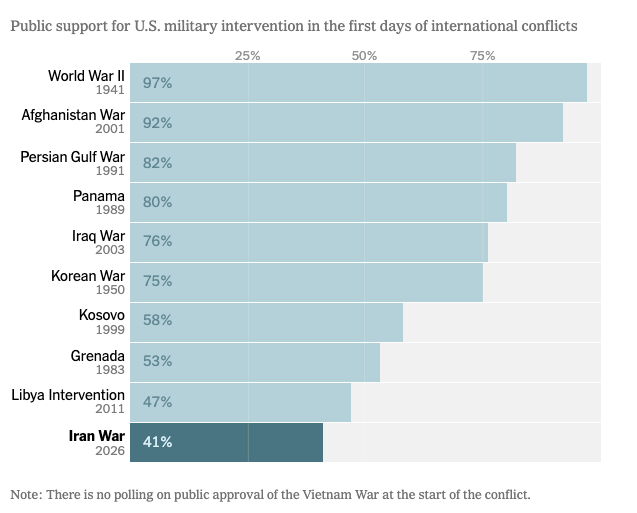
US President Donald Trump's appetite for the war is among the key factors that will determine its length. That remains unknowable, but there is now a growing body of polling on how Americans feel as the country heads towards the mid-term elections in November.
So far, polls have found that most Americans oppose the Iran attacks. Support ranges from 27% in a Reuters/Ipsos poll to 50% in a Fox News poll, according to a New York Times tally. Averages suggest support is lower than in previous conflicts (see NYT chart), though there are predictably large divergences between the views of Democrats and Republicans.
Americans are divided on many issues, but few topics unify minds quite like gas prices. Eight in 10 voters have noticed a change in prices at the pump in recent weeks and 48% blame the president and his administration for the rise, according to a Morning Consult poll carried out this week.
In other news...
‘We’re past the $200mn threshold’: the rise of super-super prime property (FT).
Sign up to Knight Frank Research.
