
The New Frontier - Your weekly science and innovation update
Your weekly pulse check on science and innovation. Those on the supply side of real estate can track the trends set to drive demand, while occupiers gain fresh perspective on competitor activity and sector dynamics.
14 January 2026

Autonomous science is coming
Last year, DeepMind slipped out an announcement that may have gone under the radar due to the Christmas holidays. It plans to open its first automated research lab in the UK. Backed by a £5 billion UK-government partnership, the lab will use AI (DeepMind’s Gemini) and robotics to synthesize and test hundreds of new materials per day. The early work, according to reporting, will focus on superconductors, advanced semiconductor materials and other high-impact materials tied to clean energy and medical imaging.
The lab is designed as a closed feedback loop. AI models generate hypotheses from existing data. Robotics runs the experiments. Sensors feed results back into the models. The system then chooses what to test next. Scientists still matter, but their role shifts from manual execution to oversight, interpretation, and strategic judgement.
The significance for property is straightforward. If autonomous science takes off, it will not live in generic lab stock and it will not tolerate flaky infrastructure. It will favour facilities that can run continuously, safely, and predictably, with heavy equipment, precise robotics, and sensitive instrumentation. That means robust power and HVAC systems. It means load-bearing capacity, ceiling height, and vibration performance. It means operational resilience, because a lab designed to learn in real time is wasted if it is forced to shut down in real life. The news also underlines a broader shift. Big AI firms are investing in physical infrastructure and science.
Capital markets: more money, fewer bets
Early UK venture figures suggest £18.77 billion raised in 2025, up marginally from £18.44 billion in 2024 and the third-highest level on record. Yet deal count fell 32% to 3,801, the lowest since 2014. That is what selective markets look like. Less experimentation, more concentration and greater pressure to show progress.
Geography tells its usual tale. London accounted for 60% of UK VC funding in 2025, followed by the South East (9.25%) and the North West (8.33%), with the East of England and Scotland rounding out the top five. London remains the centre of gravity for capital and scaling.
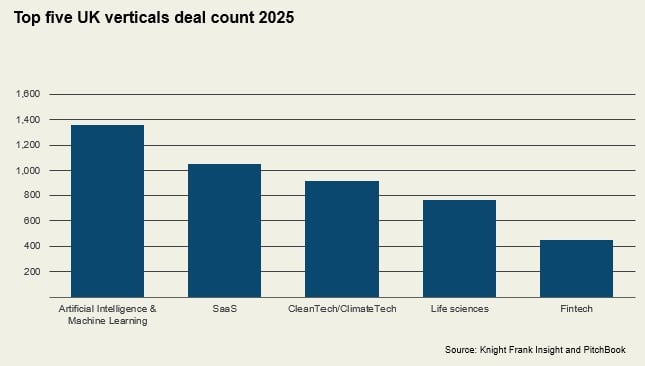
By sector, deal activity was dominated by AI and machine learning, followed by software‑as‑a‑service, suggesting continued demand from these areas.
The boardroom mood on AI: optimism becomes reorganisation
The boardroom mood is shifting in relation to AI. The latest Deloitte UK CFO Survey reports that 59% of finance chiefs have become more optimistic over the past 12 months about AI’s potential to boost organisational performance, up from 29% in Q3 2024. Almost all, 96%, expect investment in digital technology and assets to rise over the next five years. Optimism, in other words, is turning into capital allocation.
That capital will not only buy software. It will buy reorganisation. Transformation-led activity tends to show up through M&A, partnerships, outsourcing, in-house development, and corporate venture funding. It also shows up in skills. Gartner forecasts that from 2028 onwards around 32 million global roles a year will be reconfigured, redesigned, or fused because of AI.
Corporate real estate sits in the middle of that shift. AI can make CRE functions faster and more predictive, improving forecasting, automation, and portfolio decisions. Yet AI also changes what buildings must enable. Secure access protocols matter more. Digital infrastructure becomes a genuine operational dependency. Proximity to talent and research networks becomes harder to substitute and spaces must enable hybrid-AI workflows and learning and development. The winning buildings will feel less like static containers and more like platforms for continuous change.
Life sciences: selective expansion, harder-nosed space choices
Deloitte’s 2026 life sciences outlook finds 75% of companies confident about their own financial prospects but only 41% optimistic about the global economy, with geopolitics, pricing pressure, and regulation complicating planning. One sensible response is geographic diversification, building “agility muscle” by avoiding dependence on a single location or supply chain. Another is accelerating digital transformation and automation across R&D and manufacturing, which reinforces demand for digitally enabled facilities. At the same time, cost discipline remains central. Expect investment to flow into “value-creating” sites and to be squeezed out of anything that is surplus. R&D productivity is being prioritised. R&D environments that materially support it will be prized.
Other interesting reads…
- Accenture to acquire Faculty, valuing the UK AI start-up at over $1bn, reinforcing that consulting and transformation firms are retooling around AI delivery at scale. This signals that big consultancies will likely expand AI teams in the UK.
- Amgen acquires Oxford spinout Dark Blue Therapeutics, for up to £622m, another example of big pharma acquiring.
- Engitix secures a further $25m to progress cancer and fibrosis therapies. This comes alongside meaningful headcount and revenue growth. The firm is based in London. Engitix has demonstrated sustained growth since its 2016 incorporation, transitioning from seed to venture stage by December 2019 and reaching growth stage by January 2022. The company expanded from 12 employees in 2019 to 57 by December 2023, while turnover grew from £2.34m in 2020 to £8.78m in 2023.
- AgileRL raises $7.5m. The firm develops software that aims to democratise access to reinforcement learning in the development of AI systems. This is a reminder that funding is being raised for companies across the AI value chain. The firm is based in London.
- OpenAI has launched ChatGPT health in the US which can analyse medical records along with data from digital health apps to give more personalised advice. According to OpenAI, more than 230 million people ask its chatbot health and wellbeing questions every week.
- Anthropic is reportedly raising $10 billion at a $350 billion valuation. Coatue and Singapore sovereign wealth fund GIC are leading the financing.
- UK government appointed a Chief AI Officer to oversee and scale AI work across public digital teams. Kalbir Sohi was appointed to the newly created CAIO role – described as “the most senior AI leadership role” in Whitehall. Sohi will oversee the AI teams at the Government Digital Service (within the Department for Science, Innovation and Technology) and spearhead AI testing, deployment, and scaling across government. His background spans HMRC, Facebook and Spotify, and he will lead the rollout of the government’s AI strategy. This high-level hire underscores the UK’s commitment to embedding AI in public services.
- UK government announces a £140m Local Growth Fund for Scotland, with further details to follow. The package unveiled by Scottish Secretary Douglas Alexander will channel funds into five regions over 2026/27–2028/29: Glasgow (£60.9m), Edinburgh & South East (£37.8m), Tay Cities (£19.5m), Ayrshire (£11.8m) and Forth Valley (£9.8m). The money is earmarked for projects that drive economic growth: infrastructure upgrades, business support, and skills programs. Local leaders will determine priorities, focusing on housing and transport improvements, new industrial space, or R&D facilities.
Sign up to Knight Frank Research.
