
How much rail can you buy for £45bn?
Making sense of the latest trends in property and economics from around the globe
14 January 2026

The government has committed to spending £45bn on rail across the north of England, starting with £1bn to work up a detailed three-stage plan to connect cities from Liverpool to Newcastle.
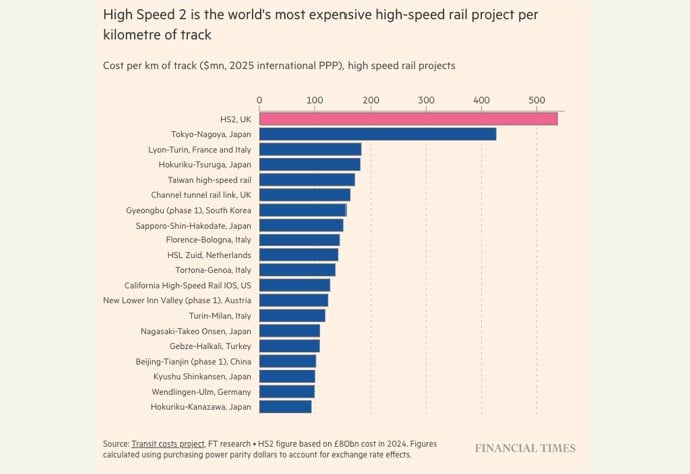
How much rail you get for £45bn remains an open question – the Treasury says it has capped its spend at this level. The FT has an excellent deep dive this morning on cost overruns at HS2, which is draining taxpayer funds at a rate of about £140m a week for barely half the length of the original plan (see graphic from the FT). I explored the UK's infrastructure challenges in more depth in this note, including the infamous bat shed and how these issues intersect with housebuilding and broader development goals.
The government also “set out its intention” to build a Birmingham-Manchester line after the completion of Northern Powerhouse Rail (NPR), although it insisted this was “not a reinstatement of HS2”, according to the Guardian.
A huge difference
The UK's expensive planning and environmental consent process lies at the heart of Britain's infrastructure woes. Barratt Redrow chief executive David Thomas gave an expansive interview to the Times this week in which he recalled watching an infrastructure executive tell the chancellor Rachel Reeves that the Lower Thames Cross, essentially just a road under the River Thames, had been in planning for 16 years – planning costs alone hit £1.2 billion. The government subsequently approved the project.
“I think the planning environment is suffocating us," Thomas told the paper. "It is not approached from the point of view of ‘What good can we do for the country?’ It’s approached from the point of view of, ‘How can we stop this?'"
That said, Mr Thomas was supportive of the government's reforms to the planning system, declaring that they would "make a huge difference, not just for residential development, but for all forms of development."
Persimmon also welcomed the government's changes to the planning system in a trading update yesterday. Total completions climbed 12% in 2025 to 11,905 homes. The Group's private average selling price was up 5% on the prior year at c.£301,000. Net sales rate per outlet per week excluding bulk sales was up 4% to 0.59.
Taxing mansions
As many as 200,000 homes are likely to be hit by the government's mansion tax on homes worth at least £2 million, Jonathan Russell, chief executive officer of the Valuation Office Agency told a Parliament select committee yesterday.
That's higher than the 150,000 homes in England and Wales that would have fallen into the bracket when we made our initial calculation in November, in part because the VOA intends to be thorough. Houses currently worth about £1.5 million will be checked to see if their value has climbed, taking them over the threshold, Russell added.
Still, a combination of buyers and sellers acting before the November Budget due to the speculation over property taxes, then the subsequent relief that mansion tax rates weren't set higher, contributed to a recovery in activity in prime markets during the final weeks of 2025. The number of exchanges above £5 million in London during the last three months of the year was 29% higher than in 2024, according to the latest Knight Frank data. Average prices in prime central London fell 5% in the 12 months to December.
Holding steady
The global economy largely shook off the turbulence caused by US President Donald Trump's Liberation Day tariffs. Global GDP growth is set to come in at 2.7% for 2025 before holding steady at that rate through 2027, according to new World Bank projections.
The US received the largest upgrade for the year ahead – the economy is now likely to grow at 2.2%, 0.6% ahead of the World Bank's June outlook. China's economy is likely to grow 4.4% this year and 4.2% in 2027, below the government's 5% target. Eurozone economies are set to grow a sluggish 0.9% this year.
The World Bank noted that risks are tilted to the downside: "Growth could falter if trade tensions escalate, barriers rise further, or financial market sentiment deteriorates amid asset price declines, fiscal concerns, or inflation surprises," the report said. "On the upside, AI-related activity could broaden, and firms’ adaptability to new trade conditions could support growth."
In other news...
Billionaire Mike Ashley Wagers on UK Rental Homes With Grainger Bet (Bloomberg).
Sign up to Knight Frank Research.
