

Why are fewer homes breaking ground in London?
Lead-in times, planning delays, and market uncertainty are slowing new housing delivery
21 August 2025

The number of new homes started annually in London has dropped by 77% over the past year compared to the market peak in 2015. In the first half of 2025, fewer than 2,200 new private homes were started - just 5% of the government’s target.
So, what’s behind the slowdown?
One major factor is the increasing time it takes for development sites to progress through the pipeline. Drawing on data from development consultancy Molior, we analysed nearly 700 sites of at least 100 private homes, tracking their journey from initial application to construction starting.
The findings reveal a sharp rise in median lead-in times, driven by mounting regulatory and financial hurdles. Sites that began construction in 2024 took an average of 26 months from initial application, up from just over 17 months in 2015 and 13 months in 2013.
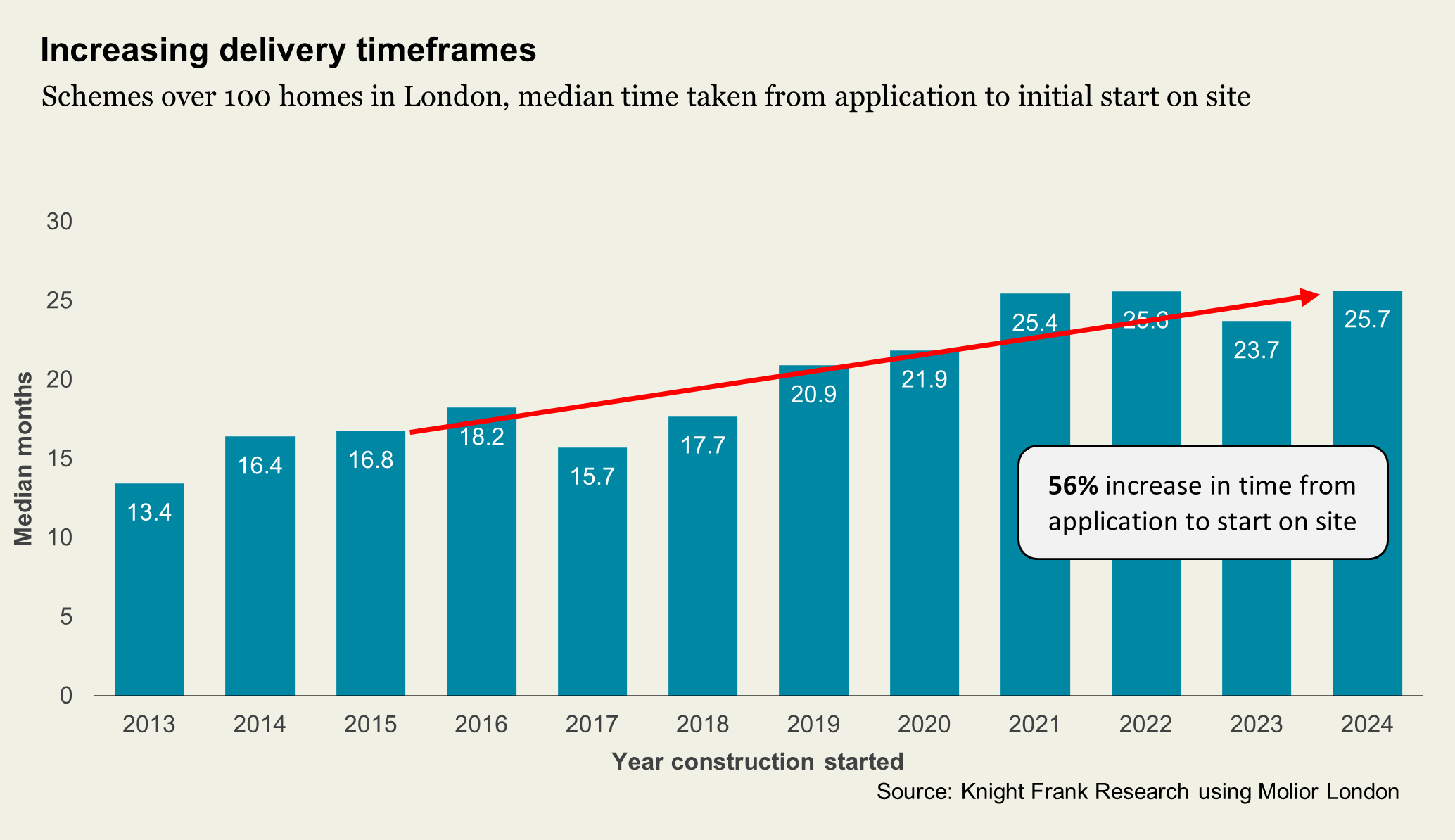
Lead-in times
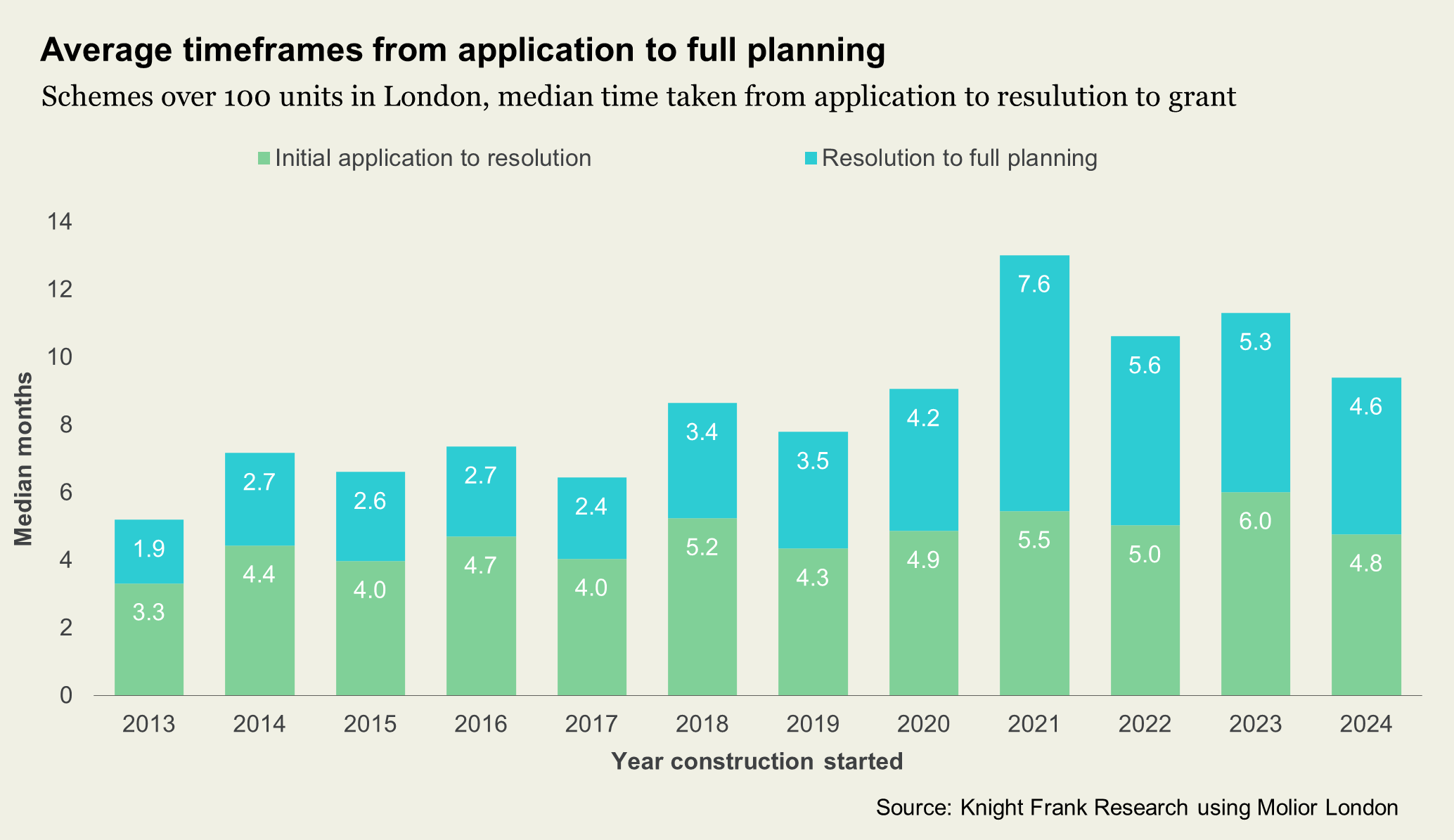
While much attention is paid to the time it takes to secure planning permission, our analysis shows that the post-permission phase - from resolution to full planning and then to site start - is where delays have grown most significantly. This is a period where a borough has resolved to allow development, but certain conditions or agreements might need to be finalised before official permission is issued.
The chart below confirms that even though the time from initial application to a site gaining a resolution to grant full permission has ticked up by a fifth since 2015, the data has been reasonably consistent. By comparison, over that same period, the time from resolution to full planning has increased by 76%.
These delays are compounded by resource shortages in local planning authorities and increasingly complex negotiations over financial contributions. A decline in demand for Section 106 homes - as Registered Providers shift focus to existing stock - adds further friction.
Where no buyer for Section 106 units can be found, or where on-site affordable housing is no longer viable, negotiations over commuted sums introduce additional delays, disrupting delivery timelines.
Permission to start
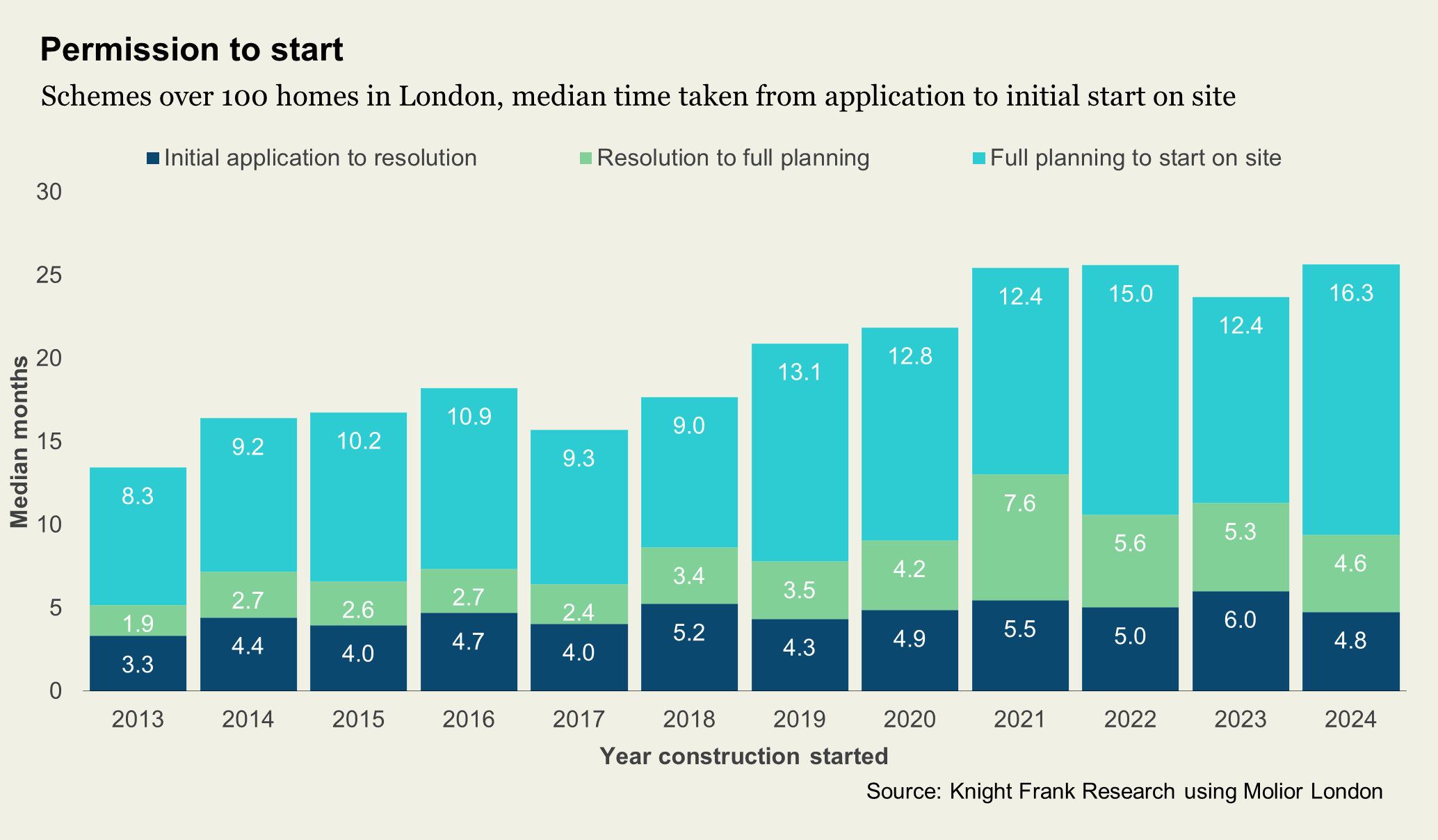
Time taken from securing full permission to starting on site has also increased, by 60% since 2015. Slower build-out rates at this stage have also been impacted by the drop in demand for Section 106 agreements from RPs, but they are also being shaped by wider macroeconomic forces.
On the demand side, affordability has taken a hit. Higher stamp duty, soaring mortgage rates, tax changes on overseas and buy-to-let investors, and the withdrawal of Help to Buy have all weakened market confidence, severely impacting on developer’s confidence to start on high-density, speculative development.
Only 3,950 new homes were sold in the first half of 2025 according to Molior, the lowest level since 2010.
On the supply side, cost pressures continue to rise. Developers are carrying multiple taxes and levies which are squeezing viability: CIL, early and late-stage reviews for affordable housing, the Building Safety Levy. Then there are new regulatory hurdles. The Gateway system has become a logjam, holding back delivery, even where schemes have full permission.
Now what?
Firstly, it is important to remember that these are average figures which come from a selection of large sites. There are significant variations within this average, with some sites progressing very slowly or quickly compared to the other examples. We have also only looked at schemes which have made it from application to construction, leaving out a significant number which have fallen away or whose permissions have expired.
That said, it is clear immediate action is needed to relieve the pressure. Steps are being taken in that regard, but achieving the necessary step-change in housing output in London cannot just be reliant on measures to improve the efficiency of the planning system, something we have discussed previously.
Other change is also necessary, including funding and flexibility on affordable housing. In the current environment, buy-side support is needed. Reformation of stamp duty and incentives to those who buy off-plan will give developers the confidence to build, as well as helping fund the delivery of high-density, high-risk, speculative development.
The key tool available to planners is flexibility, and a willingness to amend planning permissions and Section 106 agreements when problems arise. This will be vital if the supply of viable land for development is to be maintained.
Removing the roadblocks that add risk and hinder viability should be the top priority of our politicians. While the Government’s efforts over the past year have laid some important groundwork for increased housing delivery, particularly reforms to planning policy, bold action is still needed.
Sign up to Knight Frank Research.
