

Planning a sustainable London | Rooftop solar – a missed opportunity?
17 July 2025

The next London Plan will shape how London will develop over the next 23 years (2027-2050). Its early consultation document, ‘Towards a new London Plan’, outlines the ambitions of the Next London Plan and the policy ideas proposed to achieve them.
Our research experts have examined these proposals in more detail, exploring their potential impact on housing delivery, high street, industrial land supply, workspaces, and London’s environmental future.
LONDON LEADING
While the document provides a broad framework, the practical implications will depend on the finer details. London has consistently led on sustainability, with boroughs like Westminster and Hackney setting ambitious benchmarks that often exceed national standards. For instance, Westminster mandates that new non-domestic developments over 500 sqm achieve a BREEAM ‘Excellent’ rating, while Hackney requires all non-residential developments to meet the same standard, maximise water credits, and achieve zero-carbon status. This leadership at the borough level suggests that any deferral to national policies in the London Plan is unlikely to result in a rollback of these stringent local requirements.
RETROFIT CHALLENGES
Commercial property owners face significant challenges on the broader retrofitting action, as discussed in Meeting the Commercial Retrofit Challenge Series, with the Plan document highlighting 'over one million square metres of building stock (equivalent to about nine Shards) do not meet upcoming energy requirements. These require about £350m of investment to upgrade them and about half of this space is at risk of becoming obsolete.'
Retrofitting historic buildings presents significant unique challenges, including a shortage of skilled labour, with only half the workforce needed to meet demand currently available.
The discussion over whether to maintain or mandate strict efficiency requirements or defer to national policy, which may become tighter, may reduce some complexities and ambiguity for property owners when critically they need clarity and certainty. Ultimately borough level implementation will vary, but recognition of how to balance the need for retrofitting with the practicalities around cost, timing and feasibility remain - the application of standards to retrofitting properties where planning is required not just to new developments should be made clear.
Nationally, the proposed tightening of the Minimum Energy Efficiency Standards (MEES) from 2021 have not yet been cemented creating uncertainty and delaying action, beyond the London Plan any clarity here would be welcome and offer opportunities for cementing action.
One particular challenge in this regard that the document points to is the sensitive retrofitting of historic buildings, balancing heritage preservation with sustainability. Retrofitting these is critical to reducing emissions and improving energy efficiency, particularly as London’s commercial sector accounts for 25% of the city’s carbon emissions, rising to 56% in Westminster due to its dense historic stock. However, retrofitting historic buildings presents significant unique challenges, as we previously explored, including a shortage of skilled labour, with only half the workforce needed to meet demand currently available, according to a report by Grosvenor.
Addressing this gap, alongside simplifying planning processes and providing financial incentives, will be essential to unlocking the potential.
CYCLE STORAGE
The London Plan’s cycle parking standards, while ambitious, are under review due to concerns about cost and underutilisation. Current requirements for offices and residential developments are detailed but may not always align with local needs. A more flexible, demand-based approach that considers the rise of e-mobility and shared transport solutions could better balance practicality with sustainability goals. The trend towards sustainable commuting and travel is evident, with 82% of refurbished offices now including end-of-trip facilities and 75% offering cycle storage - as pointed to in Meeting the Commercial Property Retrofit Challenge - Part 1.
However, broader utilisation of our grey space more effectively, such as rooftops, for solar energy generation is still underexplored.
This trend may continue and for these types of properties, the occupier expectations may be more set. However, there is more to the story. If current mandates are leading to basements and storage facilities built, across asset types and locations, which are underutilised then this is adding to cost of development, potentially limiting viability, and increasing embodied carbon unnecessarily. The approach must be more measured and aligned to the assessed requirement, being enabling of more sustainable development and transport, rather than be prohibitive.
RESILIENT BUILDINGS
The document highlights the importance of resilient buildings and passive design features to mitigate overheating risks caused by climate change and the urban heat island effect. However, practical implementation has faced challenges around cost and delivery. Policies such as maximising dual-aspect dwellings may need to be revisited to ensure flexibility and practicality, allowing passive design elements to be effectively integrated without compromising housing delivery. There is recognition of this.
SOLAR POTENTIAL
Renewable energy integration remains a key focus, with boroughs like Hackney requiring major developments to generate at least 10% of their energy needs from onsite or local renewable sources.
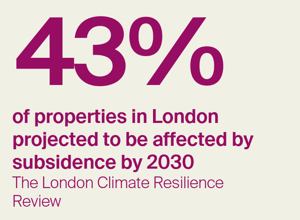
However, broader utilisation of our grey space more effectively, such as rooftops, for solar energy generation is still underexplored. While for new developments, we could see this in national policy, the shift towards retrofitting and repurposing presents an opportunity to rethink energy infrastructure and maximise renewable energy potential through these channels. Finally, the document overlooks the critical issue of subsidence, a growing climate risk in London, with 43% of properties projected to be affected by 2030, according to The London Climate Resilience Review. Addressing this risk requires integrated measures, such as maintaining tree canopies and implementing flood and drought management strategies, to protect property value and stability.
IN SUMMARY
In summary, while the London Plan outlines ambitious sustainability goals, its success will depend on clear implementation strategies, practical flexibility, and support for stakeholders. By addressing workforce gaps, streamlining processes, and leveraging emerging technologies, London can continue to lead in sustainable development while ensuring the viability of its property market.

Sign up to Knight Frank Research.
