
Powering Up: Data Centers and EVs
This month we explore Data Centres and ESG – renewable energy to repurposing heat – and the latest in EV developments and implications.
01 May 2025

AI, energy and data centres
Growth in the number of data centres globally is inevitable. Forecasts from Knight Frank's Global Data report suggest capacity will grow by 46% over the next two years, with the potential to expand by 177% by 2030, partly driven by the ‘AI boom’. With that will come questions around rising energy requirements. The IEA’s Energy and AI report noted that data centres accounted for around 1.5% of the world’s electricity consumption in 2024, and is set to double by 2030.
Many data centre operators, occupiers and owners have emission reduction targets, so procuring clean energy is a priority. A number are looking toward corporate Power Purchase Agreements or PPAs to meet this need. Meta, Google and Amazon which have had a target to procured 100% renewable energy since 2020, 2017 and 2023 respectively for example, according to the IEA. In fact, renewable energy is projected to meet nearly half of the global growth in data centre demand, according to the IEA, where the report notes: “Affordable, reliable and sustainable electricity supply will be a crucial determinant of AI development, and countries that can deliver the energy needed at speed and scale will be best placed to benefit”. Kier Starmer, speaking at the London energy summit promised to make Britain an “clean energy superpower” stating it was “in the DNA of my government".
Beyond clean energy, there are a number of climate and ESG related factors for data centre operators to consider, as Knight Frank’s Jonathan Hale highlights in the report. This ranges from understanding reporting requirements – which across markets like the EU include granular data on their ESG performance, such as energy use, e.missions, water consumption, and labour practices – to becoming a community heat provider which has been seen in Denmark, the UK, and Finland
Tariffs spur EV action in the UK
The UK government, under Keir Starmer, introduced changes to the EV mandate to support the auto industry amid tariffs on exports to the US. Key updates include a reduction in fines for non-compliant vehicles from £15,000 to £12,000, extending hybrid car sales until 2035, and greater flexibility for manufacturers to balance annual EV sales targets. These measures aim to ease the transition to electric vehicles while maintaining momentum toward net-zero goals.
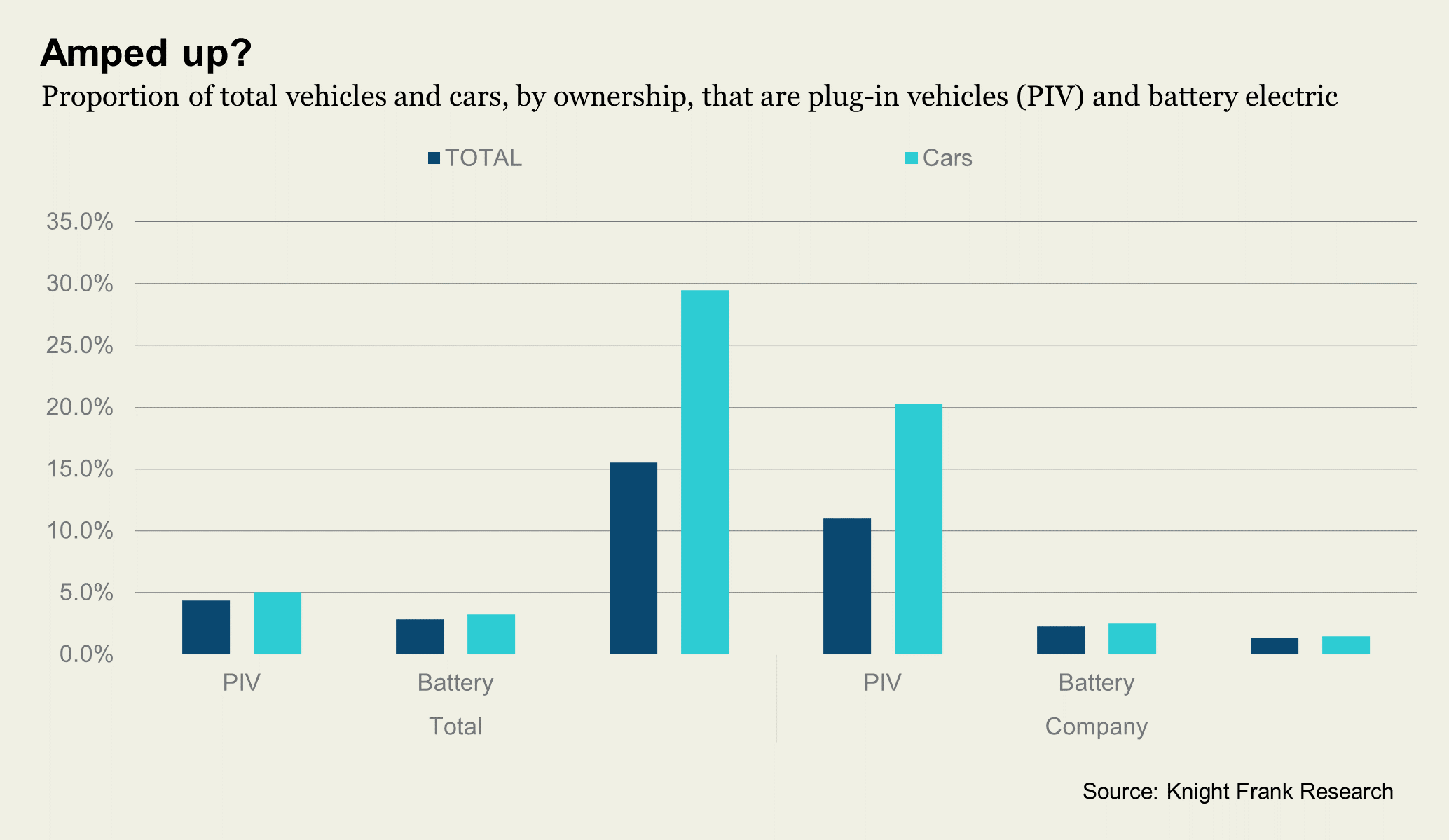
Battery electric vehicle (BEV) sales rose 43% year-on-year in March, according to the Society of Motor Manufacturers and Traders, with plug-in hybrids up 38% and hybrid electric up 28%, whilst petrol and diesel sales fell. Together, BEVs and plug-in hybrids now account for 28% of all UK new car sales, with BEVs alone accounting for just over 19% of sales in March. However, overall private ownership of EVs remains limited accounting for just shy of 3% of all privately owned cars. Easing range anxiety and charging woes (see below for more on this) will help spur adoption.
In contrast, businesses are leading the charge. Nearly 30% of company-owned vehicles were plug-ins by mid-2024. Greater adoption among businesses is likely to reflect the fact that many have integrated EV targets as part of their overall net-zero strategies. In total, 128 global companies have committed to switching their fleets to EVs and/or installing charging for staff/customers by 2030, for example. Building requirements are yet to catch up, however. Just 13% of property investors look for EV charging provisions in acquisitions currently, according to our recent survey. But with growing occupier requirements and European legislation from the European Performance of Buildings Directive, this is likely to rise in the coming years.
This is not only for offices, homes and retail but also for logistics, yet the pace may be slower. When looking at heavy goods vehicles (HGVs), the adoption of EV thus far is lagging, with around 0.2% of HGVs in the UK being plug-in. The EV100+ takes the EV100 group one step further, with those pledging to transition to zero-emission medium and heavy-duty vehicles (MHDVs). So far, only seven members have signed up, including Prologis, Unilever and IKEA.
Charging - race to zero?
The Prime Minister is also looking to accelerate EV adoption announcing: "We're putting £2.3 billion towards tax breaks for people buying electric vehicles and improving charging infrastructure - one public charging point pops up every half an hour." Reflecting this, Brighton has announced 6,000 lamppost connections to make it "the best-connected place in the UK for on-street electric car recharging." In our 2024 report, we highlight areas of opportunity for public slower chargers, such as those proposed in Brighton, as well as ultra-rapid chargers, which will be critical on transitory routes to ease the range anxiety.
The EV charging landscape is evolving rapidly, with Chinese manufacturers Zeekr and BYD unveiling ultra-rapid chargers capable of delivering 1.2 MW and 1 MW, respectively. These chargers can reduce charging times to as little as five minutes, effectively doubling or tripling current capacities. However, this leap in technology comes with challenges: battery compatibility as vehicles must be equipped to handle ultra-fast charging rates, a feature BYD has already introduced in its latest models, and importantly grid capacity with high-power chargers needing robust grid connections, potentially requiring significant upgrades to local infrastructure.
The shortcomings of the UK electricity grid have often been highlighted and Ofgem last month announced final decision on Connections Reform Package. This includes the commitment to prioritise those projects that are 1) ‘ready’ and 2) ‘needed’, i.e. meeting Strategic Alignment Criteria under the CP2030 Action Plan, to a Gate 2 connection queue, some of which will receive new offers at the end of the year, with the first projects to benefit from the reforms connected and operational from 2026. Those that don’t meet the criteria are deprioritised to Gate 1 and can reapply in future once they meet the criteria with new projects also needing to meet Readiness Criteria and Strategic Alignment Criteria to be eligible to join the Gate 2 connections queue. Ofgem notes that Projects that are “ready” and “needed” will be prioritised with new offers by the end of the year, cutting waiting times to connect to the grid, with the first projects to benefiting from the reforms connected and operational from 2026.
While EV charging project demand capacities are typically below the Transmission Impact Assessment (TIA) thresholds - currently 1MW in England and Wales - and therefore not subject to the capacity ranges and gate process set out in the CP30 reform, the reduction in delay and 'grid lock' will be welcome for greater rollout potential.
76,507 - Nicola Ryan's stat of the month
As at April 2025, there were 76,507 public charging devices, according to data released by the Department for Transport. Yet, the proportion of rapid chargers remains limited, rising from 17% to 20%. It’s a clear signal for property owners: high-traffic locations continue to provide opportunities for EV charging investment.
What else I am reading
Net zero could make us warmer and be cheaper, claims the Energy Transitions Commission (ETC), schools and hospitals look to cut energy bills demonstrating this, the Government updated solar capacity targets in the connection's reform due to a recent trend of increased solar projects, environmental regulation in for a shake-up, Spain’s minimum energy efficiency standards, NYC public pension funds keep climate pressure on asset managers, the bifurcating cost of decarbonisation and latest on refurbishment costs from Knight Frank Cost Consultancy.
Sign up to Knight Frank Research.
