
The New Frontier - Your weekly science and innovation update
Your weekly pulse check on science and innovation. Those on the supply side of real estate can track the trends set to drive demand, while occupiers gain fresh perspective on competitor activity and sector dynamics.
08 December 2025

Re-wiring the UK’s drug cost calculus
This week there was positive news in the form of a US-UK drug pricing deal which agreed zero tariffs on UK origin pharmaceuticals, pharmaceutical ingredients, and medical technology shipped to the US, shielding the UK’s £6.6 billion in annual pharma exports to the US from punitive duties for at least three years. In return, the UK has committed to spend more on medicines by changing how it values new drugs for the NHS.
Under the deal, the UK will increase the price threshold at which it deems new treatments to be too expensive, by 25%. The UK will also increase the overall amount the NHS spends on medicines, with a target to increase that spending from 0.3% of GDP to 0.6% of GDP over the next decade.
Central to the agreement is a long-sought change to NICE, the UK’s cost-effectiveness watchdog. The National Institute for Health and Care Excellence (NICE) will raise its threshold for approving new drugs from the current £20,000–30,000 per quality-adjusted life year (QALY) to £25,000–35,000. By allowing a higher cost per year of healthy life gained, NICE can green-light medicines that previously failed its value test. The agency estimates the higher threshold will enable three to five additional drug approvals each year.
The deal also reshapes the UK’s VPAG scheme. Under the new agreements, the UK pledges to slash the payback rate to 15% by 2026 and keep it at or below that level through to 2028. This move aligns with what the sector has been clamouring for. The voluntary scheme remains in force through 2028. An accelerated review after 2028 is promised, with ministers and industry to design a “more sustainable” pricing model for beyond 2029.
Pharmaceutical companies and industry bodies, unsurprisingly, have applauded the outcome. “These commitments begin to address industry concerns on NHS access to medicines, and the UK’s record-high and unpredictable payment rate,” says Richard Torbett, ABPI’s chief executive. Executives at GSK issued guardedly positive notes, calling the agreement “a real opportunity to secure the UK as an attractive environment for life sciences that rewards innovation”. Notably, Bristol Myers Squibb (BMS) swiftly announced it “anticipates being able to invest upwards of $500 million over the next 5 years” They added “This agreement is a sign of progress and one that creates an environment conducive to our continued presence in the UK. Such public statements hint at a tentative turning point. Yet those hoping for a rapid unfreezing of investment plans did not get unalloyed good news. Eli Lilly, for one, has said it will not restart its paused UK investment until it sees a shift in the types of drugs being approved. As the company’s chief executive put it, “the trajectory before was definitely downward and now there’s optimism that it’s going upward and that’s an important thing for your country.”
Will the gambit work? Given the above there are reasons for optimism but also caution. The UK is only ~2% of the world pharma market by sales, so even a 25% price bump moves the needle only modestly on a giant company’s global income. However, industry decisions on where to locate R&D labs or manufacturing plants hinge on more than just immediate sales. they encompass the overall friendliness of a country’s innovation ecosystem. Signals matter, and the UK’s new policy sends a clear one. It is willing to put money on the table to be seen as a pharma friendly hub. The tariff truce with Washington also removes another uncertainty.
Then there is the US. Ironically, even as Washington prods others to lift price caps, the US itself is tentatively moving in the opposite direction. Recent legislation will let Medicare negotiate some drug prices, raising industry fears that the US gravy train may slow. If the UK inches upward on pricing while the US inches downward, a new equilibrium in global drug pricing and investment could emerge.
AI dominates the deal books of the world’s top VCs
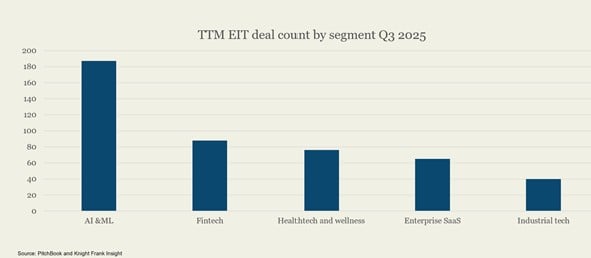
Pitchbook’s latest breakdown of pre-seed, seed, and early-stage deals by top global VCs shows AI firmly in the lead. In Q3, AI startups secured 52 deals worth a combined $2.2 billion, accounting for 36.1% of all capital deployed. Activity is strongest where AI is most immediately deployable, notably in enterprise SaaS, fintech, and health tech, while a renewed focus on defence and production is channelling fresh money into industrial tech. The standout AI deal of the quarter was Periodic Labs, which raised a $300 million at a $1.3 billion valuation. The funding round was one of the largest seed investments in history. The firm is building AI-native materials science, developing models and autonomous labs to create a closed-loop system where AI agents generate their own training data and rapidly iterate on new hypotheses.
Identifying the UK’s next big companies
By using indicators such as rapid headcount or revenue growth, multiple funding rounds in quick succession, and sharply rising valuations, we can start to pinpoint and follow companies that look like strong contenders to become the UK’s next breakout successes.
A targeted search focusing on serial founders, capital raised in the past year, rapid headcount growth from a baseline of at least 50 employees, founding dates within the past decade, and a substantial post-money valuation in the latest funding round brings up 19 companies. These include PhysicsX, a London based business founded in 2019. Its simulation engines enable manufacturers to iterate product designs at speed, making it particularly compelling for defence and aerospace clients. PhysicsX raised $135 million in June at a valuation close to $1 billion and secured further backing from Nvidia two weeks ago.
Other interesting reads
- Mistral has launched Mistral 3, a new family of 10 open-weight models aimed at closing the gap with Big Tech rivals. The news comes as HSBC entered a multi-year partnership with Mistral AI to expand the use of generative AI across the bank. The company has grown to over 400 employees in the space of a few years and it’s positioned as Europe’s answer to the US AI agents. They have a presence in London.
- Modo Energy, a tech firm building software to value electrification assets, is planning to rapidly expand its business off the back of a £25m Series B investment. Currently operating in five markets, Modo Energy plans to expand to 20 after securing its lates capital injection.
- A new frontier AI research lab is coming to London via a five-year partnership between Thomson Reuters and Imperial College London.
- The UK Space Agency has announced £17 million for seventeen UK space projects through its National Space Innovation Programme (NSIP).
- The UK’s Nuclear Industry Association published a report stating that the UK risks falling behind in the global race to scale artificial intelligence unless urgent action is taken to accelerate nuclear development. Electricity demand is set to increase more than fivefold to 26.2 terawatt hours (TWh) by 2030, equivalent to almost 9% of the nation’s electricity use and around 30% of commercial consumption. Such interest is fuelling research and development in areas such as fusion energy and small modular reactors.
- UK pension funds are cutting back their exposure to US equities amid concerns over the market’s growing concentration
Sign up to Knight Frank Research.
