
Ski Resorts, Super-Prime and Shifting Taxes
Plus, the Alpine pivot to year-round markets and Italy’s new flat-tax era
20 November 2025
As Europe heads into a pivotal 2026, the property landscape is shifting fast — from Alpine resorts reinventing themselves as year-round investment hubs to Italy recalibrating its tax regime and major markets across the continent regaining momentum. Below is a snapshot of the key forces shaping where capital is flowing, how wealth is moving, and what to watch next.
Alpine homes
Knight Frank’s latest Alpine Property Report finds the mountains are still outpacing global prime real estate, with prices up 23% in five years as Europe’s leading resorts pivot from seasonal ski escapes to full-fledged, year-round investment plays.
Standout performers:
- Andermatt tops the 2025 index with 14.6% annual growth, helped by its exemption from Lex Koller/Lex Weber and a surge in US buyers
- Swiss resorts grew 5% on average, beating France’s 1.2%
- Cortina d’Ampezzo remains the region’s strongest value opportunity: prime prices of €19,500–€21,500 per sq m sit 30%–40% below St Moritz, even after 10% annual gains ahead of the 2026 Winter Olympics
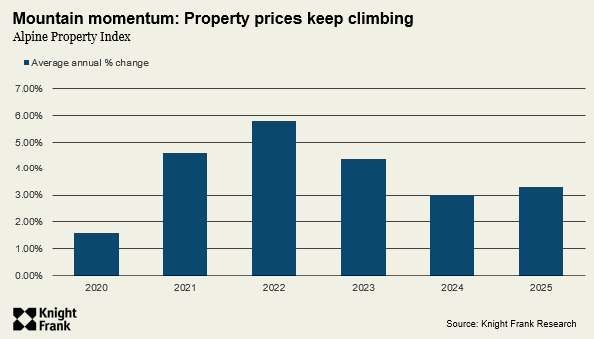
Demand shift: A structural pivot is under way: 73% of HNWIs, rising to 80% of millennials, would consider full-time Alpine living. Summer lift-pass sales in Chamonix jumped 46% since 2021, underscoring year-round appeal.
Climate resilience: The Alpine Sustainability Index ranks Val Thorens, Val d’Isère and Zermatt highest for long-term snow reliability, while lower-altitude resorts diversify into cycling, hiking, culture and wellness.
Download the full 32-page Alpine Property Report here for the complete picture.
Italy
Italy’s tax landscape is about to shift. From 1 January 2026, Rome will overhaul elements of the Flat Tax regime — a change with clear implications for internationally mobile UHNWIs and long-term relocators.
What’s changing?
From 2026 onwards, newcomers will face a higher rate.
- The flat tax for new residents rises from €200,000 to €300,000.
- The fee for qualifying family members rises from €25,000 to €50,000.
Current beneficiaries retain their existing rate.
The reforms aim to curb “tax tourism”, increase revenue, whilst still remaining competitive with regimes in Portugal, Greece and Switzerland. At the same time, proposals to raise income-tax thresholds for mid-earners may offer some support to broader housing demand.
Italy is also tightening its holiday rental rules and regulations. Expect more uniform registration standards, city-level consistency and potential caps in high-volume markets such as Florence and Venice.
These efforts could temper speculative buying while improving long-term rental availability - a growing priority for policymakers under pressure to address affordability.
Market signals
- Foreign demand in Milan, Rome and Tuscany remains above pre-pandemic levels.
- Super-prime markets remain robust, with international buyers dominating €5 million+ transactions.
So what? Italy is signalling fiscal discipline — but not a retreat from attracting international capital. Prime markets including Rome, Milan, Tuscany and Lake Como remain underpinned by global liquidity and continued supply shortages.
European Outlook
Europe will enter 2026 with cautious optimism. Eight ECB rate cuts have revived sentiment, liquidity is returning, and prime residential markets are leading the recovery.
Market momentum:
- Europe now claims eight of the world’s top ten house-price performers, underscoring the region’s resilience.
- Buyer demand is strongest in Spain and Portugal, both forecast by the IMF to grow around 2% in 2026, outpacing the eurozone average near 1%.
- Stockholm, Madrid, Lisbon and Dublin top the 2026 Prime Residential Forecast, supported by tight supply and robust employment trends.
Investor confidence is rebuilding as lower borrowing costs and infrastructure investment help sustain housing demand.
Wealth inflows:
- More than 100,000 HNWIs are expected to relocate globally in 2025, with Europe the top destination.
- Lifestyle, stability and cultural capital now rank alongside tax as key relocation drivers.
- Millennials account for 45% of potential movers; 63% of HNWIs work remotely more than half the week, making location increasingly lifestyle-driven.
Regulation reshaping value:
- London’s stamp duty changes and Barcelona’s rental reforms show how policy can slow transactions or divert capital.
- In contrast, tighter zoning in Chamonix has turned scarcity into a premium, with buildable plots commanding higher values.
- Short-let rules are tightening across Europe as cities and resorts seek greater transparency, curb “ghost stock” and protect affordability.
Bottom line: Europe’s residential recovery is uneven but strengthening. Lower rates, structural demand and record wealth inflows support a positive 2026 outlook. But risks remain: weaker trade, political uncertainty in key 2026 elections, rising public debt (on track for 130% of GDP without reform) and the IMF’s 0.5% downgrade to Europe’s growth outlook could limit momentum.
Read the full European Outlook 2026 for the complete analysis.
In other news…
Swiss Set to Reject Inheritance Tax on Super Rich, Poll Shows (Bloomberg), Bulgaria to join Eurozone in 2026 (FT), ECB to stay on hold before year-end (Bloomberg) and French Government touts investment as tax concerns mount (Bloomberg).
Sign up to Knight Frank Research.
