Grit to Growth
The inside story on Manchester's rising innovation economy
06 October 2025

Manchester, long synonymous with industrial prowess, is reinventing itself as one of the UK’s most successful innovation hubs outside the Golden Triangle. The city’s growth figures are eye catching with Manchester named the UK’s fastest growing city economy in 2025 by EY Item Club. 142 high growth businesses announced office and lab openings or expansions in sites across both the city and in Cheshire last year. The region’s pull was further recognised when last week Manchester entered the global top 100 innovation clusters for the first time, ranked 94th. Also last week Manchester University was ranked 4th in a list of top UK universities by number of founders.
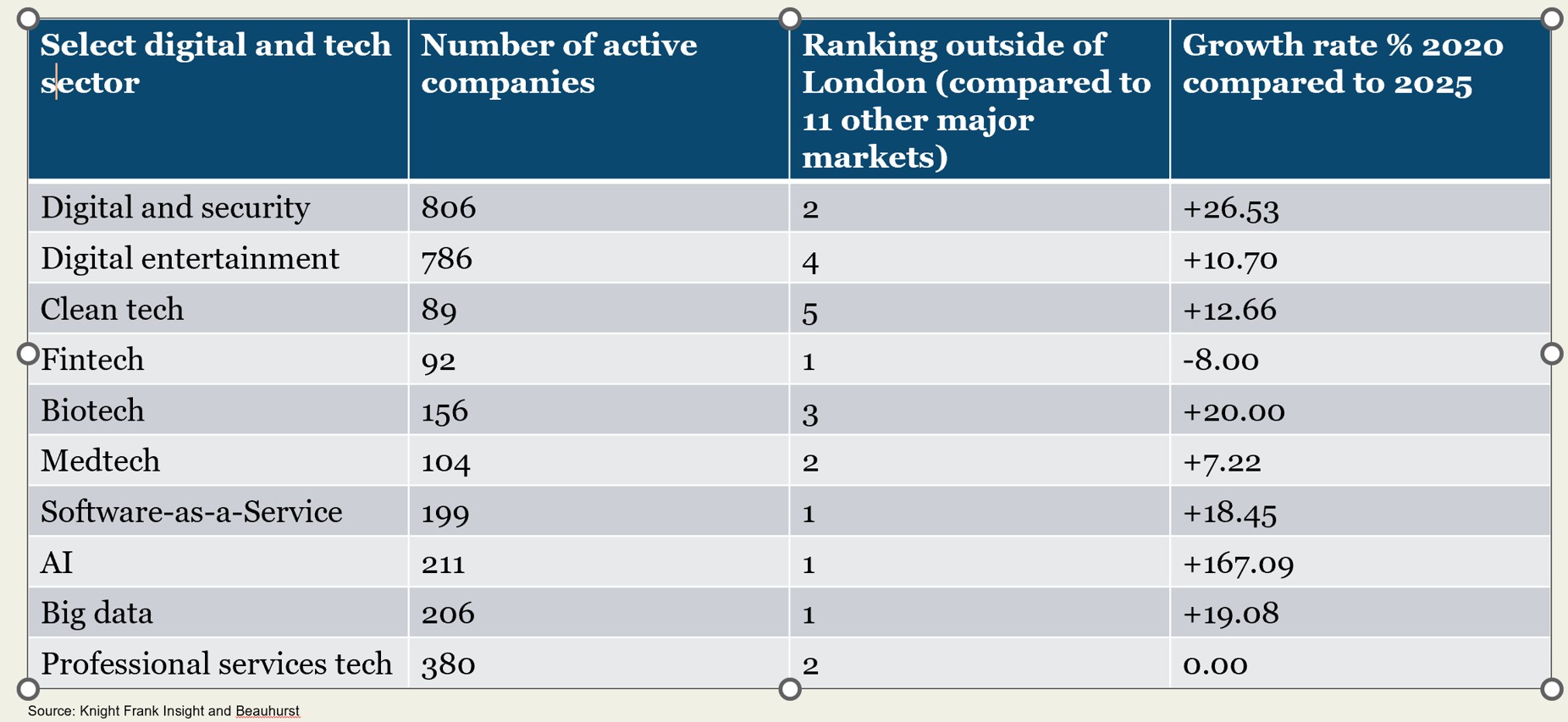
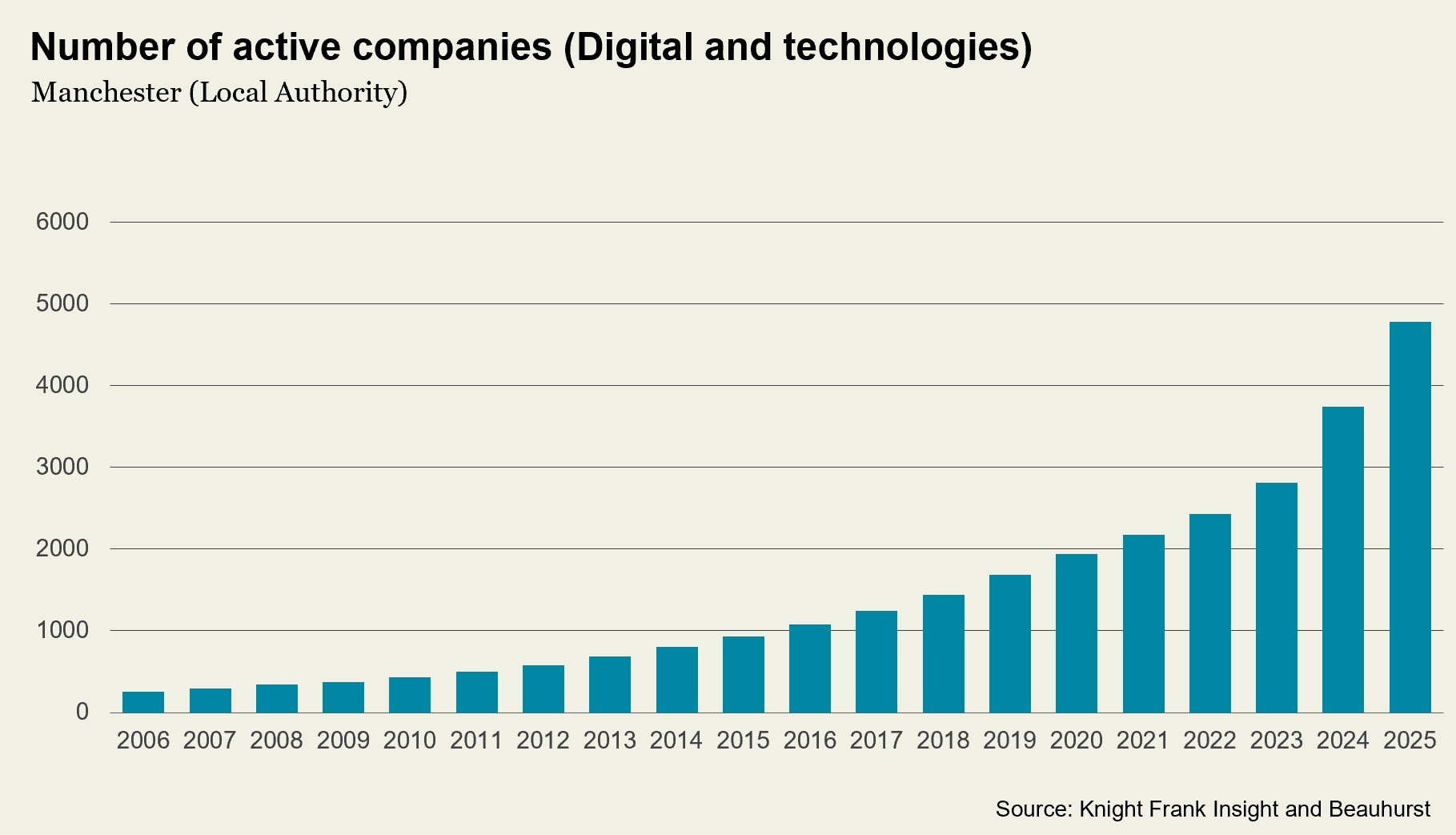
Nowhere is Manchester’s dynamism more evident than in its digital and technology sector. The city boasts a thriving £5 billion digital ecosystem and was named the second most popular UK city to start a tech business. Our latest analysis finds that more than 4,500 active digital and technology businesses have a registered or headquartered address in Manchester (local authority), making it the second largest hub for such companies outside of London. According to ONS data on online job vacancies, programmers and software development professionals recorded the highest number of listings in the city in August 2025.
Digital and technology companies range from home grown unicorns to multinationals like Amazon. E-commerce ventures have led the charge in many ways. Online retail giants like The Hut Group (THG) and fashion seller Boohoo grew from Manchester’s fertile soil.
The city has also become a major hub for AI and tech centres of excellence. In May of this year Deloitte announced it was to create 100 jobs in a new Manchester-based technology centre while the UK government is building a major new AI and digital hub in the city.
On artificial intelligence, Manchester has stolen a march. It is now ranked the country’s most “AI-ready” city, with the number of AI start-ups more than doubling since 2022. A report from April of this year valued Greater Manchester’s AI companies at £3.14 billion, more than five times their value in 2020 and found the city now ranks among Europe’s top 15 locales for AI talent. Ambitions run high. Projections suggest Manchester’s AI sector could be worth £11 billion by 2035 and support 25,000 jobs. But its digital and tech ambitions do not end there. Manchester is also carving out a lead in other fast growth fields, from data science to cybersecurity.
Finance is also meeting the future in Manchester. The city region now hosts a fast-growing fintech sector, contributing over £1 billion annually to the regional economy. Nearly 100 fintech firms operate in the city, reinventing everything from payments to digital banking. Big names have piled in. Most recently Zopa announced the opening of a new office in the city centre. The Zopa Manchester office will initially provide space for 50+ employees, with roles focused on product, engineering, and specialist operations. It could grow tenfold to over 500 staff over time. According to Zopa “Manchester has the energy, connectivity, and capability Zopa needs to support its next stage of expansion”.
Such convergence of finance and technology is no coincidence. Manchester’s traditional strength in financial and professional services provides fertile ground for fintech collaboration while local universities are chipping in with dedicated fintech research centres. Little wonder that industry observers dub Manchester the “fintech capital of the North”.
Manchester’s life sciences narrative is one of deliberate momentum. The city has quietly assembled the largest life sciences cluster outside the Golden Triangle. Preliminary Q3 figures suggest that although Manchester still trails the Triangle on funding and company count, its trajectory is steepening. The North West has moved into second position for number of new company formations with London in first place. This marks a clear break from five years ago, when the North West sat behind the London, South East and East of England. Over that period, the North West’s active life sciences base has risen by 13.7 percent to 1,459 companies, outpacing growth of 7.0 percent in the South East, which now has roughly 2,309 firms, and 11.2 percent in the East of England at around 1,708.
Labour market signals reinforce the shift. ONS online vacancy data show London remains the largest life sciences market, averaging about 733 vacancies per month in 2025 (January to August). The South East and North West follow with roughly 663 and 443 monthly vacancies respectively in 2025.
The Oxford Road Corridor, Europe’s largest clinical-academic campus features a high concentration of hospitals, labs and biotech companies. This corridor alone generates roughly £3 billion GVA per year. The city’s health innovation pedigree runs deep. It was here that Rutherford split the atom and where the first test of a new cancer therapy took place. Today Manchester is home to leading R&D assets like the Manchester Cancer Research Centre and UK Biobank, the world’s most important repository of biomedical data. UK Biobank’s decision to relocate its headquarters and samples to a new facility in Manchester underscores the city’s appeal as a science base. Global firms have noticed too. Multinationals such as Qiagen, Hologic and Lonza have established bases in Manchester. Earlier this week, as part of a £500 million UK investment, Convatec announced it will relocate its R&D operations from Deeside to Bruntwood SciTech’s CityLabs 4.0. Further momentum is set to come from increased funding from sources such as the Northern Gritstone (much needed given the concentration of funding in the Golden Triangle) and a relatively new partnership that links Manchester to Cambridge.
Underpinning both the digital and life sciences booms is Manchester’s strength in advanced manufacturing and materials. Greater Manchester sits at the heart of one of the UK’s largest advanced manufacturing clusters, hosting giants from Siemens to Jaguar Land Rover and BAE Systems alongside thousands of specialist SMEs. Crucially, cutting edge manufacturing here is intertwined with frontier science. Manchester’s universities have created an advanced materials powerhouse, giving the city a “globally unrivalled concentration” of graphene and 2D-materials expertise. After two Manchester scientists famously isolated graphene, the city doubled down opening a £61 million National Graphene Institute and a follow on Graphene Engineering Innovation Centre to pilot real world applications. In tandem, the Henry Royce Institute leads national research in materials science.
Success on this scale is reshaping Manchester’s urban landscape and the calculations of its property developers whether that be in the form of dedicated innovation districts or new and repurposed office space that has the tech and science crowd in mind. For real estate stakeholders, Manchester’s evolution is a call to innovate themselves. To create environments that match the city's growing tech and science base and bold aspirations.
For occupiers in science and innovation led fields it offers a compelling location opportunity combining a critical mass of research assets, talent and industry players. Add to this its strong transport connectivity and expanding international profile, and Manchester stands out as one of the UK’s most compelling locations for science and innovation led companies.