
Two years to save the planet and the cost of nature
This month I highlight a critical UN climate action alert, probe the real estate sector's response, explore the economic toll of natural degradation, and detail the biodiversity costs for housebuilders. I also examine how infrastructure gridlock is significantly delaying new home deliveries.
02 May 2024

Two years to save the planet, are real estate actors stepping up?
The UN's stark warning underscores the urgency: the next two years are critical for saving our planet. Globally, people are increasingly feeling the impact of climate change on their daily lives and finances—from rising energy and food prices to record-breaking temperatures. March marked the Earth’s 10th consecutive month of record breaking heat.
Despite this backdrop, UK businesses are less concerned. More than half (52%) of respondents to an ONS survey in March reported that they were not concerned about the impact climate change may have on their business, up 10 percentage points from February 2023 (42%). Real estate is bucking the trend, with concern rising significantly among firms. Just a third said they were unconcerned, down from 55% the previous month. The buildings and construction sector, responsible for 37% of energy and process-related carbon (CO2 ) emissions and 21% global greenhouse gas emissions, recognises its critical role and vulnerability.
While there is a trend towards building decarbonisation, progress has been slow and is hindered by economic challenges. Globally, investment in building decarbonisation exceeded US$285 billion in 2022, according to the UN, but was expected to have declined in 2023, due rising costs.
But is there greater cost in inaction? For the real estate industry, the prevalence of extreme weather is pushing insurance costs higher around the world. Two recent stats illustrate this. In the UK, the median cost of home insurance policies rose 36% over 2023, according to Go Compare. In the US, the rise was 21%, according to insurance brokerage Policygenius. And it’s not just homes. Commercial property premium have more than doubled as a proportion of income receivable in the US last year, according to MSCI.
Perhaps that is why more are taking action. Some 57% of real estate businesses reported taking at least some level of action to reduce their carbon emissions. That encompasses steps including switching to light emitting diode (LED) bulbs and adjusting heating and cooling systems (both 36%). Just under a quarter (23%) have insulated buildings and a fifth (20%) have installed a smart meter.
The cost of nature
Natural environment degradation is not just a natural crisis but an economic one, potentially leading to a 6-12% reduction in UK GDP, according to the Green Finance Institute. For the banking sector this could mean up to 5% of asset portfolio values with the most at-risk sectors being agriculture, utilities, real-estate and manufacturing. Despite these risks, only 2% of UK businesses have a nature or biodiversity strategy, according to the ONS, rising to 5% of large businesses (250+ employees). These figures are alarmingly low, considering the urgent need to integrate natural considerations into business planning for sustainability, as put forward by a recent paper from the Transition Planning Taskforce (TPT) Nature Working Group.
In the real estate sector, 4% have set biodiversity targets, including adjustments to their supply chains. This is notable given recent regulations mandating at least a 10% biodiversity net gain on large developments starting in February, with similar requirements for smaller sites from April.
The industry is beginning to reckon with these costs. Some 80% of volume and SME housebuilders across the UK indicated they needed to buy up to 50 biodiversity units off-site, according to our latest quarterly survey in the Development Land Index from Anna Ward. With quoted costs for units off-site currently in the region of £20-30,000, the total cost could reach £1.5 million. Furthermore, the requirement is higher among some, with 10% looking to buy 51-150 and 5% require over 150 units.
That’s scratching the surface. One in ten respondents said they were unable to meet on-site or off-site biodiversity net gain (BNG) requirements. Their only option is purchasing statutory biodiversity credits from the government, which are significantly more expensive and vary widely in cost depending on the habitat's type and distinctiveness.
Gridlock delaying housing delivery for a third of developers
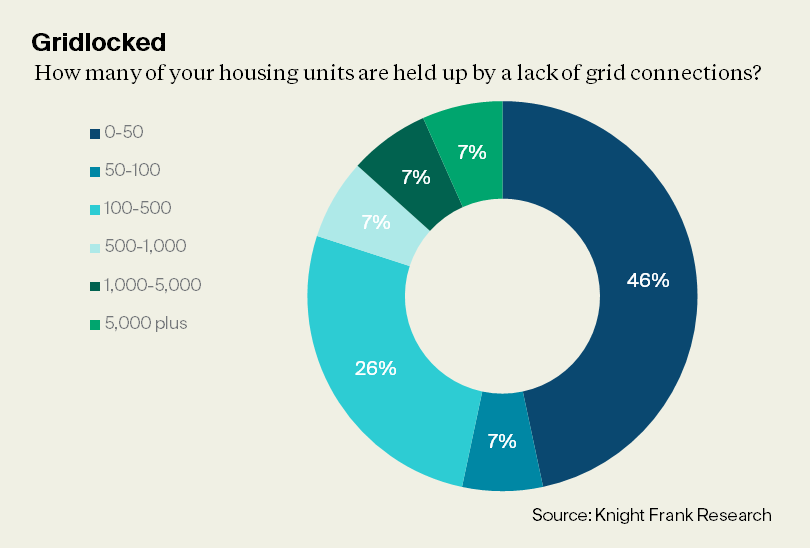
Biodiversity is one in a list of hurdles facing housebuilders. That same housebuilder survey highlights the infrastructure challenges holding back the delivery of new homes. A third of respondents said a lack of power capacity in the National grid has affected the progress of housing schemes in the region they operate in.
This is something we have written about previously, yet as housing delivery becomes a key political issue in the lead up to the election, the scale of the issue is being laid out. We estimate that some 15,000 new homes are being held up by a lack of grid connections among our survey respondents – who together build 70,000 homes a year - alone. In further comments, some respondents reported difficulties with utility firms delivering connections in a timely manner which can cost thousands of pounds in temporary connections or portable generators. For more on the survey results and land values see the full report here.
Amenity and energy considerations in the single family housing
ESG considerations have become integral for property investors across all sectors, particularly highlighted in our latest report on single family housing (SFH) sector, written by Lizzie Breckner and Oliver Knight. The report reveals significant investment growth, with spending reaching a record £1.9 billion in 2023, up from £388 million the previous year.
The level of investment is underscored by sustainability practices. Some 90% of leading institutional investors surveyed agreeing that ESG is an important consideration for futureproofing assets and lowering any potential regulatory risks.
What does this mean for development? Just over half of survey respondents (55%) are planning on installing air source heat pumps and 50% look towards solar energy solutions. To support the growing adoption of EV's as a requirement for homes, charging points are required at SFH schemes by 55% of investors.
The report also looks at the proximity of amenities to SFH schemes which can be important for the S side. Findings include that 80% are within 650m of green space and around 60% have culture and sports facilities within 1 km. The accessibility of amenities and sustainability credentials has been demonstrated as a factor within resident experience in the Build to Rent market which may have implications for operational performance.
What else I am reading
Digital real estate for repurposing buildings, Landsec greenlit for the redevelopment of Hill House in the City of London, retaining nearly 60% of the existing structure and materials from the building will be recovered and re-used where possible, The European Banking Federation warn EU lenders won’t be able to compete with their US rivals if regulators continue to pile on ESG rules, Landmark ruling by European Court of Human Rights on inadequacy of Switzerland's actions.
Sign up to Knight Frank Research.
