
Physical risks, Davos and net-zero standards
As we stride into 2024, the focus shifts from the conversations at COP to the dialogues at Davos. Environmental risks continue to dominate the discussion, standing tall as long-term challenges to the global economy. In this newsletter, we delve into the ever-growing evidence of physical risks in real estate, the evolving discourse on embodied carbon, and the standards that define a net-zero building.
01 February 2024

Physical risks and resilience in real estate
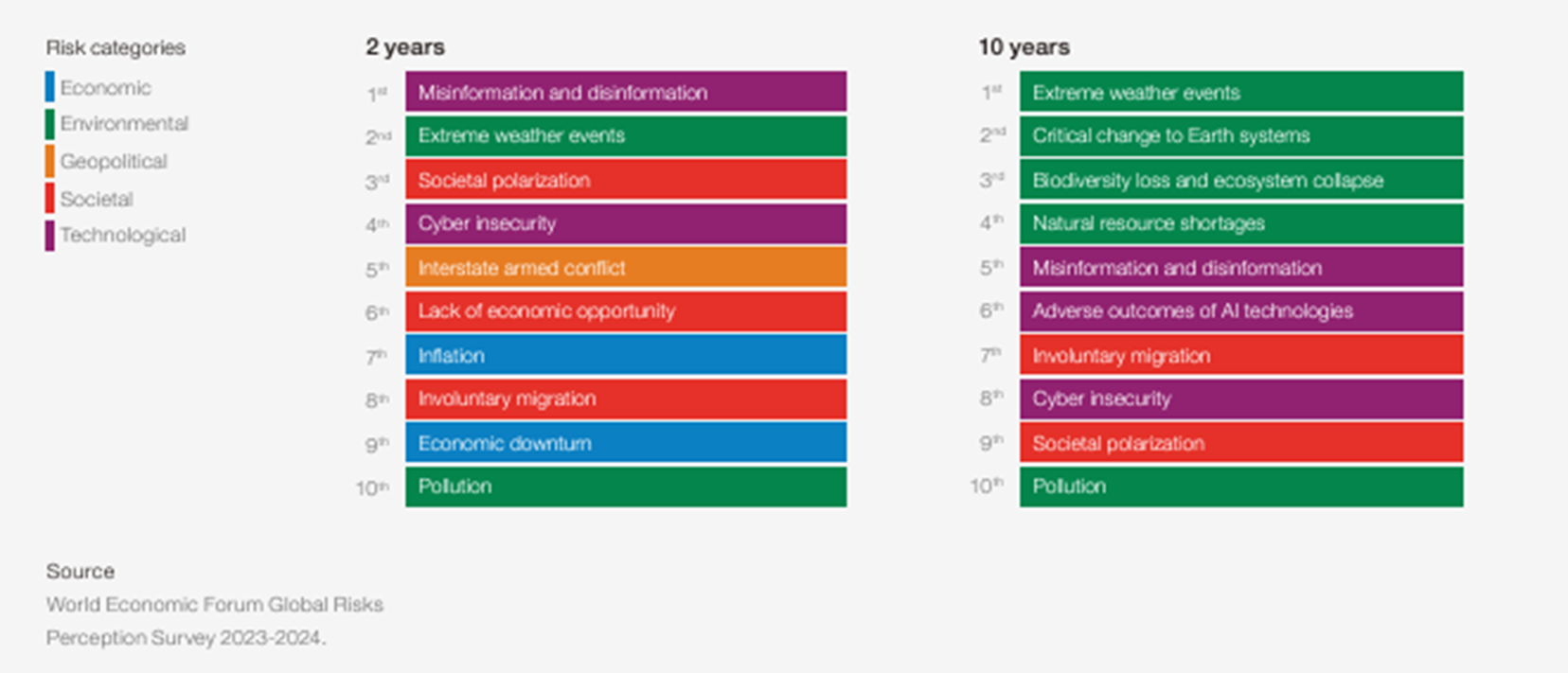
One of my picks for key theme for 2024, often overlooked in the discussion of obsolescence and stranding risks, is the resilience of buildings to climate change. Achieving net-zero operation is no longer sufficient; structures must also be resilient to extreme weather events. The World Economic Forum’s (WEF) Global Risks Report for 2024 signals extreme weather as the most significant global concern, echoing the unprecedented temperatures of 2023 and the persistent impact of the El Niño.
Examining risks over short and long horizons, extreme weather takes precedence in the long-term, albeit momentarily shadowed by misinformation and disinformation in the near term. Real estate's double materiality underscores the need to reduce emissions (40% of the global total is from the built environment) and fortify buildings against extreme weather and earth system changes.
Flood and sea level risks
The cost impact of physical risks, particularly those related to floods and rising sea levels, varies across different assets and regions. Recent studies forecast substantial costs: the UK could face over £100 billion, or 1.1% of its GDP. Across Europe, the total cost is close to €900 billion, with areas like northern Italy and Poland’s north potentially seeing up to 20% of their local economies affected.
Whilst these projections extend to 2100, there could be more immediate consequences. AEW’s research suggests a relatively small increase in risk premiums for commercial real estate over a 20-year period. They found that across the 133 markets affected by flood risk, the risk premium stands at 6 bps per annum (up from 3 bps last year), while sea level rise risk increased from 1.3 to 1.8 bps for the 47 affected segments. However, when including unaffected markets, the average flood risk drops to 3.9 bps, and the sea level risk lowers to 0.4 bps across the 196 markets.
Liam Bailey’s recent commentary draws attention to UK’s slow progress in creating "a nation more resilient to future flood and coastal erosion risk", according to a new report by the Public Accounts Committee (PAC). The government's six-year, £5.2 billion capital programme running to 2027, originally intended to provide better protection for 336,000 properties in England (some 5.7 million at risk), has seen an underspend of £310 million in the first two years. The Agency expects to fund only 1,500 of the 2,000 flood defence projects originally planned, protecting only 200,000 properties by 2027.
Flood risks impact residential property too. We have previously pointed to a study by Bayes Business School, which found that "residential properties in England with flood risk are sold at an 8.1% discount compared to non-affected properties. The level of the price discount is strongly correlated with the probability of flood risk. The price discount reaches 31.3% for very high-risk properties." Numbers not to be ignored.
As an indication of the disruption flooding can cause, we turn to a new report from the London Mayor's office as part of The London Climate Resilience Review. "London is underprepared". It highlighted the impact of floods in July 2021, where over 2,000 properties were flooded with stormwater and sewage. More than 30 tube stations were affected; hospital wards were evacuated. At a roundtable hosted by the Better Buildings Partnership, "a major commercial real estate provider in London" said 20% of their occupied commercial properties had to be vacated due to flooding from summer rainfall.
Building carbon
Embodied carbon is emerging as another key ESG theme for 2024, gaining significance as we decarbonise electricity and develop more standardised measurements. Planning authorities, such as those in London, mandate whole-life carbon assessments (recent high-profile decisions have cited it). We may also see more investor focus with the inclusion of embodied carbon emissions in new construction and major renovation projects in the 2023 GRESB Real Estate Standard, used by 2,084 real estate entities representing $7.2 trillion gross asset value.
Reusing materials, highlighted by the Circularity in the Built Environment report from WEF and McKinsey, estimates that Circularity could abate 75% of embodied emissions from the built environment by 2050. The report highlights not only environmental but sizeable economic rewards, with a potential annual net value gain of $31-46 billion by 2030 and $234-360 billion by 2050, through cost savings related to carbon taxes among other elements.
Defining net-zero buildings
Navigating the labyrinth of ESG certifications, a pressing question arises: What defines a net-zero building? The World Green Building Council distinguishes between net-zero energy buildings and net-zero operational carbon, emphasising the importance of embodied carbon reductions and offsetting residual emissions for a building to be deemed net-zero whole-life carbon.
In the UK, a cross-industry partnership is working to create a Net Zero Carbon Buildings Standard to "provide a consistent, standardised approach to assessing whether a building can be defined as NZC." Testing started in autumn 2023, with a full launch in Q1 2024. The US is also trying to define the term "Zero Emissions Buildings" (ZEB) with the Department of Energy, issuing a draft definition intended to clarify the matter and inviting comments by February 5 from industry and other stakeholders.
For those looking ahead and wanting to ensure buildings are net zero, then understanding what's within these proposals could be a good indication. The Science Based Targets for buildings and CRREM pathways also offer some insight. Also released in January, the latest ESG Metrics for Real Estate proposals from a working group of representatives from AREF and six other associations. The aim is "to inform the development of real estate-specific metrics that enable consistent, transparent, and comparable reporting and disclosure for real estate portfolios and covering all real estate asset classes" that are TCFD aligned.
Will this add to the noise and have different standards across geographies? It seems we are in ever crowded space of definitions, certifications and metrics.
A recent Bisnow article highlighted that we need to be speaking the same language to see more rapid progress in emissions reduction and how even sustainability professionals get lost in certification. Perhaps the key comes down to reliable metrics, with the article pointing to just two that matter: "the kilowatts of energy used by a building in its operation and the kilograms of carbon produced per square metre during construction." Keeping these two numbers below a certain level — 70 kilowatts per square metre (kWh/sqm) of energy consumed in operations per year and 500 kilograms of carbon per square metre during construction (kgCO2/sqm)— is the right path in helping the real estate sector meet decarbonisation targets and combat global heating." The Leti guidance for offices specifies a slightly different – 55 kWh/sqm and 600 kgCO2/sqm.
Why efficiency matters
Efficiency holds the key to a successful net-zero transition. Beyond cost and emission reductions, lower energy usage facilitates the switch to renewable energy, electric vehicles, and electrified heating/cooling.
We can expand our renewable capacity, but to go 100% and without huge and lengthy upgrades to the grid, we are capped at a certain generation capacity. In the UK, if all our vehicles shifted to electric and all homes switched to heat pumps, electricity demand would rise by about 80%. This is before factoring in commercial buildings, the demand for more data centres and other electrical innovations. This must be met with a fall from elsewhere, and as buildings are responsible for a significant proportion of energy demand, they are again a key piece of the puzzle. Encouragingly, an estimated two-thirds of companies have efforts underway to improve energy efficiency, according to PwC's Global CEO Survey. A further 10% report completing such initiatives, and about half say they have work in progress to innovate climate-friendly products or services.
As we race towards electrification, battery storage, hydrogen, and efficient transmission become critical components. The surge in electrical demand, especially with the transition to electric vehicles and heat pumps, underscores the importance of managing peak demand efficiently. Currently, the UK faces rising costs due to wind turbine shutdowns to prevent power grid overloads, a concern that is estimated to escalate in the coming years.
What else I am reading
Fitting for your author, although not property specific - maker of Flora unveils world's first plastic-free recyclable tub, Taskforce on Nature-related Financial Disclosures (TNFD) was "delighted to announce that 320 organisations from over 46 countries have committed" representing some US$4 trillion in market capitalisation, updated Green Lease Toolkit, first solar subscription model in the UK, Australia cracking down on greenwashing and introducing new reporting, could greenwashing fears be putting firms off reporting? Maybe, as 40% of Singaporean companies are greenhushing.
Sign up to Knight Frank Research.
