
Survey reveals strong desire to climb property ladder
The future home ownership aspirations of our Saudi residential survey respondents have revealed some fascinating differences.
05 April 2022

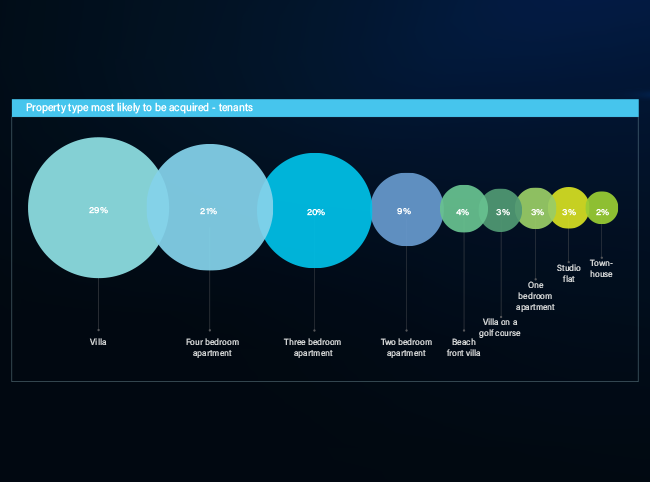
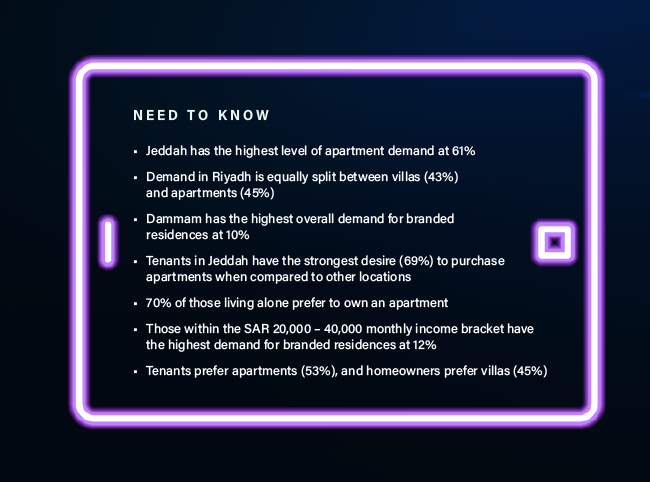
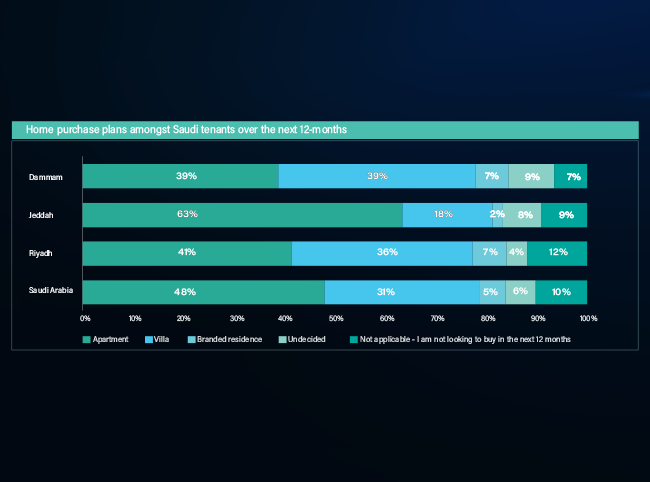
In our Saudi residential survey, 84% of tenants stated their desire to purchase a home in the next 12 months. Interestingly, the vast majority prioritized apartments (48%) over branded residences and villas. Whereas for existing homeowners, the appetite to buy a villa (44%) is higher than apartments (14%).
Amongst tenants, apartments (48%) are more highly coveted as a first home when compared to villas (31%). While branded residences appear to be the least popular option (5%), we feel this is reflective of the lack of branded residential stock in the market. Indeed, in Riyadh, there are just a handful of branded residential properties, which form a negligible proportion of all the units in the city.
Overall, 84% of tenants say they will want to make a purchase in the next 12 months. Those living with their parents (90%) have the strongest desire to buy their own home, while almost irrespective of monthly income bracket, the desire to transition to homeownership ranges from 88% (<SAR 20,000) to 92% (>SAR 60,000).
Amongst existing homeowners, who are planning to either upgrade their homes, or buy a second home, the appetite to purchase a villa (44%) is perhaps unsurprisingly higher than apartments (41%). Dammam’s homeowners have the highest appetite for branded residential property at 15%.
“84% of tenants will make a property purchase within 12-months”
Budgets amongst homeowners are higher than their tenant counterparts, with 29% saying they will spend upwards of SAR 3 million on their next purchase (>US$ 800,000), which bodes well for all the planned Giga projects in the Kingdom, all of which are believed to have starting price points of close to US$ 1 million. While this clearly indicates the presence of a second homes market in the Kingdom, there is a risk of an oversupply of luxury homes in the future should all developers target this relatively small segment of the population.